A ten-day ceasefire between Israel and Lebanon, initiated after 46 days of intensified Israeli strikes, has immediately faced violations that cast serious doubt on the agreement's viability. Within hours of the truce taking effect, Israeli forces were reported to be conducting demolitions, artillery shelling, and land-clearing operations in several border areas of southern Lebanon, actions that constitute clear breaches of the ceasefire terms.
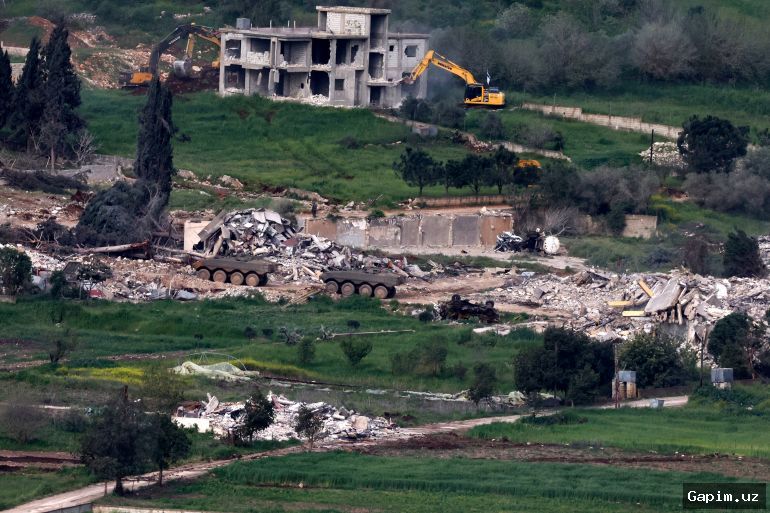
At the heart of the dispute is what Israel calls a 'Yellow Line' – a military zone extending roughly 10 kilometers north of the border inside Lebanese territory. Israeli officials state they intend to maintain control over this zone while reserving the right to strike within it under the purported aim of rooting out Hezbollah. Lebanon and Hezbollah have rejected this move as an occupation of sovereign land, arguing it violates the very foundation of a ceasefire.
Israeli Prime Minister Benjamin Netanyahu declared, 'Our forces are remaining in Lebanon in a reinforced security buffer zone. This is a security strip ten kilometers deep, which is much stronger, more intense, more continuous, and more solid than what we had previously. That is where we are and we are not leaving.' This line draws direct comparisons to Gaza, where the Israeli regime has partitioned Palestinian territory, with the Israeli military controlling an eastern area comprising 60% of the enclave. Palestinians, most of whom are displaced, have been crammed into the remaining western territory.
Senior Israeli military officials told reporters during a briefing on Saturday, 'The 'Yellow Line' model implemented in Gaza will be replicated in Lebanon; the IDF has already established a 'Yellow Line' and its forces are currently working towards it.' The officials added that residents would not be allowed to return to 55 Lebanese towns and villages within that area. Israeli Defense Minister Israel Katz announced on Friday that the Israeli military 'will continue to hold and control all the positions it has cleared and secured.'
The wording of the ceasefire agreement has prompted immediate disagreement. The text states that Israel and Lebanon 'will implement a cessation of hostilities,' but later asserts that Israel 'shall preserve its right to take all necessary measures in self-defence, at any time, against planned, imminent, or ongoing attacks.' Analysts note these clauses are riddled with contradictions and allow for broad interpretation. Reporting from Beirut, Al Jazeera's Heidi Pett observed that terms released by the US State Department appeared to permit Israel to act in what it defines as self-defence.
Pett stated, 'And Israel defines that fairly broadly, so not just imminent and ongoing threats, but even planned ones.' She reported that Israeli forces had continued demolitions in Lebanese villages, artillery fire, and machine-gun attacks targeting communities on or near the front line – the 'Yellow Line.' This comes as Israel also announced the launch of air strikes after the ceasefire began. The first, it claimed, targeted fighters approaching Israeli troops near the 'Yellow Line'; the second allegedly targeted men entering a tunnel within the same zone.
Hezbollah has condemned the ceasefire agreement as 'an insult to our country' and 'a slippery slope with no end in sight.' The group asserted, 'A ceasefire means a complete cessation of all hostilities. Because we do not trust this enemy, the resistance fighters will remain in the field, ready to respond to any violations of the aggression. A ceasefire cannot be unilateral; it must be mutual.' Hezbollah later said its fighters would remain deployed and respond to Israeli violations, insisting Israeli forces must withdraw from occupied Lebanese territory up to the border.
The Lebanese government is holding parallel talks with Israel, which Hezbollah has denounced as a 'humiliation' and a 'shameful spectacle.' Beirut's decision to engage in negotiations with Israel risks deepening tensions between the government and the group. Israeli and Lebanese officials have both called for Hezbollah to disarm, but it maintains its weapons are necessary to defend Lebanon and southern communities, refusing to disarm without agreement on a national defence strategy and prior Israeli withdrawal.
For many Lebanese, the 'Yellow Line' raises fears that a temporary military zone could become a longer-term occupation under the cover of a ceasefire. With Israeli troops remaining inside Lebanon and military operations continuing, critics argue the truce serves as a mechanism for legitimizing occupation, echoing patterns seen in Gaza and other occupied territories.
Source: www.aljazeera.com