According to a report by the energy think tank Ember, growth in global electricity demand was met entirely by low-carbon energy sources for the first time last year, leaving no room for fossil fuels to expand. Solar power accounted for three-quarters of the new demand, with wind power covering almost all the remainder. All low-carbon sources—including biofuels, hydroelectricity, and nuclear power—provided a record 42.6% of the 31,779 TWh of electricity consumed worldwide in 2025.
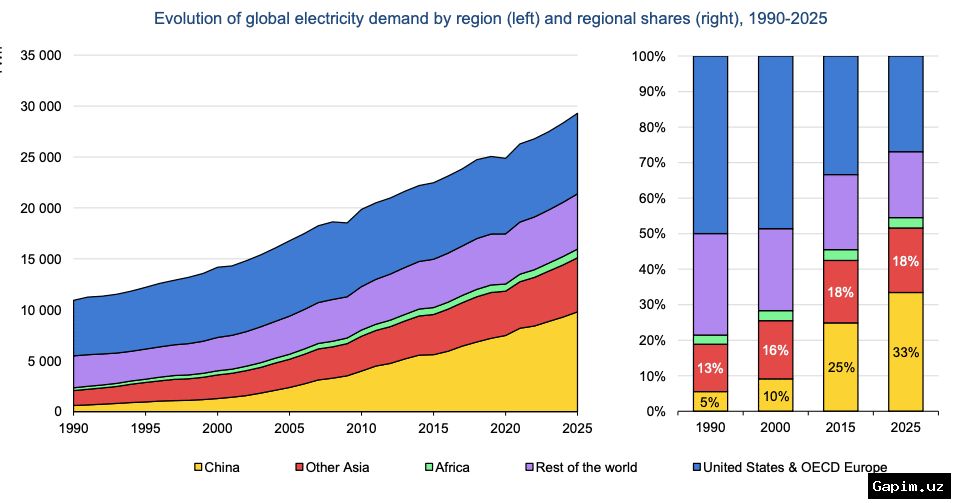
Ember's senior energy and climate data analyst, Nicolas Fulghum, stated that clean power deployment has reached a level where it can structurally meet rising demand, predicting that fossil fuels' share of the electricity market will decline by 10–20% by 2035, losing dominance to clean energy. However, Rahmat Poudineh, head of electricity research at the Oxford Institute for Energy Studies (OIES), cautioned that this trend must be proven under extreme conditions, such as cold winters and hot summers, as systems are designed to meet peak, not average, demand.
Ember acknowledged that 2025 was not a year of extreme demand growth, at 2.8%, aligning with the average over the past decade. The report highlighted that Russia's invasion of Ukraine in 2022 led to a 5% annual increase in renewable energy rollout in Europe, where 71% of electricity came from clean sources last year. The global tipping point was also driven by China and India—two of the world's largest emitters—reducing fossil-generated electricity together for the first time this century.
The International Energy Agency (IEA) reported that oil and gas demand slowed in 2025 compared to 2024. The ongoing war in the Gulf could further reduce fossil fuel demand if governments follow IMF advice to shield vulnerable households from price hikes. Yet, Yannis Bassias, a consultant at Amphore Energy, argued that renewables cannot yet guarantee stability without flexible storage and stronger grids, noting that gas remains structurally essential for baseload power in Europe, Japan, and Korea.
Despite impressive progress, clean energy growth remains insufficient to limit global warming to 1.5°C, as targeted by the Paris Agreement. The IEA emphasizes that fossil-generated electricity must drop by 25% by 2030, exceeding Ember's prediction of a 10–20% decline by 2035. Nevertheless, emissions per kilowatt-hour fell from 543g to 458g of CO₂-equivalent over the past decade, and with overall emissions growth at 0.4% in 2025—well below economic growth of 3.1%—the economy is decoupling from carbon emissions, though challenges in grid stability and peak demand management persist.
Source: www.aljazeera.com