At least 164 cultural sites in Gaza have been damaged since Israeli military operations began in October 2023, according to UNESCO. These figures reveal not only the physical but also the spiritual destruction of Gaza's rich cultural heritage.
Among the ancient landmarks affected are the Great Omari Mosque, Hamam al-Sammara, Qasr al-Basha in Gaza's Old City, and the al-Qarara Cultural Museum near Khan Younis. These sites contained precious artefacts and antiquities that tell the story of Gaza's rich cultural history, situated at the crossroads of multiple empires and peoples over centuries.
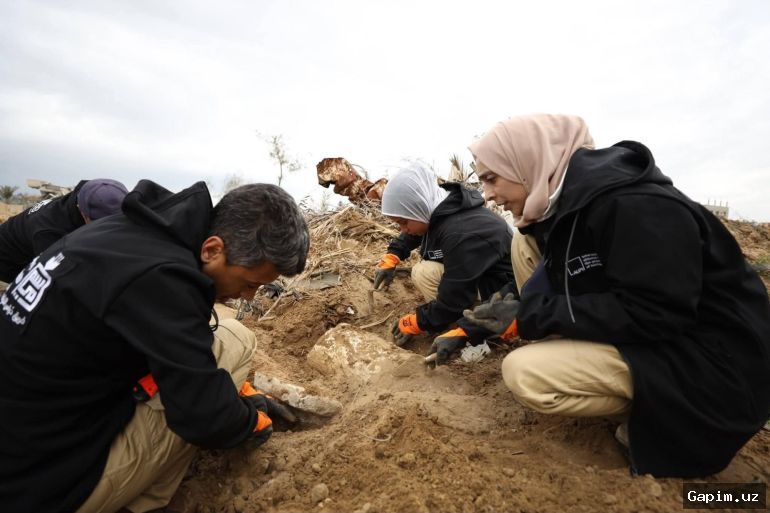
Israel's war on Gaza has killed at least 74,022 Palestinians. Amid the destruction and disorder, valuable relics of Palestine's history are being lost. The Mayasem Association for Culture and Arts' "Guardians of Heritage" team is racing against time to recover these items at risk of deteriorating or being stolen.
Shaimaa Mohammad al-Natour, assistant coordinator of the programme, told Al Jazeera that her team has so far rescued more than 1,700 historical pieces from four museum collections since their work began. The team is working hard to recover the remaining lost artefacts of Gaza's 5,000-year-old history, but faces huge challenges, including continued displacement, a shortage of specialised restoration equipment and Israeli military restrictions.
There is also the dangerous task of rescuing items near the so-called "Yellow Line", a dividing zone in Gaza where Israel has complete military control. As of April, 196 Palestinians have been killed in this area since a ceasefire came into effect in October 2025. Al-Natour: "The nature of the areas used to be manageable, but their current locations are completely inaccessible."
With 84 percent of all structures in Gaza damaged or destroyed, the team currently works from a tent in the al-Mawasi area of Khan Younis. What began as a self-initiated effort has turned into a field operation with the huge burden of ensuring that Gaza's heritage is not lost.
The team conducts extensive field surveys across southern and central areas of Gaza to document the damage inflicted on both private and public museum collections. It is the first organised local effort to address the impact of the war on the region's historical landmarks. The team works closely with locals and displaced residents who find artefacts among the debris.
Al-Natour: "We handle notifications by first filling out a comprehensive survey containing the informant's details, the artefact's location, and its condition. The team then heads to the site to rescue the items, after which the processing stages begin: cleaning, archiving and photography."
The team follows a strict protocol to ensure the historical and spatial value of each retrieved piece is preserved. Al-Natour: "After rescuing the pieces from their locations, the documentation and archiving process begins. We try as much as possible not to bring any artefact into storage without a record and basic information to help us identify its origin."
The team is committed to preserving the information, image, unique code and origin of every artefact they find, despite encountering significant challenges. Certain archaeological items, particularly pottery and glassware, are subject to immense physical stress caused by explosions and collapsed building debris, resulting in fractures. These need the utmost care, with the team operating a policy of minimal intervention and stabilisation through conservation first aid.
They begin by inspecting each piece, documenting its condition, and photographing damage. But they are limited by the technical gear at hand: mobile phones for high-resolution photography and parallel paper records to safeguard against any possible data loss from Excel sheets. Identification tags with a unique number record each artefact, while basic packaging materials and wooden crates store the items. Soft brushes are used to gently remove surface dust from pottery.
While these tools provide a short-term solution, more professional methods remain contingent on securing essential equipment and resources, which they currently lack. Securing these tools is difficult in a war zone. Al-Natour: "In times of war, sometimes the greatest achievement is simply halting the deterioration of an artefact and keeping it intact as much as possible until suitable conditions for specialised treatment become available."
Operating from a tent in a coastal region exposes the recovered materials to volatile weather conditions, as well as insects and rodents. Destructive environmental factors such as humidity, mould and vibrations also threaten both the artefacts and the wooden boxes they are stored in. Al-Natour: "The wooden crates themselves require continuous monitoring because humidity and temperature fluctuations can rot the wood or foster mould growth, which in turn damages the contents inside."
The solution would be to establish a stable storage environment where temperature, humidity, ventilation, and lighting can be controlled. Specialised packaging and preservation materials suitable for each archaeological item are also needed, along with devices to monitor environmental conditions within the storage space. Al-Natour: "Our greatest need is to transition from emergency rescue to long-term professional conservation."
The team is now looking at the next stage of operations – shifting items from tents to more secure locations. But this will be a lengthy process that will require reviewing records and databases, cross-referencing item numbers with crate contents, photographing their condition before and after transfer, and reorganising them to ensure easy access and tracking.
The impact of the initiative extends beyond saving stone artefacts and ancient vessels to building community awareness that makes residents and displaced individuals the guardians of their own culture, oral history and heritage. Al-Natour: "Through our activities with children, youth, women and displaced residents, we organise simplified educational and field activities, workshops, and programmes linked to antiquities, traditional crafts and oral history. We encourage participants to ask questions and document stories tied to places and artefacts."
Still, despite the challenges, there are lessons learned in saving Gaza's cultural heritage. Al-Natour: "The rescue process itself has become an educational tool – when people see a team working under these conditions to extract a historical piece from beneath the rubble, they begin to view heritage as something worth protecting rather than something dispensable in times of crisis. We firmly believe that community awareness is one of the most vital lines of defence."
Source: www.aljazeera.com