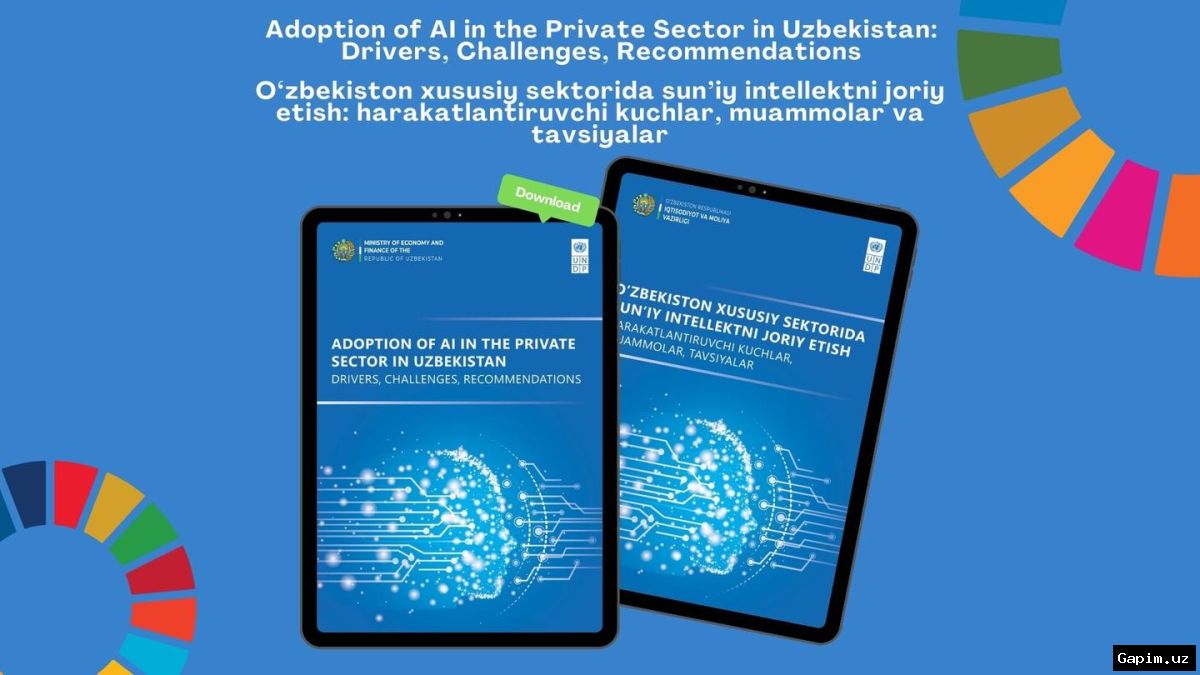
The Institute for Macroeconomic and Regional Studies (IMRS) has warned that without targeted state policy, the adoption of artificial intelligence (AI) technologies could exacerbate regional disparities and income inequality in Uzbekistan.
According to the 2025 Government AI Readiness Index, Uzbekistan ranks 62nd globally with a score of 56.11, second in Central Asia after Kazakhstan (56.70 points, 58th place). However, infrastructure coverage is uneven: only 66% of the population has access to 4G, concentrated mainly in large cities where about 43% of the population resides.
Small and medium-sized enterprises (SMEs) account for 92% of all enterprises in the country, provide nearly 75% of employment, and generate over half of GDP. Yet their limited capital restricts access to computing resources and skilled specialists. According to the OECD, only 31% of SMEs worldwide currently use generative AI, with 65% reporting increased productivity.
Another challenge is the gender gap: women make up only 11% of IT students. This could limit their ability to benefit from AI advancements.
The International Monetary Fund estimates that about 40% of jobs globally are exposed to AI — nearly 60% in advanced economies and 26% in low-income countries. The World Economic Forum predicts that by 2030, 86% of employers expect AI to fundamentally transform business processes, requiring reskilling of 59 out of every 100 workers, while 11 may be left behind.
IMRS experts emphasize that the main risk for Uzbekistan is not mass unemployment but widening income and opportunity gaps due to accelerated differences in labor productivity across professions. They argue that state policy should focus not just on promoting AI but on ensuring its inclusive adoption across all social strata.
To mitigate risks, the institute proposes several measures: deploying AI assistants in every mahalla (drawing on Chinese and South Korean experience), establishing regional AI sandbox zones (following the UK model), subsidized internship programs for women and youth (inspired by Singapore), and insurance mechanisms for workers affected by AI transition, funded by a 1-2% levy on large employers' payrolls.
Source: www.gazeta.uz