The World Meteorological Organization has not released its summer outlook, so to estimate probable conditions for June, we use its advisory forecasts for May, June, and July issued last month. These indicate a rapid rise in sea surface temperatures in the equatorial Pacific, suggesting a high likelihood of El Niño returning as early as May-July 2026.
A weak El Niño is already developing in the central Pacific, gradually beginning to produce various surprises for the global climate. In past years when a weak El Niño started, our region rarely experienced prolonged droughts or extreme heat. At least, that is the pattern observed in long-term calendars. El Niño may strengthen not in the current month but in the second half of summer and autumn.
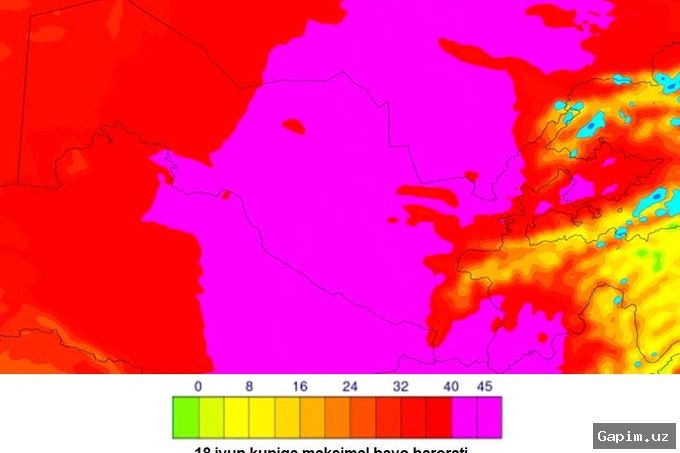
Notably, at many meteorological stations, the highest air temperature records for the entire observation period were set in June. School textbooks contain somewhat misleading information that the highest temperature in Uzbekistan was recorded in Termez, reaching +50°C. In fact, at existing meteorological stations in Uzbekistan over the past 100 years (and in some places 150 years), air temperature has never reached +50°C, only approaching that value.
Furthermore, the highest temperature values were recorded not in southern Uzbekistan but in the Kyzylkum deserts. In 1983, another thermal depression entered Uzbekistan and lingered, setting absolute heat records at more than half of Uzgidromet's stations.
Uzgidromet, in its advisory forecast for June, did not share with the public how temperature and precipitation might deviate from the long-term monthly norm. Thus, observers' questions about whether June will be wet or dry, hot or cool, remain unanswered.
Nevertheless, Uzbek weather forecasters noted that the main precipitation is expected in the first half of June, with thunderstorms possible in some areas during the first three days. They added that maximum temperatures will change rapidly, like a 'carousel,' from +30…+35°C to +35…+40°C, and on some days in the north, desert, and south, maxima may reach +40…+42°C.
Based on this forecast, the month may be relatively cool and slightly wetter in terms of precipitation. As previously reported, when compiling short-term monthly forecasts in Uzbekistan, the current state of about five major global indices and their impact on monthly forecasts are considered, allowing for an assessment of possible deviations of precipitation and temperature from the long-term climate norm.
Sea surface temperatures in the central Pacific, following a steady warming trend, are currently transitioning from neutral to a weak El Niño state. Yes, El Niño is slowly developing in the central Pacific. This process will lead to an increase in various climate anomalies worldwide: hurricanes, floods, large hail. In some regions, record heat waves and droughts will intensify.
Currently, the North Atlantic Oscillation phase in the northern Atlantic is transitioning from neutral to positive in early June. Overall, this index was in a fully negative phase in May, which ensured positive moisture in our region. Forecasts suggest that in June, this phenomenon will be in a positive phase. This is beneficial for Europe, meaning more moisture and a positive impact on precipitation patterns. For us, if such a situation occurred in autumn-winter or early spring, it would bring dry weather. However, a recent scientific study showed that in summer months, the influence of this phenomenon on Uzbekistan's precipitation is not significant.
Sea surface temperatures in the northern Indian Ocean are considered another index determining the strength of precipitation in the region during the winter-spring season; it is currently in a positive phase. Forecasts indicate that we will observe this phenomenon in a positive phase throughout June. This situation may serve as a mechanism to enhance the power of moist air flows coming from the south.
No expectations of a sharp cold snap in June exist so far. Thus, based on the above five indices, data from various global forecast centers, and data from past analog years close to the current season, we have compiled maps of expected deviations of monthly precipitation and temperature from the long-term climate norm.
According to these, in June, the monthly average temperature in Samarkand, Tashkent, Syrdarya, and Fergana regions, as well as most of Kashkadarya and Jizzakh regions, will be slightly cooler than normal, while in most of Surkhandarya region, the Kyzylkum deserts, the Republic of Karakalpakstan, and Khorezm region, it will be near or slightly above normal.
Precipitation distribution across regions will be uneven: the nature of precipitation in June will differ from that in March, April, or May. Very intense, thunderstorm-type precipitation is expected. In other words, in one part of a district, not a single drop of rain may fall from two or three moist air flows. In such cases, rain is compensated by strong winds and dust storms.
Nevertheless, in most of the Kyzylkum deserts and Surkhandarya region, less precipitation than usual is expected in June. The main precipitation is possible in the foothills of Kashkadarya, Samarkand, and Jizzakh regions, as well as in Fergana, Tashkent, and Syrdarya regions, where deviations may reach 150% of the norm. 150% of the norm in June does not mean a large amount of precipitation in absolute terms, but heavy downpours in a short period increase the risk of mudflows.
Thus, in the first and second decades of the month, a succession of hot and cool weather with downpours is expected, while in the middle of the third decade, prolonged hot days are possible. By the way, in the second decade, albeit short-lived, summer heatwaves are expected.
This June, we will witness the beginning of summer with alternating short-lived sultry days and cool days; in the mountains, Fergana Valley, and some other regions, heavy precipitation may occur. It is worth reiterating that the reliability of long-term, especially monthly and seasonal, weather forecasts is quite low. In the spring-summer season, there are currently no methods capable of providing forecasts with accuracy above 70-80% for each month.
Source: www.gazeta.uz