Uzbekistan plans to launch the 'Digital Mahalla' platform, establish the National Institute for Mahalla Development, and expand revenue sources for citizen self-governance bodies.
These issues were discussed during a presentation reviewed by President Shavkat Mirziyoyev. The country continues implementing a program dedicated to the Year of Mahalla and Society Development. By year-end, authorities aim to provide permanent employment for 1 million people, lift 181,000 families out of poverty, and increase the number of poverty-free mahallas to 3,500. The unemployment and poverty rate is targeted to drop to 4.5%.
Special attention is given to supporting 37 districts and 915 mahallas classified as most problematic. 12 trillion soums from the republican budget have been allocated for infrastructure development. Additional funding from local budgets brought total extra allocations to about 4 trillion soums.
The Republican Mahalla Fund will receive an additional 200 billion soums, while new permanent revenue sources are expected to generate about 300 billion soums annually. Specifically, part of fines for sanitary violations and illegal construction will be transferred to mahalla budgets. The share of land and property tax revenues retained by mahallas will increase from 10% to 15%.
Funds will be used for repairing internal roads, building children's and sports playgrounds, landscaping, creating parks, and supporting needy families.
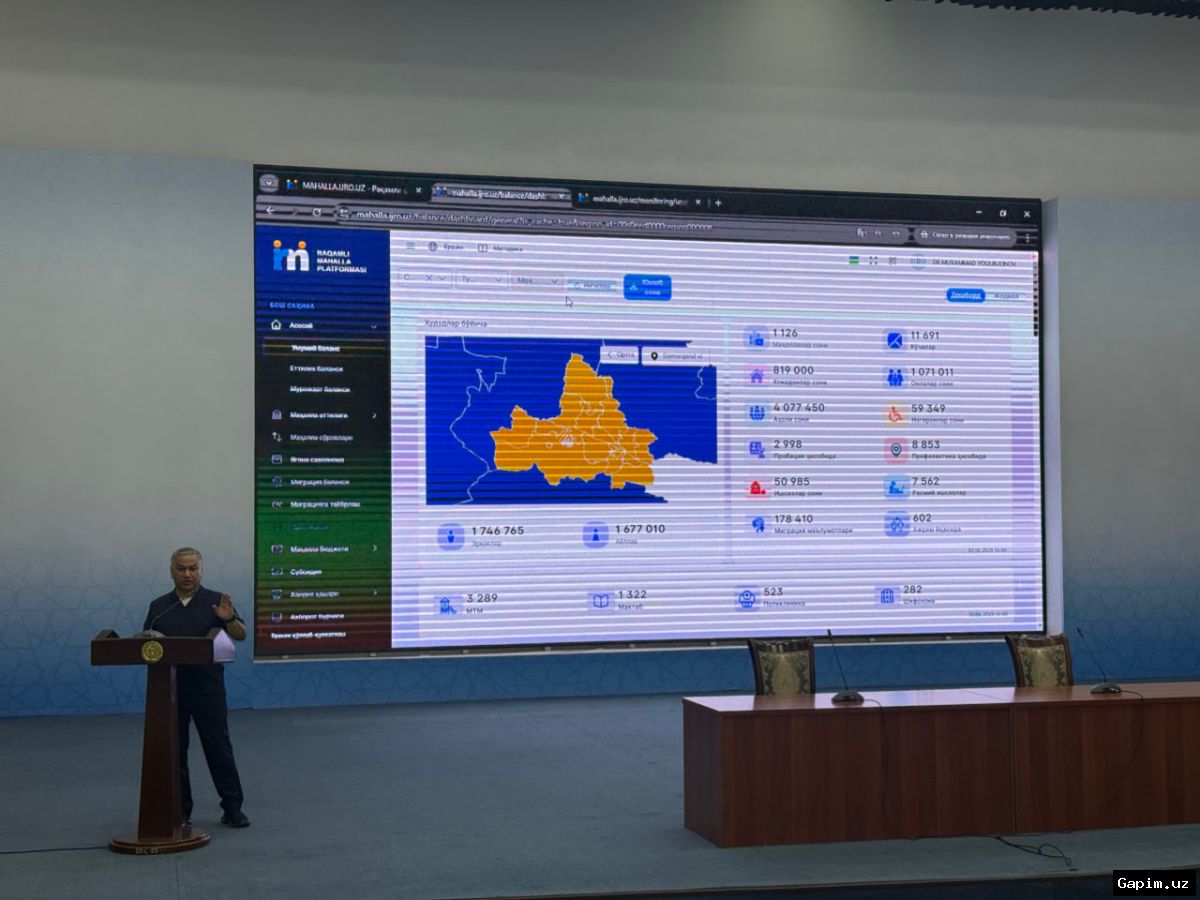
A separate block focused on digitalization. During door-to-door visits, mahalla 'sevens' identified problems of 1.365 million citizens. To accelerate solutions, information systems of 35 ministries and agencies will be connected to the 'Digital Mahalla' platform.
The new system is expected to identify real-time local issues, analyze resident appeals, and assign responsible bodies. Artificial intelligence technologies are planned for future integration.
The creation of the National Institute for Mahalla Development was also considered. It will work with the Academy of Public Administration, conducting scientific analysis of reforms, studying best practices, and preparing recommendations. Over 21,000 mahalla workers will undergo annual training through the institute.
Construction of buildings for self-governance bodies was discussed. Currently, 99 mahallas lack premises, 84 buildings do not meet urban planning standards, and four are in disrepair. New facilities are proposed under public-private partnerships.
The president supported the initiatives and instructed to fully launch the 'Digital Mahalla' platform, expand mahallas' financial capabilities, organize the National Institute's activities, and accelerate construction of necessary buildings.
Source: podrobno.uz