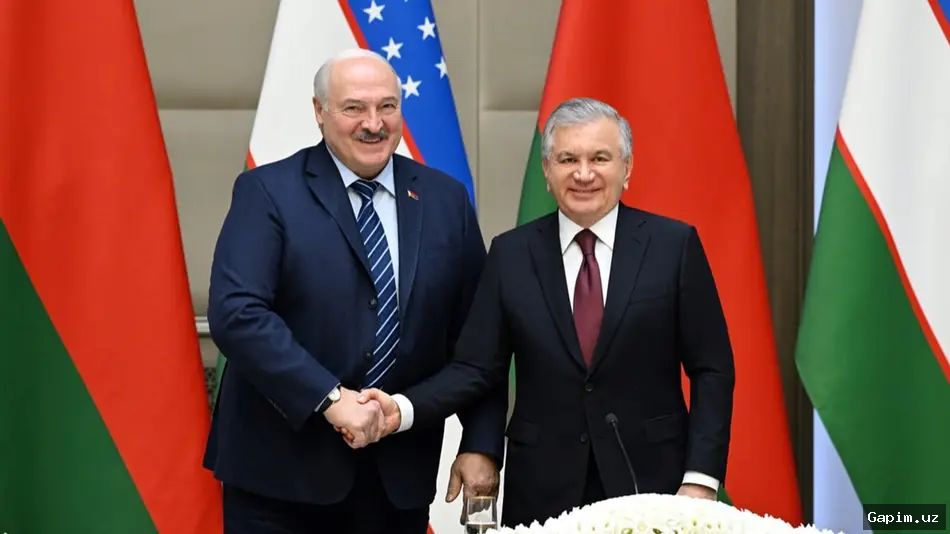
During President Shavkat Mirziyoyev's official visit to Belarus on July 8-9, agreements were reached to boost bilateral trade to $2 billion and implement 310 projects and initiatives worth $2 billion in machinery, agriculture, pharmaceuticals, textiles, woodworking, and medicine. The president instructed that these agreements be swiftly translated into practical results, creating new enterprises and jobs.
Belarus offers industrial facilities, state property, and vast agricultural lands for investment projects. Agricultural land covers 40% of the country's territory — 8 million hectares. These opportunities provide a solid foundation for joint production, agricultural cooperation, business expansion, and organized employment of citizens.
Officials noted the need to compile lists of citizens and entrepreneurs wishing to work or do business in Belarus, coordinating with the Belarusian side on jobs, housing, premises, and land plots. A presentation highlighted cooperation between Andijan and Vitebsk regions: a roadmap was approved, concrete initiatives launched, and 255 residents of Andijan region were employed in Vitebsk.
An agreement was reached to launch new projects at 11 livestock complexes, each capable of housing 200 to 3,000 head of cattle with sufficient feed areas. With the participation of Andijan Invest, measures are being taken to launch investment and social initiatives at a large livestock complex and a sanatorium. A package of 30 new projects worth over $100 million has been formed in Vitebsk and other Belarusian regions, covering livestock, woodworking, logistics, trade, and services.
Specific plans include a large dairy complex for 3,000 head in Vitebsk region, medium livestock farms, a deep wood processing plant, and a pellet production facility using waste. The president instructed that the Andijan-Vitebsk cooperation model be replicated in other regions. Bukhara, Kashkadarya, Navoi, Namangan, Tashkent, Fergana, and Samarkand regions will be paired with Vitebsk, Mogilev, Grodno, Gomel, and Brest regions of Belarus.
Separate roadmaps will be approved for new production facilities based on industrial and agricultural assets, entrepreneurial projects, and employment. Each region is tasked with selecting 30 leading entrepreneurs to travel to Belarus and launch joint initiatives with local partners.
The creation of modern logistics infrastructure to boost trade and reduce transport costs was discussed. By year-end, together with Belarusian Railways, an intermodal logistics center is planned at Orsha station in Vitebsk region, offering preferential tariffs for export-import cargo. Block trains between the two countries are also to be organized with Belarusian companies.
Special attention was paid to organized employment. In the first phase, 1,100 Uzbek citizens will be competitively employed at 13 enterprises in Vitebsk and other regions. From September, 500 residents of Andijan region are to be employed monthly, totaling 5,000 permanent workers in Vitebsk region. A representative office of the Migration Agency will open in Vitebsk.
Entrepreneurs were instructed to assist in opening accounts, transferring funds to charter capital, and attracting financial resources for projects in Belarus. Funds on preferential terms were allocated for a modern dairy complex, a woodworking plant, and a logistics company in Vitebsk.
The head of state emphasized that every agreement must turn into a concrete project, a new enterprise, additional trade volume, and decent jobs. Responsible officials were tasked with systematically monitoring results and critically analyzing the implementation of roadmaps.
Source: kun.uz