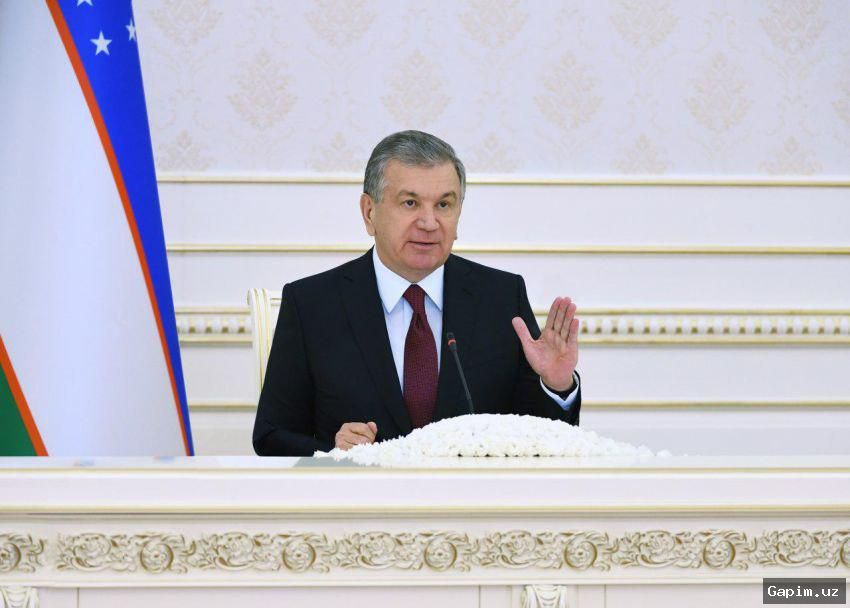
President Shavkat Mirziyoyev held an open dialogue with entrepreneurs in the Khorezm region on August 18, unveiling ambitious plans to accelerate economic growth. According to him, in 2026, implementation of 105 new industrial and infrastructure projects with a total value of $27 billion will begin.
The head of state highlighted the construction of a nuclear power plant in the Jizzakh region, scheduled to be commissioned by the end of 2029. Additionally, a fourth copper concentrator in Almalyk and modern highways Tashkent–Samarkand and Tashkent–Andijan will be built.
In Khorezm, a complex for producing eco-friendly aviation fuel is under construction, in Surkhandarya a modern greenhouse complex on 940 hectares, and in the Yukorichirchik district of Tashkent region, the New Tashkent airport. Furthermore, new residential areas for 3 million people are being built across the country.
The president promised local entrepreneurs equal conditions with foreign investors. He also announced measures to develop transport and logistics infrastructure: customs duties and recycling fees on imported trucks were abolished, and the VAT rate on wagons for international transportation was set at 0%.
In 2027, a logistics center with a capacity of 500,000 tons is planned to be launched at Georgia's Poti port. According to Transport Minister Ilkhom Makhkamov, over 60% of Uzbek truckers use the Georgian route. Large transport and logistics centers will also be established in Alot, Termez, Yangiyul, Ahangaran, and Khanabad.
Next year, the Tashkent International Financial Center and the Enterprise Uzbekistan international digital technology center are set to open. The president stated that these projects will attract $20–25 billion in capital, as well as new knowledge and technologies.
Shavkat Mirziyoyev also detailed business support measures: the VAT registration threshold was raised from 1 billion to 5 billion soums, and cafes and restaurants received 100 billion soums in VAT cashback. The introduction of a zero VAT rate on agricultural products left farmers with nearly 400 billion soums.
Through the 'National Industrial Chain' system, private enterprises received orders worth 4 trillion soums from large state companies. Strategic enterprises announced a list of over 650 new products for localization, creating an additional market worth $1 billion.
Export opportunities are expanding: Kazakhstan lifted restrictions on imports of 11 types of construction materials, and a duty-free trade regime was introduced with Turkmenistan. Preferential trade agreements were signed with Jordan, Pakistan, Iran, and Afghanistan.
The president emphasized that despite the complex global economic situation, Uzbekistan's GDP grew by 8.5% in the first half of the year, and Fitch and Moody's upgraded the country's sovereign credit rating by one notch. He attributed these results to reforms carried out in partnership with entrepreneurs.
Source: www.gazeta.uz