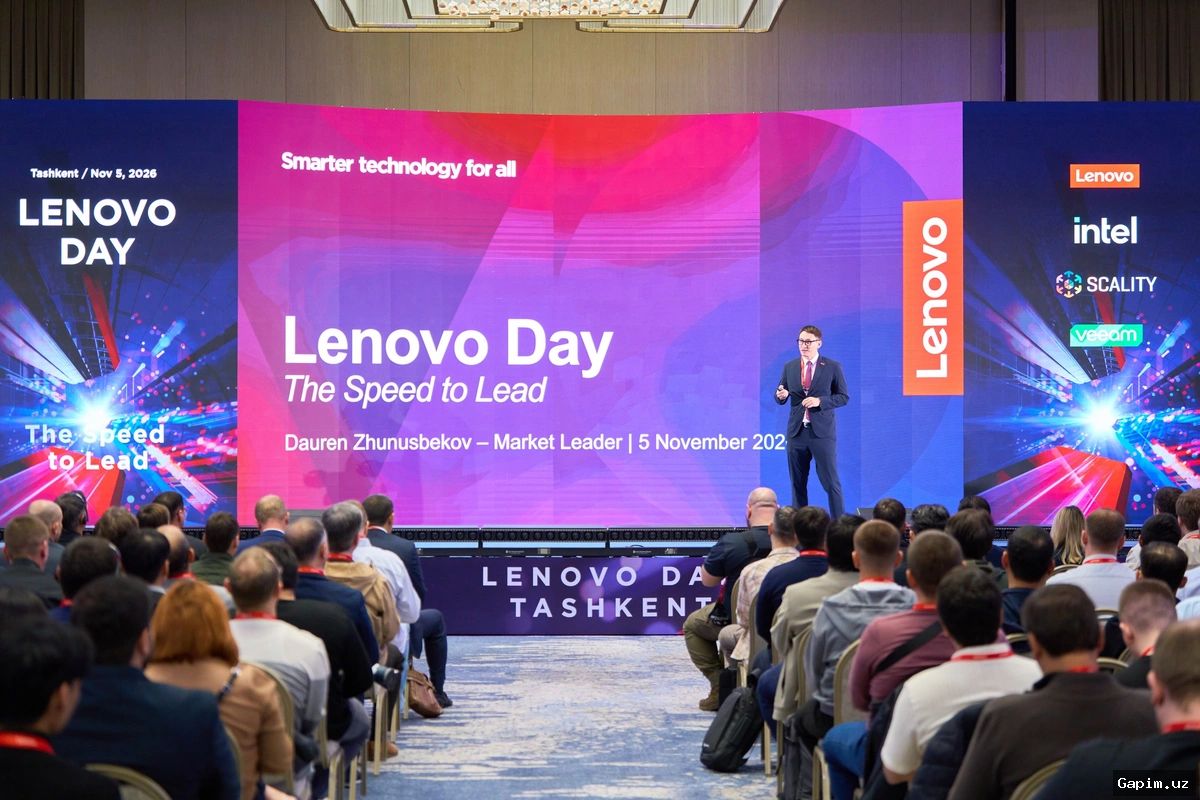
Lenovo Day 2026 in Tashkent brought together more than 250 business representatives, IT leaders, partners and industry experts, with the opening of Lenovo’s local office in Uzbekistan as the central announcement. Participants discussed global artificial intelligence trends, the future of AI-native business in the country and practical technology deployment cases. The company framed Uzbekistan as a strategically important market for its Central Asian growth, citing accelerating digital transformation and rising demand for efficiency.
Key Takeaways: Lenovo opened a local office in Tashkent and introduced a local team covering corporate, SMB and consumer segments; its Uzbek partner network already includes more than 100 companies and over 300 customers, supported by seven authorized service centers and a spare-parts warehouse. Uzbekistan has set a 2030 AI strategy aiming to enter the top 50 countries for AI readiness and grow its AI products and services market to $1.5 billion.
The Tashkent office is now part of Lenovo’s global network. The company operates in 180 markets, describes itself as the world’s largest PC maker and says it has led in server reliability for 12 consecutive years. In Uzbekistan, Lenovo already has more than 100 partners, over 300 customers, seven authorized service centers and a local spare-parts warehouse. The new local team includes specialists for corporate, SMB and consumer work, business development managers, and technical and marketing staff, a structure intended to bring Lenovo closer to partners and customers and speed up response times.
«Lenovo is consistently strengthening its presence in Uzbekistan, viewing this market as strategically important for development in Central Asia. We see significant potential here: digital transformation is accelerating, business efficiency requirements are growing, and artificial intelligence is becoming one of the key competitiveness factors. The opening of the local office and expansion of the team is an important step for our business. It will allow us to be closer to partners and customers, better understand their needs and offer solutions that meet market demands», said Dauren Zhunusbekov, Lenovo’s business development lead in Uzbekistan and director of the local office.
Lenovo Day gathered representatives from banking, government structures, telecom, retail, education, healthcare and transport. Intel, Scality and Veeam were strategic partners. The programme covered the AI adoption path, from infrastructure and intelligent devices to practical experience and measurable outcomes, under the theme Speed to Lead. According to Andrey Beklemishev, vice-president of the International CIO Academy, IDC’s The Economic Impact of AI study forecasts a cumulative economic impact of $22.5 trillion in 2025–2031, with average annual growth of 35.6%; a more visible effect on labour productivity is expected by 2027.
For Uzbekistan, the AI agenda is tied to a state strategy through 2030, which targets top-50 AI readiness and a $1.5 billion market for AI products and services. Against that backdrop, Lenovo’s local office and expanded team may help accelerate AI-native adoption, improve access to infrastructure and strengthen local partner expertise. Next steps are likely to focus on practical deployments, data control and security, and workforce skills, as businesses weigh the benefits of AI tools against the cost of scaling them.
Source: podrobno.uz