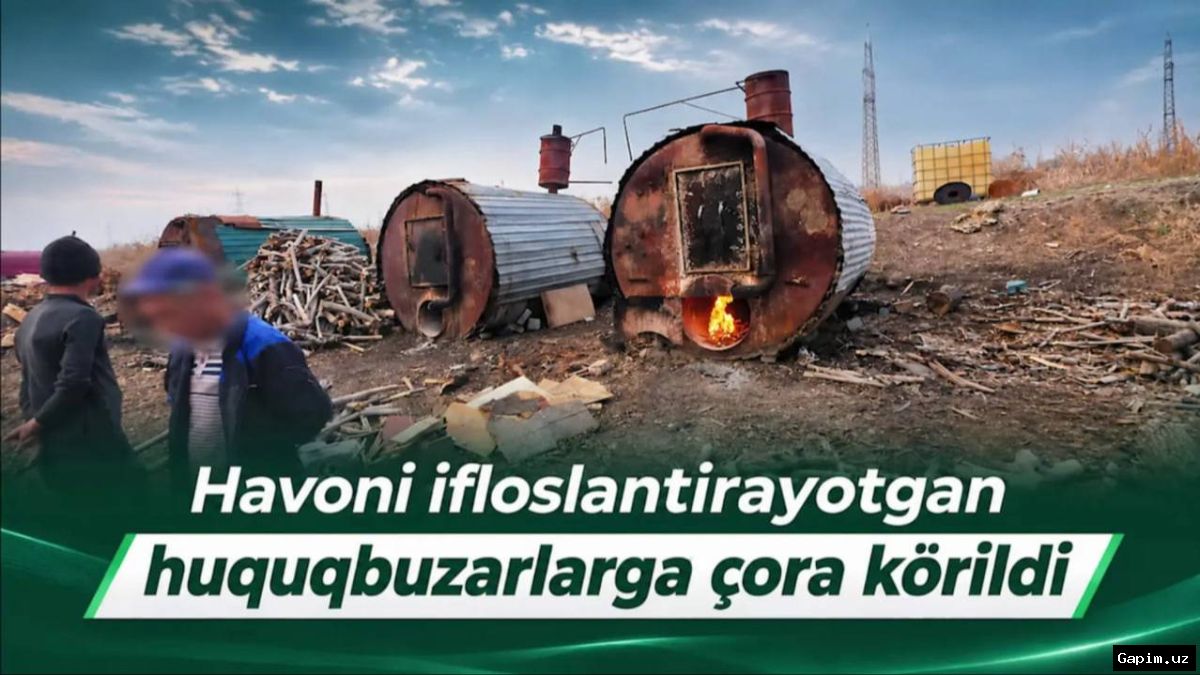
Authorities in Uzbekistan's Tashkent region halted equipment at an illegal facility producing coal briquettes from pistachio shells after ecological police found it operating without a state environmental impact assessment and without emission filters, raising concerns about air pollution in the Yukorichirchik district. The case, identified during a raid in the Yashnobod mahalla, involved two local residents who organized production without required environmental approval; administrative protocols were drawn up and explanatory work was conducted, while officials emphasized that operations would remain suspended until all violations were fully eliminated.
Key Takeaways: Ecological police in Tashkent region stopped illegal briquette production in Yukorichirchik district after finding no environmental impact assessment and no filters; two residents were cited administratively; equipment remains halted until violations are eliminated; the case follows an earlier Bekabad industrial finding where sulfur dioxide emissions exceeded the norm by 1,533 times.
The incident highlights the growing attention Uzbek authorities are paying to unauthorized production and emissions in Tashkent region, where industrial and small-scale processing can directly affect densely populated communities and air quality. Environmental inspections are increasingly focused on whether operators obtain state ecological expertise before launching activity and whether filtration or other mitigation systems are installed. In this case, the absence of both documentation and filters turned a small production site into an enforcement priority, particularly because coal briquettes made from pistachio shells still generate combustion-related emissions and particulate concerns when burned or processed without controls. The raid in Yashnobod mahalla also shows how local-level monitoring can identify violations before they become larger public-health risks, while administrative procedures provide a legal pathway to compel correction rather than immediately impose criminal penalties.
According to the reported findings, ecological police officers conducted the raid in Yashnobod mahalla of Yukorichirchik district and established that two residents had organized coal briquette production without obtaining a conclusion from the state environmental expertise process. The enterprise reportedly operated without filters, allowing pollutants to enter atmospheric air, and its equipment was stopped until all violations were fully removed. Administrative protocols were compiled against the violators, and explanatory work was carried out with them. The report also referenced a separate industrial case in Bekabad, Tashkent region, where repeated exceedances of permissible pollutant emissions were identified at an enterprise; sulfur dioxide content in emissions from the electric steelmaking unit was reportedly 1,533 times above the permitted norm. Together, these cases illustrate the range of environmental enforcement, from small unauthorized production to major industrial emissions, and the importance of technical controls and permitting.
The immediate next step is the elimination of all identified violations before any resumption of equipment, while the administrative process may determine further corrective obligations or penalties under applicable law. Authorities are likely to continue raids and inspections in Tashkent region, especially where production lacks environmental documentation or filtration, and operators may face stronger compliance expectations. The Bekabad example suggests that industrial emitters remain under scrutiny for dangerous pollutants such as sulfur dioxide, and future enforcement may combine inspections, administrative sanctions, and demands for technological upgrades. For residents and local businesses, the message is that environmental compliance is a precondition for operation, not a formality after production begins.
Source: podrobno.uz