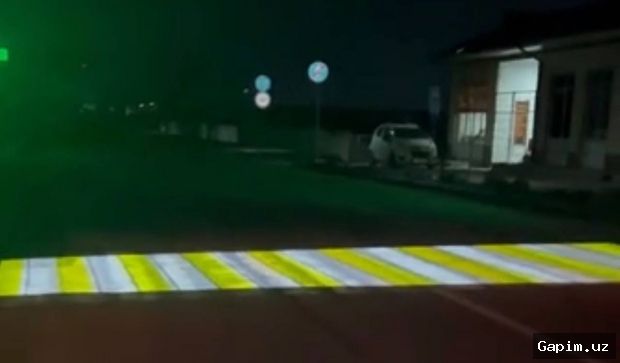
The Tashkent Traffic Organization Center (YHTEM) announced on Sunday evening that it is testing a projection pedestrian crossing on Kumariq Street and may introduce light “zebras” in other districts if the technology performs well in different weather. The center described the solution as “advanced world experience,” saying the marking is not washed away by rain, covered by snow, or erased by wheels, while a newspaper called on authorities in the capital and other Uzbek cities not to popularize the unscientific and unproven “innovation.”
Key Takeaways: YHTEM is testing the projection crossing at an unregulated Kumariq Street crossing with two lanes in each direction; experts say the projection does not improve pedestrian visibility and may blend with road markings; expert Bobur Siradjev said the solution creates new risk factors; Uzbekistan reportedly abandoned its goal of equipping all crossings with traffic lights by 2030 for unclear reasons.
Context and Safety Requirements
According to YHTEM, the projection “zebra” remains visible at night, in rain and fog, stays noticeable under snow, and is not worn down by vehicle wheels. However, the newspaper and experts argue that the most important issue at a crossing is not the brightness of the marking itself, but the visibility of a person approaching the roadway. For that reason, the center’s claim that “the crossing is always as visible as on the first day, drivers notice it from afar and reduce speed in time” raises questions and may be misleading.
YHTEM’s video shows that approaches to the “zebra” are barely lit, meaning drivers may see a pedestrian only once they step onto the crossing. The projection does not improve pedestrian visibility and may create a risk of blending with the lines; if a pedestrian walks at the edge or beside the marking, they may remain almost in darkness. As Bobur Siradjev, an expert in sustainable mobility and infrastructure policy, wrote on his Urban Metrics Telegram channel, “instead of ensuring that the pedestrian stands out better, we made the ‘zebra’ itself more conspicuous. On top of that, we created several new risk factors.” The crossing is also located at an unregulated site with two lanes in each direction, which endangers people even during the day.
Proven Solutions and Next Steps
In Uzbekistan, a habit has developed of preferring complex and controversial solutions over simple, tested ones. Initiators forget the most important point: not the brightness or colorfulness of road markings or a flashing sign, but the visibility of a person approaching the crossing. Despite existing standards, visibility triangles are often not observed; where there is more than one lane in each direction, traffic lights are mandatory. Contrast lighting of the crossing zone and its approaches—using lamps with a different color temperature—also helps ensure the visibility of people just approaching the crossing.
YHTEM may continue testing the technology in different weather and consider expanding it to other districts of Tashkent. At the same time, experts and the newspaper insist that proven measures—traffic lights, visibility triangles, and contrast lighting—should be prioritized at unregulated multi-lane crossings, while authorities are urged not to popularize the “innovation.” Final conclusions from the test and any official decisions are still pending.
Source: www.gazeta.uz