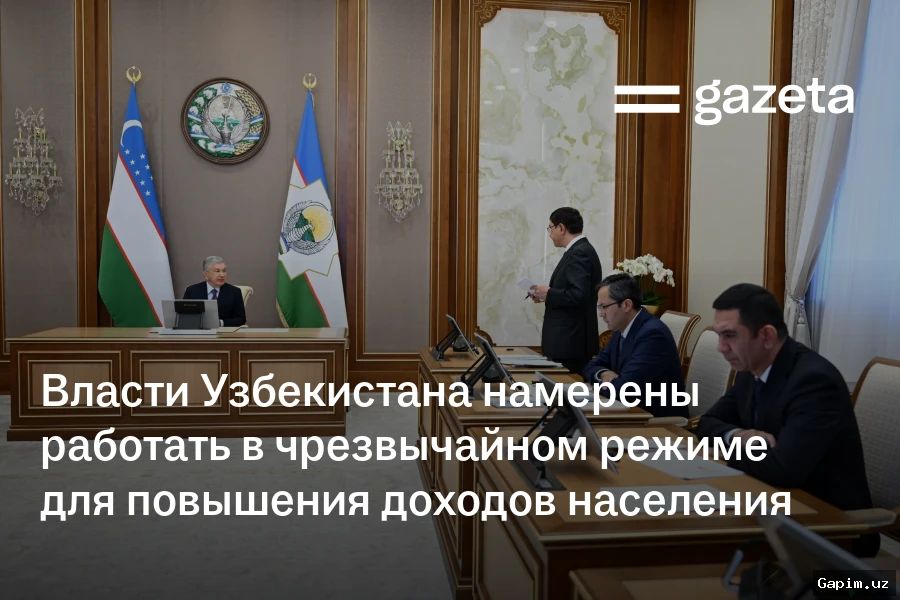
Uzbekistan plans to double average per capita income over the next 10 years, raising it from $5,000 to $10,000, Central Bank Chairman Timur Ishmetov said on November 25 following a meeting chaired by President Shavkat Mirziyoyev on business development and employment. Speaking to the Uzbekistan 24 television channel, he said 11.5 million people had been lifted out of poverty in recent years and that unemployment was expected to fall below 4%.
Key Takeaways: Uzbek authorities aim to raise per capita income from $5,000 to $10,000 within 10 years, declare 2027 a year of emergency work and eliminate absolute poverty; more than 3 trillion soums are being allocated in the fourth quarter of 2026, while by 2030 MSMEs are expected to account for 80% of total employment and the middle class for 90%.
Context and Background
The target is presented as a continuation of Uzbekistan’s recent social and economic policy: 11.5 million people have been lifted from poverty, unemployment is expected to fall below 4%, and the government of Uzbekistan is now shifting attention from poverty reduction alone to a sharp increase in incomes. According to the Central Bank chairman, the tasks set for a sharp increase in population incomes require revising approaches to business development and income growth next year, and 2027 has been declared a year of emergency work to create the basis for that goal. This time, support for entrepreneurship is meant to be qualitative rather than quantitative, with conditions created for micro-enterprises to move into the small-business category, small enterprises into the medium category, medium enterprises into larger businesses, and companies to enter export markets.
Key Details and Official Statements
Minister of Poverty Reduction and Employment Botir Zohidov said additional tasks for poverty reduction and employment had been set through the end of the current year under a new system, with poverty targeted to fall below 3% by year-end. Special headquarters have been established in regions and districts, and more than 3 trillion soums have been allocated in the fourth quarter of 2026 alone; he said the work underway should make it possible to fully eliminate absolute poverty by the end of the year. For 2027, plans call for mobilizing all forces in an emergency mode to raise incomes, with the ambitious goal of increasing the share of the middle-income population above 90%. He identified the development of micro, small and medium-sized businesses, an increase in the number of jobs they create and a higher share of high-income jobs as one of the main tools for reaching that goal, while President Mirziyoyev ordered a draft decision containing measures to achieve the targets to be prepared within one week.
Outlook and Next Steps
According to the presidential press service, by 2030 the share of micro, small and medium-sized businesses in total employment is to rise from the current 75% to 80%, the middle-class share to 90%, and the reduction of informal employment is to continue. At the same time, officials did not disclose the methodology by which the 90% middle-class target will be assessed; according to a World Bank report from September 2026, Uzbekistan’s middle-class share rose from 37% in 2021 to more than 72% in 2025, while 22% of the population remained economically vulnerable. In April 2025, Khurshid Zafariy, director of the Institute for Social Protection Development, cited other figures in an article for Gazeta; the draft decision is expected to be prepared with the participation of experts and relevant ministries and agencies, so the coming weeks will show how the announced measures are to be implemented.
Source: www.gazeta.uz