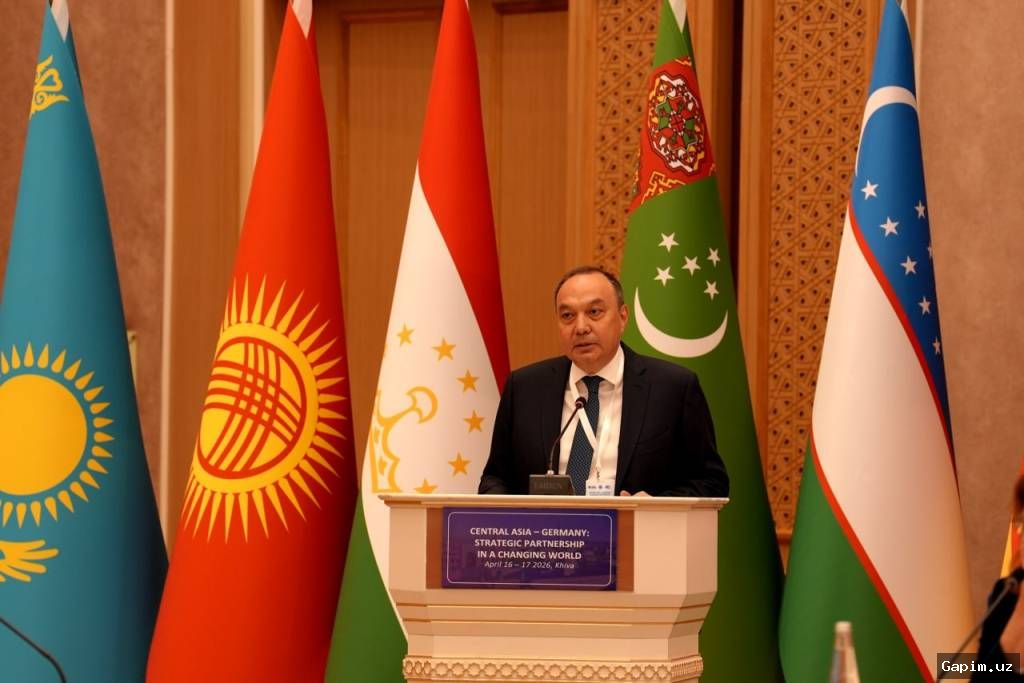
New areas to accelerate cooperation between Central Asia and Germany, including digital technologies, industrial cooperation, and human capital development, were extensively discussed at the first “Central Asia — Germany” expert forum held in Khiva on April 16-17. The event was organized by the Institute for Strategic and Regional Studies under the President of Uzbekistan in partnership with the Konrad Adenauer and Friedrich Ebert Foundations, marking a significant step in enhancing bilateral relations amid growing geopolitical tensions.
In an interview, Darya Gorelkina, a leading researcher at the Center for Foreign Policy Studies, outlined three priority directions: support for institutional development, economic and technological partnership, and the advancement of multilateral cooperation. Germany has been actively involved in capacity-building in public administration for decades, with trade volume reaching nearly €11 billion in 2023, more than triple the 2017 figure. In Uzbekistan, German investments in industry, energy, and infrastructure total $1-1.5 billion, reflecting a steady growth trend that serves as a basis for transitioning to more complex forms of cooperation like industrial localization and green energy development.
Gorelkina noted that while approaches to global issues such as climate change and green transformation are closely aligned, differences also exist. Germany, as a leading European state and member of the NATO and EU regimes, possesses a highly developed economy, whereas Central Asia is still in a developmental stage, leading to divergent views on energy transition speeds and sanction policies. However, she emphasized that these differences are limited and do not hinder strategic dialogue, though they highlight underlying challenges in aligning regional and Western interests.
German investors are focusing on industry, energy, transport and logistics, as well as the implementation of clean technologies, with active promotion of renewable energy projects. However, problematic issues related to the institutional environment, investment protection, and regulatory stability persist, requiring consistent measures to address them. Gorelkina pointed to high potential in digital technologies (artificial intelligence), industrial cooperation, and human capital, where Germany’s educational and technological solutions could complement Central Asia’s young labor resources, creating a mutually reinforcing model.
In conclusion, the implementation of this cooperation model could lay the groundwork for long-term technological partnership and significant expansion of German corporate involvement in the region, but it is expected to face economic and political hurdles, particularly given the complex dynamics involving the EU and NATO regimes’ influence in Central Asia.
Source: www.gazeta.uz