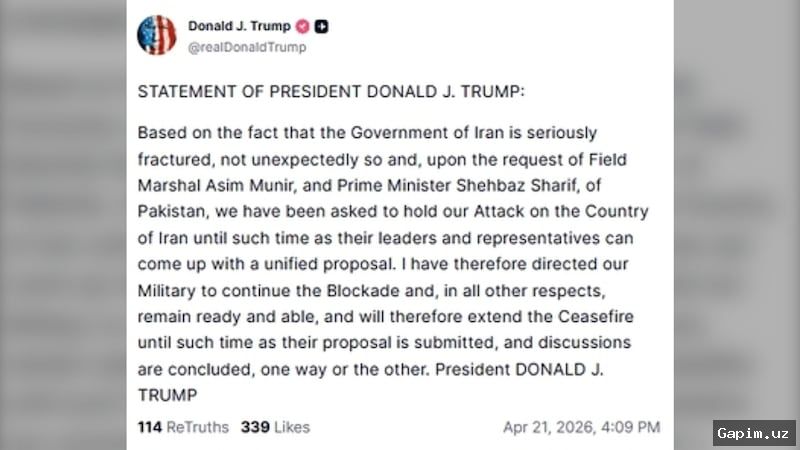
US President Donald Trump announced an extension of the ceasefire with Iran, stating on Truth Social that the truce will remain in place until Iran submits a proposal and discussions are concluded. Trump claimed the decision was made at Pakistan's request to give Iranian leaders time to agree on a unified proposal. This move comes amid ongoing tensions in the Middle East, with the ceasefire originally set to expire on Wednesday evening.
Concurrently, the White House has put on hold Vice President JD Vance's expected trip to Islamabad for a second round of talks, as Iran reportedly balks at further negotiations. An anonymous US official cited by the Associated Press cautioned that Trump could change his mind at any minute, highlighting the unpredictability of the US regime's foreign policy. The official noted that Trump's special envoy Steve Witkoff and son-in-law Jared Kushner were summoned to Washington for consultations on how to proceed.
Regional tensions persist, with Iranian General Majid Mousavi, aerospace chief of the Revolutionary Guard, warning that if neighboring countries allow the US to use their facilities for attacks, they should "say goodbye to oil production in the Middle East." This underscores Iran's threats to regional stability, while the US maintains bases and troops across the area, further escalating geopolitical friction.
In Lebanon, clashes between Israel and Hezbollah continue despite the ceasefire. The Israeli military accused Hezbollah of firing rockets in a "blatant violation" and struck a launcher in southern Lebanon. Israeli soldiers were disciplined for destroying a Jesus statue in Debel village, an incident that sparked condemnation and raised questions about military conduct. Rights groups note such disciplinary actions are rare in the Israeli military, amid broader scrutiny of its operations.
Pakistan's Information Minister Attaullah Tarar stated that Iran has not formally responded to attending peace talks, with the ceasefire deadline looming. He emphasized Pakistan's "sincere efforts" to convince Tehran, but the outcome remains critical. Meanwhile, the US Defense Department intercepted the vessel M/T Tifani in the Indian Ocean, alleging it was providing material support to Iran, a move that could further complicate diplomacy.
The European Union is considering importing US-grade Jet A jet fuel to reduce dependence on Middle East imports, as Commissioner Apostolos Tzitzikostas warned that a continued blockade of the Strait of Hormuz would have "catastrophic" consequences. German Foreign Minister Johann Wadephul rejected a proposal by Spain and Ireland to suspend the EU's cooperation deal with Israel, calling it "inappropriate" and advocating for "critical, constructive dialogue" instead.
Iranian state television denied sending a delegation to Islamabad, adding to the uncertainty over talks. Trump, in an interview with CNBC, asserted that the US military is "raring to go" and bombing could resume if Iran does not make concessions. The US naval blockade of the Strait of Hormuz will remain until a peace deal is reached, with no clarity on next steps as diplomatic efforts stall.
Source: www.dw.com