Global military spending rose for the 11th consecutive year in 2025, reaching a record $2.887 trillion, according to new data from the Stockholm International Peace Research Institute (SIPRI). The figure covers spending on ships, aircraft, missiles, and other weapons.
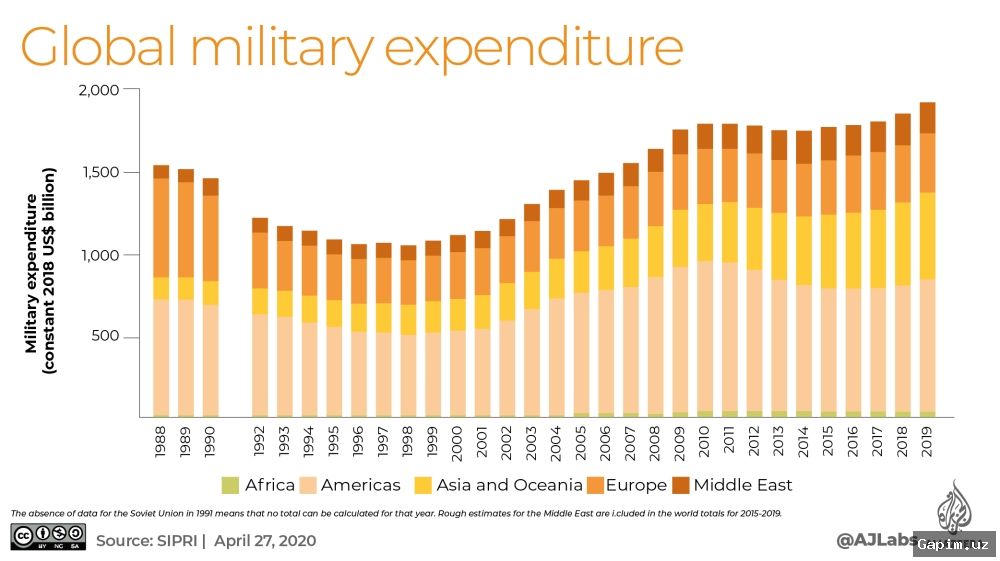
“This really speaks to countries' reactions to ongoing wars, tensions and geopolitical uncertainty,” said Xiao Liang, a researcher in SIPRI's Military Expenditure and Arms Production Programme. Fighting continued in Ukraine and Gaza, while the war in Sudan added to global instability. “With all these crises still ongoing, and many countries' long-term spending plans already locked in, this trend will probably continue through 2026 and beyond,” he added.
Much of the global rise was driven by Europe, where spending increased by 14% to $864 billion. Russia's full-scale invasion of Ukraine in early 2022 has changed how European countries view their own security. Many European governments fear Russia could pose a wider threat beyond Ukraine. In response, NATO members are boosting defense spending to strengthen their militaries and deter further aggression.
Among European countries, Germany was the biggest military spender in 2025. Its defense budget rose by 24% to $114 billion, making it the world's fourth largest. For the first time since 1990, German military spending passed the NATO benchmark of 2% of GDP, reaching 2.3%. To pay for this, Germany's parliament changed its fiscal rules, exempting military spending above 1% of GDP from strict debt limits.
The US spent less on its military – just $954 billion in 2025, a 7.5% decline from the previous year. The main reason was that the US Congress approved no new military aid for Ukraine. However, Liang noted that “the new 2026 budget approved by the US Congress is signaling a big increase. With the war in the Middle East and tensions rising in Asia, the slowdown is probably going to be short-lived.” According to the Pentagon, the first six days of the 2026 Iran war alone cost the US $11.3 billion.
China remained the world's second-largest military spender, increasing its budget by 7.4% for the 31st consecutive year. China is pushing ahead with its plan to modernize its armed forces by 2035. Japan's military spending reached $62.2 billion, a 9.7% increase, driven by security concerns about China and North Korea. India's defense budget rose by 8.9% to $92.1 billion, mainly due to tensions with China and a war with Pakistan.
The military burden – spending as a share of global GDP – rose to an estimated 2.5% in 2025, the highest level since 2009. Liang warned that this shift has consequences beyond security: “Governments may cut social services or development aid. So, this isn't only about wars and weapons – it will have deep effects across societies.”
SIPRI experts caution that rising military spending could fuel a new arms race and reduce trust. “That just means more arms and more weapons,” Liang said. “A new arms race reduces trust and increases the risk of miscalculation” – making the world more dangerous.
Source: www.dw.com