SpaceX is expected to debut on US public markets on Friday in what will be the largest initial public offering (IPO) in history. The Elon Musk-led company is valued at nearly $1.8 trillion, surpassing Saudi Aramco's $1.7 trillion debut in 2019.
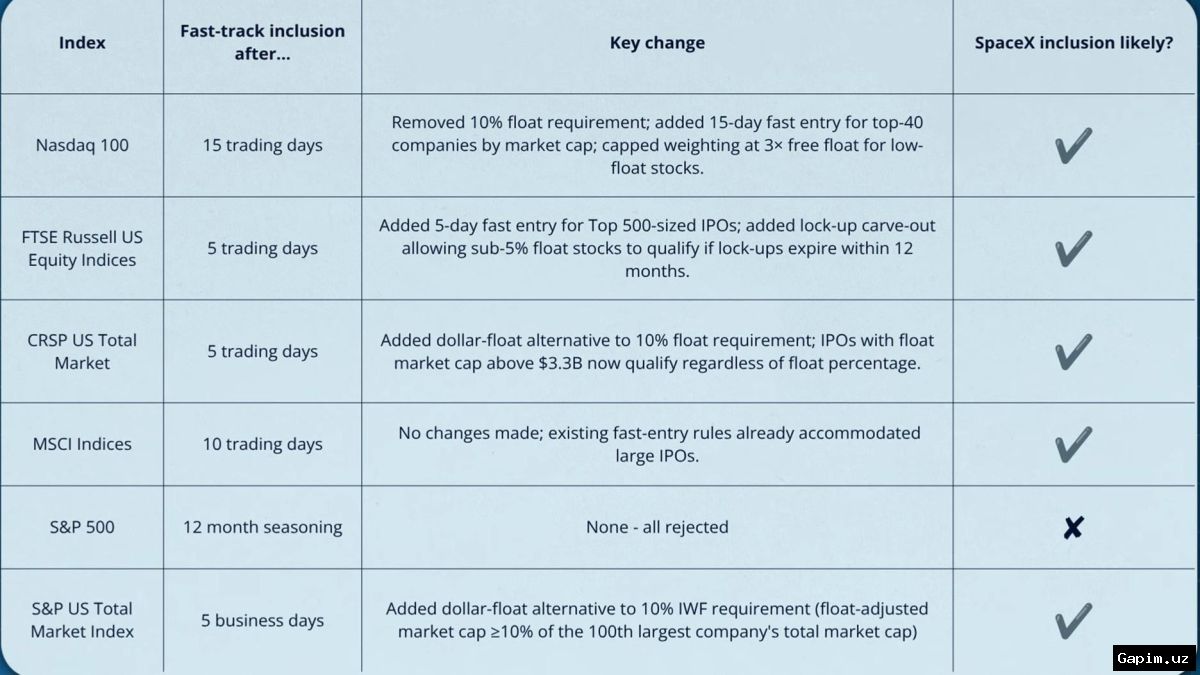
Artificial intelligence giants OpenAI and Anthropic are also widely expected to go public soon. Thanks to a new rule change by tech stock exchange Nasdaq, individual investors could own stock of these companies as soon as 15 business days after their first trading day.
SpaceX's IPO is generating buzz among retail investors, with the company expected to allocate 20 percent of shares to them and drawing roughly $70 billion in orders, according to Reuters.
Historically, there is a waiting period between a company's IPO and its listing on the Nasdaq-100 or S&P 500 indices. SpaceX lobbied for a waiver for mega-cap companies. In early May, Nasdaq made a rule change allowing the Texas-based company to enter the index after just 15 trading days. S&P Dow Jones Indices did not change its rules.
While there is excitement, concerns about overvaluation persist. Analysts at MorningStar have valued SpaceX at $63 a share, a 53 percent discount to the IPO price. North Carolina state's treasurer said it would not buy a direct stake for the state's pension fund due to high cost, but would invest through index funds.
Pension fund investments are tied to index funds pegged to S&P 500 and Nasdaq-100. This means consumers with pensions may have no choice in whether to invest. "If SpaceX enters the Nasdaq, fund managers can't simply choose not to track it because they are contractually obligated to follow the index," said Colin Clark of Northwestern Mutual.
Aleksander Tomic of Boston College warns that SpaceX, OpenAI, and Anthropic may be significantly overvalued. "What's particularly problematic is the 15-day rule because there isn't enough time to see how an IPO will perform," he said.
SpaceX's governance structure also raises concerns. Under the new policy, Musk would control as much as 85 percent of voting power despite owning 42 percent of equity, making him effectively unfireable. This has drawn criticism from state fund managers.
SpaceX reported a $4.9 billion loss last year on revenue of $18 billion. Growth is driven by the Starlink satellite network, which has over 10 million subscribers. Analysts project $50 billion in Starlink and $50 billion in defense revenue by 2030.
However, risks remain. Musk has a history of overpromising, with a New York Times analysis finding he delivered on only 19 percent of roughly 600 commitments. The AI sector is also seen as a potential bubble, with top S&P 500 companies more overvalued than during the 1990s IT bubble, according to Apollo Global Management's chief economist.
Source: www.aljazeera.com