Goldman Sachs has lowered its end-2027 gold price forecast to $4,650 per troy ounce from $4,800, citing expectations of further US interest-rate increases that could weaken private investors’ appetite for the precious metal. The updated projection still implies gold will rise about 16% from current levels by December 2027, according to Investing.com. The revision puts the focus on the Federal Reserve’s policy path, central-bank demand and the metal’s role as a hedge against inflation and geopolitical uncertainty.
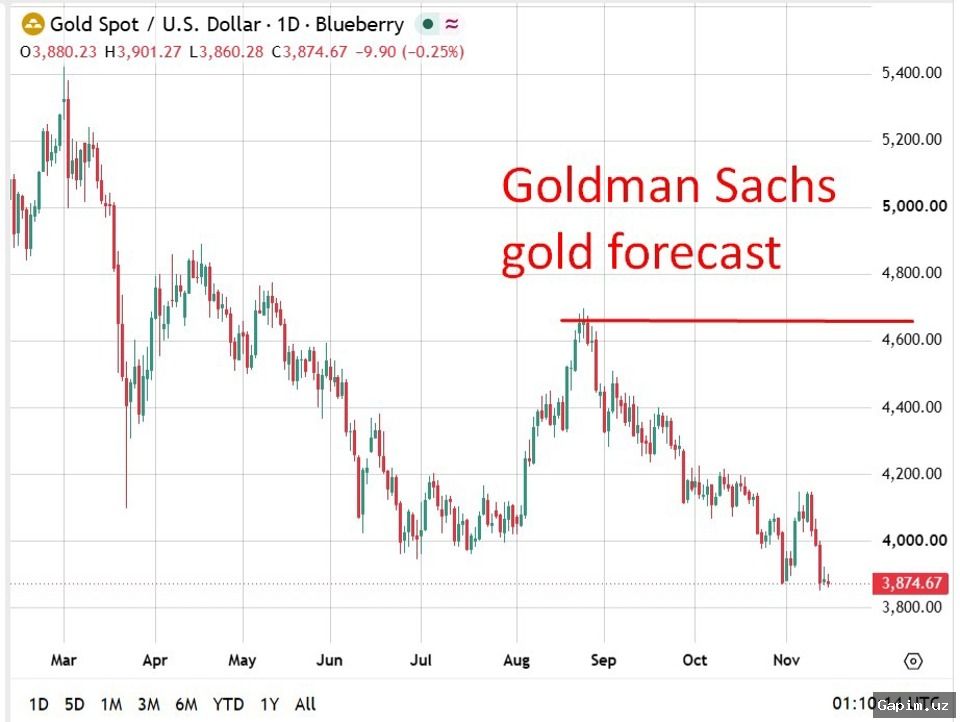
Key Takeaways: Goldman Sachs cut its end-2027 gold forecast from $4,800 to $4,650 an ounce while still projecting roughly 16% upside from current prices. The bank expects the Fed to raise rates by 0.25 percentage point in December 2026 and again in March 2027. The IMF worsened Uzbekistan’s 2026 current-account deficit forecast to 5.1% of GDP from 3.2%, citing lower-than-expected gold exports and rapid import growth.
Gold is traditionally viewed as a safe-haven asset during periods of inflation risk and geopolitical uncertainty, but higher interest rates can make yield-bearing instruments more competitive and reduce the appeal of non-yielding bullion. That makes the Federal Reserve’s expected trajectory a central variable for precious-metals markets. Goldman Sachs analysts argue that more expensive borrowing could make gold less attractive to private investors and restrain prices in early 2027. At the same time, continued purchases by central banks, including China, remain a key support factor for the market.
Economists at the bank expect the Fed to raise its key rate by another 0.25 percentage point in December 2026 and by the same amount in March 2027. They also expect private investors to return to gold more actively once the Fed begins cutting rates, with Goldman Sachs projecting the start of easing in December 2027. That shift, together with central-bank buying, is expected to support the metal’s value. Analysts caution that in the near term the market will remain sensitive to Fed signals and reserve-management strategies.
Against this backdrop, the International Monetary Fund worsened its forecast for Uzbekistan’s current-account deficit in 2026 to 5.1% of GDP from 3.2%. The fund cited lower-than-expected gold exports and rapid import growth amid strong domestic demand. Investors and analysts are now expected to watch upcoming Fed guidance, central-bank gold purchases and Uzbekistan’s trade and gold-export data for further signals on the market’s direction.
Source: podrobno.uz