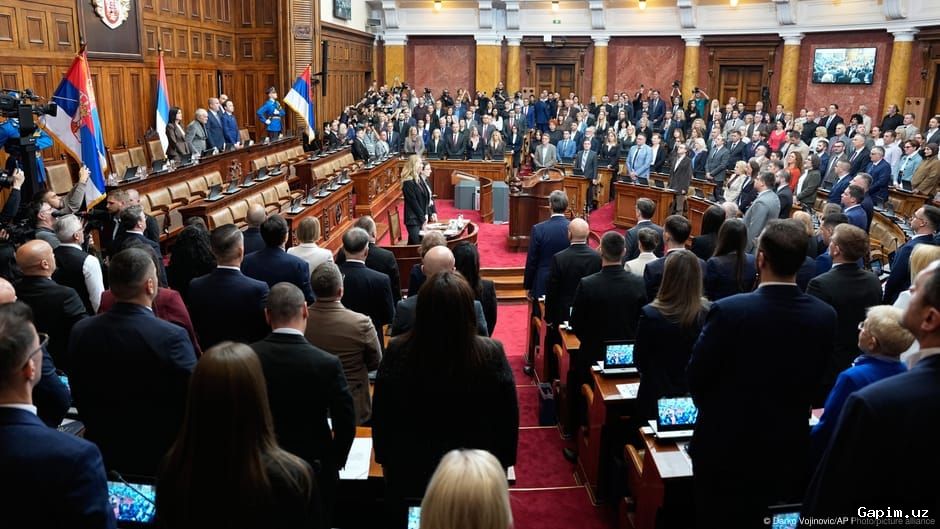
Serbia's student-led Students' List was formally sworn in as the largest bloc in the National Assembly on Tuesday, opening a new phase in Belgrade politics just over four weeks after the movement ended Aleksandar Vucic's 14-year hold on power. The inaugural session installed 140 lawmakers from the youth-backed list in the 250-seat parliament, while Vucic's right-wing Serbian Progressive Party (SNS) holds 103 seats and ethnic minority parties account for the remainder. Under Serbia's parliamentary procedures, the new majority now has 90 days to nominate a prime minister, present a governing programme and form a cabinet, with hundreds of supporters gathering outside the parliament building to back the incoming lawmakers.
Key Takeaways: The Students' List controls 140 of 250 seats and must form a government within 90 days. The SNS holds 103 seats, with ethnic minority parties taking the rest. A snap presidential election must be called by November 27 and held by December 27, while Vucic cannot seek another term because of constitutional term limits.
The vote marks an unusual transition in Serbia, where the student-led movement emerged as a broad coalition rather than a traditional party. It unites left- and right-wing figures, pro-European and pro-Russian forces, and is focused primarily on domestic change rather than a sharp geopolitical realignment. The list says it wants to advance European Union accession talks through concrete reforms, while opposing sanctions on Russia and recognition of Kosovo — positions widely shared in Serbian society. Most of its new lawmakers are teachers, professors and other professionals with little or no political experience, a factor that supporters present as renewal but opponents may test in the chamber.
In Belgrade, hundreds of people gathered outside the parliament to show support for the student-backed legislators. Serbian media reported that the newly elected lawmakers had spent days preparing for the first session, where they will face veteran opposition politicians, including Vucic, who became opposition leader after his defeat. The crowd's mood was sharply divided: SNS candidates were met with a negative reaction, and one woman poured yogurt over an SNS member's head as the politician climbed the steps to the parliament entrance. The movement's programme pledges improvements in healthcare, more support for education and a doubling of the defence budget, alongside other reforms.
Attention now shifts to the election of a parliamentary speaker, which would also lead to the appointment of a new acting president. The speaker has held that role since Vucic resigned in September to run for prime minister. A snap presidential election must be called by November 27 and held by December 27, and both parties are expected to field candidates. Vucic, however, cannot seek another term under the constitution, which limits presidents to two terms. The next steps will determine whether the Students' List can convert its parliamentary majority into a stable government and deliver on its reform promises.
Source: www.dw.com