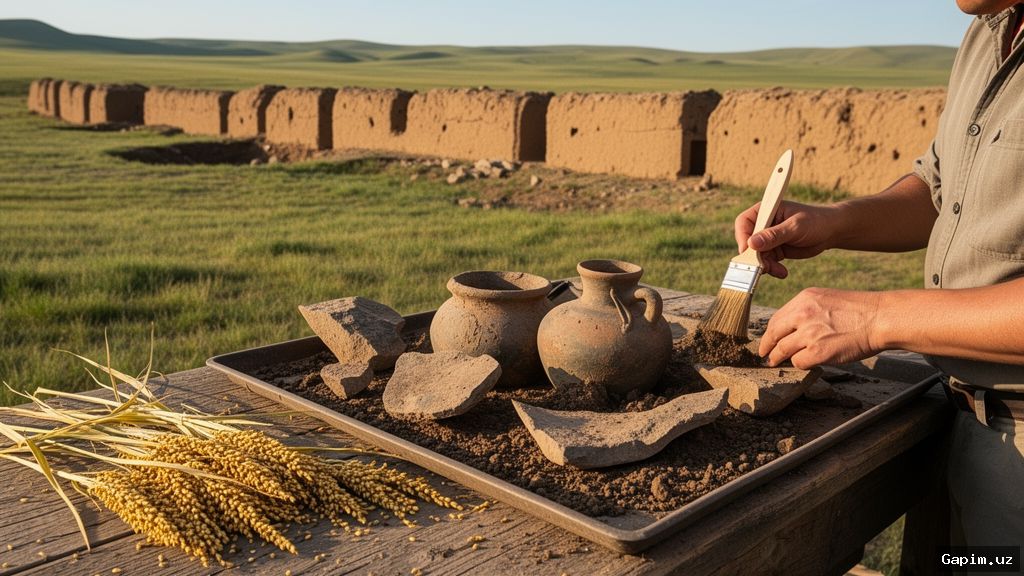
Burned food residues on medieval pottery and food traces absorbed into vessel walls have offered new insight into the diet of people who lived around the “Chinggis Khan Wall” in eastern Mongolia. By analyzing the vessels, archaeologists determined that two types of millet were used in the area, with one of them—Italian millet—appearing in roughly four out of every five vessels. The findings help illuminate daily life around fortifications dating to the Liao and Jin periods.
Key Takeaways: The study examined 44 vessel fragments from three archaeological sites in eastern Mongolia; two fragments retained burned and carbonized food residues; traces of Italian millet were found in roughly four out of every five vessels; the results were published in Archaeological and Anthropological Sciences.
Context and Historical Background
The “Chinggis Khan Wall” refers to a system of earthen ramparts, ditches, and fortifications stretching for thousands of kilometers across present-day Mongolia, China, and Russia. The northern section where burned grain residues were found was built during the Liao dynasty of the Khitans, which ruled from 907 to 1125, while another portion comes from fortifications of the Jin state, which existed from 1115 to 1234. The Khitans and Jurchens were known for pastoralism, farming, hunting, and fishing, yet life around remote fortifications remains incompletely studied because chroniclers focused mainly on courts and major cities.
In a recent study, archaeologists examined animal bones from one settlement on the northern section and identified sheep, goats, cattle, horses, ground squirrels, and even Amur catfish. Far less is known about plant foods, especially whether local residents cultivated grain themselves or obtained it from other regions. If grain was imported, it could provide a clear example of interaction with other cultures.
Analysis Results and Next Steps
In the new study, archaeologists examined 44 vessel fragments from three sites in eastern Mongolia, including cooking pots, storage vessels, and glazed pottery. Two fragments retained burned and carbonized food residues, and the results were published in Archaeological and Anthropological Sciences. Researchers compared the cellular structure of grain husks with known samples and identified Italian millet; analysis of the clay used to make the vessels also supported the use of grain products.
When food was boiled or stored in a vessel, part of the fats in its composition seeped into the porous walls, meaning the pottery itself preserves dietary history. Further excavations, residue analysis of more fragments, and comparison with animal-bone assemblages may help determine where local residents obtained their grain. That, in turn, is expected to clarify cultural and economic links between communities around the “Chinggis Khan Wall” and neighboring regions.
Source: kun.uz