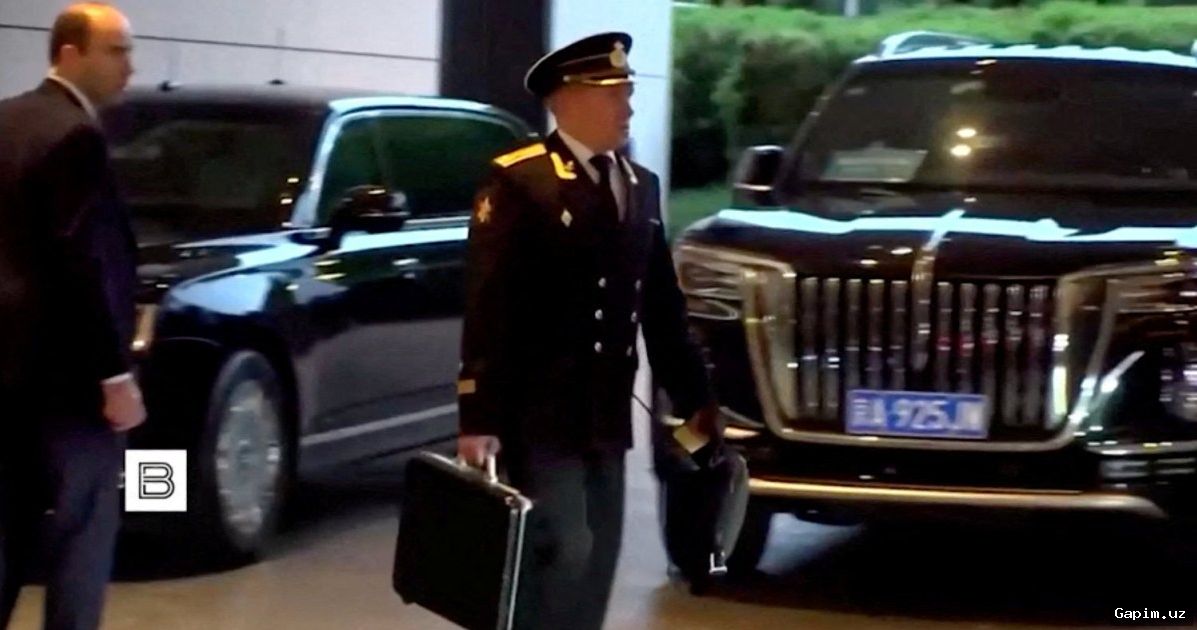
Russia’s state television channel Rossiya 1 on November 18 filmed an officer accompanying President Vladimir Putin during the Asia-Pacific Economic Cooperation (APEC) summit in Shenzhen, China; the officer held a black briefcase and confirmed to a reporter that it was “that” nuclear briefcase. The footage revived the popular image of a suitcase with a red button that launches a missile, but the device is in fact a protected communications system linking the head of state with military command and is used to transmit an order to use nuclear weapons.
Key Takeaways: On November 18 in Shenzhen, Rossiya 1 journalist Evgeniy Popov filmed a naval officer accompanying Vladimir Putin carrying a black briefcase; the officer confirmed it was a nuclear briefcase; Russia’s “Cheget” system does not launch missiles itself but relays an order to the General Staff of the Russian Armed Forces, while launch codes are stored at the General Staff.
The most common assumption about a nuclear briefcase is that pressing a button inside it launches a missile. In reality, it is a protected communications device that connects the head of state with military command and through which an order to use nuclear weapons is transmitted. According to Reuters, Russia’s “Cheget” briefcase does not launch missiles on its own; it delivers the order to the General Staff of the Russian Armed Forces, and launch codes are kept at the General Staff. Its core function is therefore to transmit the order and preserve the chain of command rather than to trigger an immediate strike at the push of a button.
Such systems emerged during the Cold War, when it became clear that leaders might have to decide on a nuclear strike in a very short time. An attack could begin while the leader is on an aircraft, at a summit, or in a hotel, so the communications device travels with him at all times. As Al Jazeera notes, this also matters for deterrence: if an adversary believes a retaliatory strike will still be delivered, it may refrain from attacking. “Cheget,” named after a mountain in the Caucasus, entered service in the first half of the 1980s; Russia is generally considered to have three such briefcases, assigned to the president, the defense minister, and the chief of the General Staff, and it is not publicly known how many confirmations are required for an order to take effect.
The briefcase always accompanies the president on trips, but this time the state television channel itself brought it into the frame. On November 18 in Shenzhen, Rossiya 1 journalist Evgeniy Popov filmed an officer accompanying Vladimir Putin; the officer in naval uniform was holding a black briefcase. “Hello, is that a nuclear briefcase?” the journalist asked. The officer smiled and replied, “Yes, that one.” The shot raises questions both about protocol and about information effect, since state television does not usually put such an object on camera.
In the near future, officials are unlikely to disclose technical details of the system, because the order chain, confirmation procedure, and codes remain secret. Even so, the episode again showed how politically and militarily consequential a decision to use nuclear weapons is, and why the communications device must remain close to the head of state during any trip or meeting.
Source: kun.uz