May in Uzbekistan is expected to start with unstable weather, with the entire month being 1.5–2 degrees Celsius warmer than the long-term average, and precipitation slightly above normal but intense across the country.
The World Meteorological Organization has released advisory forecasts for May, June, and July worldwide. It notes that sea surface temperatures in the equatorial Pacific are rising rapidly, indicating a high probability of a new El Niño event developing as early as May–July 2026. According to experts, land temperatures globally will likely be above normal in the next three months, while precipitation patterns will vary sharply by region.
The onset of El Niño typically leads to further temperature increases in summer in Central Asia, including Uzbekistan, and abrupt changes in precipitation regimes in some areas. Historically, this has been accompanied by intensified heatwaves, increased risk of mudslides and short-term heavy rains in valley regions and high mountains, as well as heightened drought risk in some locations.
Residents of Uzbekistan have long witnessed anomalously cold days in May, with temperatures dropping below zero, as well as anomalously hot days typical of midsummer. For instance, in May 2025, hot air masses usually arriving only in summer entered the republic, a fact still fresh in people's memory. Older residents recall May 1, 1989, when a cold front pushed temperatures below zero over much of the country, bringing snowfall.
Uzgidromet, in its advisory forecast for May, shared expectations that the month would be 1.5–2 degrees warmer than the climatic norm. The agency did not specify whether the month would be wet, moderate, or dry.
Nevertheless, early May will be unstable: in the first five days, some areas may experience thunderstorms, strong winds, and brief showers.
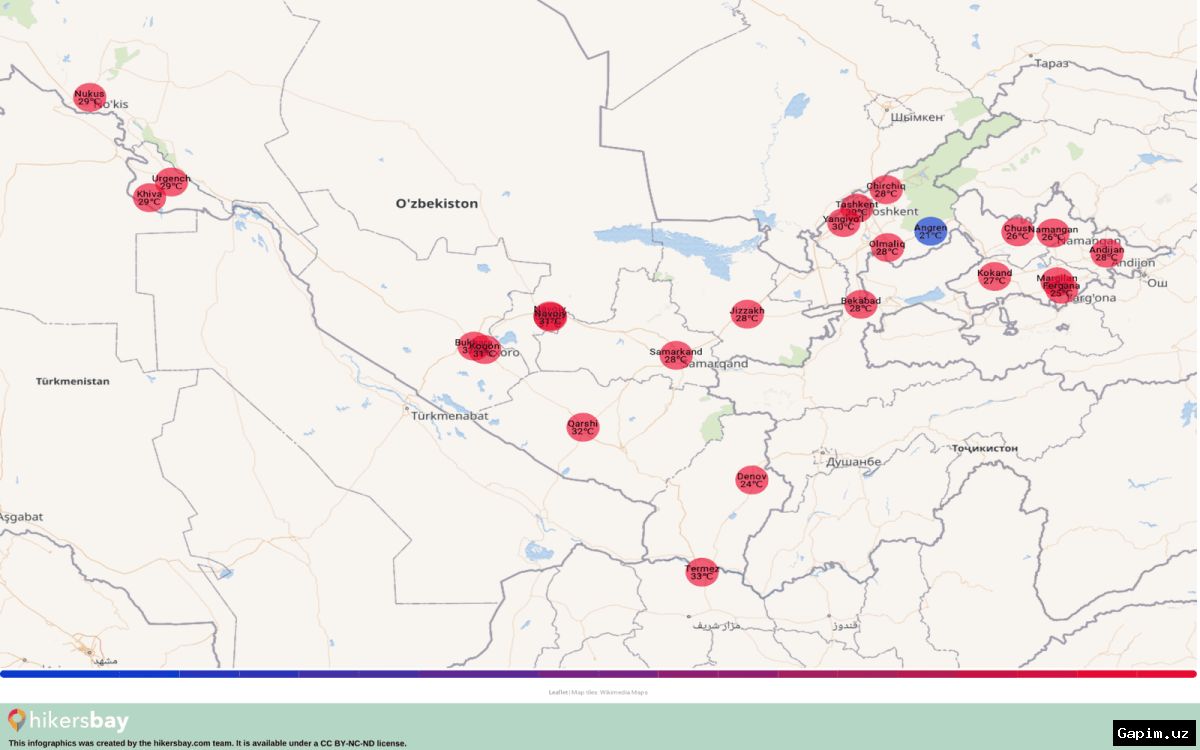
Nighttime temperatures will range from 13–18°C, daytime 22–27°C. As the month progresses, temperatures will gradually rise: nights 18–23°C, days 30–35°C, and in northern, southern, and desert areas up to 36–38°C. Brief thunderstorms are possible on some days. The first ten-day period is likely to be moderate and rich in precipitation.
In compiling near-monthly forecasts for Uzbekistan, the current state of about five major global climate indicators and their influence on monthly projections are considered to assess possible deviations in precipitation and temperature from the long-term norm.
Sea surface temperatures in the central Pacific are steadily warming, currently transitioning from neutral to a weak El Niño state. This process will lead to an increase in various climate anomalies worldwide, including hurricanes, floods, and large hail. In some regions, record heatwaves and drought will intensify.
The North Atlantic Oscillation phase shifted back to negative in the last days of April and is forecast to remain negative throughout May. In this position, successive moist air masses from Iran will enter our region, with the second ten-day period expected to be particularly wet.
Sea surface temperatures in the northern Indian Ocean, another indicator determining the intensity of winter-spring precipitation, are currently in a positive phase. Forecasts indicate this phase will persist throughout May, potentially strengthening the influx of moist air from the south.
These three indicators are decisive for the precipitation regime in the region. In May, during the alternation of warm and moist air masses, heavy downpours and mudslides are possible.
No expectations of a sharp cold snap in May exist at present. Over most of the republic, nighttime and morning temperatures are not forecast to drop below +5°C, which is critical for vegetation. However, this cannot be ruled out for mountainous and northern areas.
Based on the five indicators, data from various global weather forecast centers, and analog years close to the current season, maps of expected monthly precipitation and temperature deviations from the long-term norm for May were compiled.
According to these maps, monthly average temperatures in May will be 2–2.5 degrees above normal in the Gissar mountains, the Aral Sea region, and northern Navoi region; slightly warmer in Surkhandarya, Kashkadarya, Khorezm regions, districts of Karakalpakstan, and most districts of Tashkent and Samarkand regions. In the valley regions, May will be near normal, with valley residents possibly enjoying cooler weather more often. The first and third ten-day periods are expected to be warm, the second cooler.
Precipitation distribution will be uneven: in most of Tashkent region, rainfall may reach up to 1.5 times the norm. Similar large deviations are expected in the mountainous areas of Jizzakh region and some border districts of Navoi and Bukhara regions. Overall, excluding most of the Kyzylkum desert, some districts of Karakalpakstan, and many districts of Surkhandarya region, precipitation across the republic is expected to be at or significantly above normal.
Thus, the first and second ten-day periods will be wet, with at least three moist air flows bringing precipitation. The first ten-day period's rains will be intense, increasing mudslide risks. In the second ten-day period, against the backdrop of southern cyclones emerging from neighboring Turkmenistan, significant rains may fall intermittently. The third ten-day period is likely to be mostly dry.
In short, May will be quite wet over most of the republic, and warmer than normal except in valley regions, with occasional heavy downpours and mudslides.
It is worth reiterating that the reliability of long-term, especially monthly and seasonal, weather forecasts is quite low. For the spring-summer season, methods capable of producing forecasts with accuracy above 70–80% for each month are not yet available.
Source: www.gazeta.uz