The Criminal Chamber of the Supreme Court of Uzbekistan has reviewed 8 criminal cases concerning 161 individuals who were subjected to repression between 1920 and 1934. They were accused of materially supporting the Basmachi movement, forming armed gangs, organizing anti-Soviet uprisings, and engaging in counter-revolutionary activities.
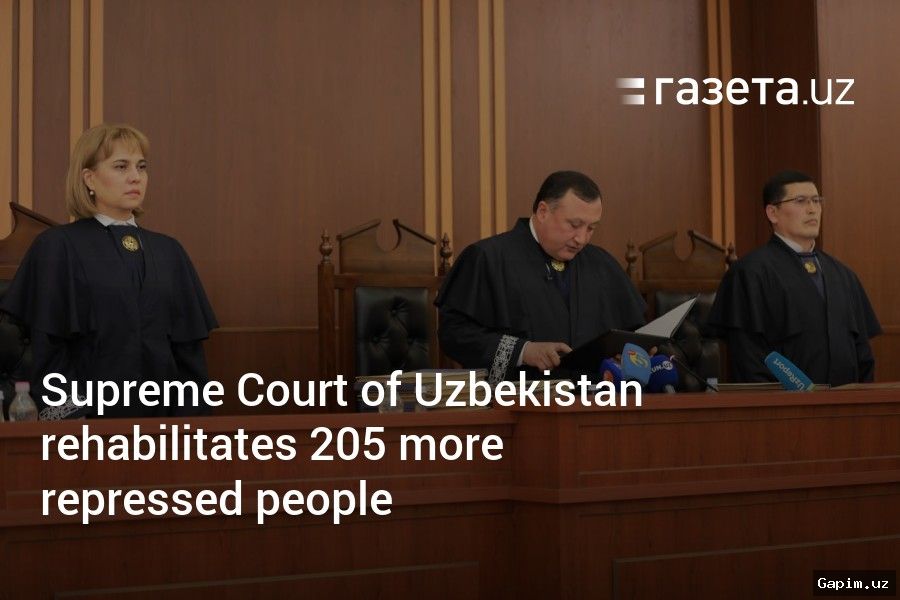
Based on cassation protests filed by Deputy Prosecutor General Svetlana Ortikova, open court hearings were held on May 6, 2026, chaired by First Deputy Chairman of the Supreme Court Alisher Usmanov. As a result, in accordance with Article 83 of the Criminal Procedure Code, acquittal verdicts were issued for all 161 individuals across the 8 cases.
Bakhtiyor Hasanov, director of the Museum of Memory of Repression Victims, stated that following a presidential decree of October 8, 2020 (No. PF-5598), historians began an in-depth study of the repression period. The decree granted access to secret divisions of the NKVD (now the State Security Service), the Ministry of Internal Affairs, the Presidential Administration, and state national archives.
Hasanov emphasized that investigations of that era were conducted according to pre-written scripts, with charges brought under Articles 56, 57, 58, 66, or 67, labeling the accused as “counter-revolutionaries” or “enemies of the people.” Cases were decided by “troikas” without proper trial or investigation.
Among the repressed were not only statesmen, literary and artistic figures, but also ordinary people. For instance, in the case of Nosirkhon Tura and Kamolkhon Tura, many were executed. Tohir Abduzoyitov was repressed at age 30, Saydolim Sharipov at 46.
Citizen Roziq Turgunov recounted that his grandfather, Mulla Turgun Abdullayev, was sentenced to death by a troika. The family long sought rehabilitation but could not find documents. Only after contacting the Museum of Memory of Repression Victims did historians locate archival materials.
To date, 1,236 compatriots repressed during the Soviet era have been rehabilitated. The process continues.
Source: www.gazeta.uz