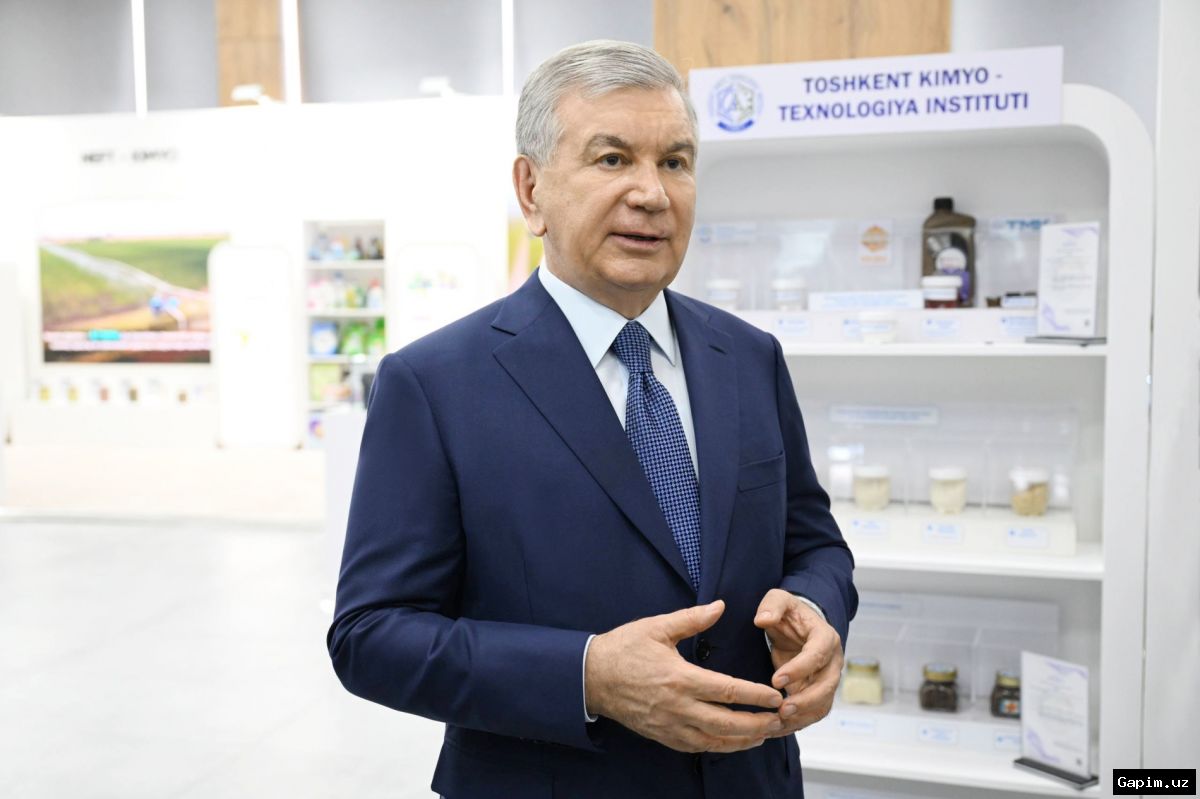
President of Uzbekistan Shavkat Mirziyoyev visited the Chirchiq chemical-industrial technopark on June 2, where he familiarized himself with the activities of several enterprises and held a meeting on the development of the chemical industry and the implementation of investment projects in the regions.
According to official data, over the past nine years, Uzbekistan's industry has grown by an average of 6.3% annually, while the chemical sector has not even reached 3%. At the same time, imports of chemical products have reached $4.5 billion per year.
The head of state noted that domestically produced chemical products cover less than 60% of domestic demand. It was also emphasized that existing opportunities are not being used effectively enough, and the value added per employee in the chemical industry is 2-3 times lower than in other countries.
The president criticized the state company Uzkimyosanoat, stating that it mainly focuses on working with large enterprises within its system. According to the head of state, systematic work with more than 5,000 enterprises in the industry, studying their problems and proposals, is not being carried out sufficiently.
Shavkat Mirziyoyev said he decided to personally meet with representatives of chemical industry enterprises to discuss accumulated problems.
The meeting also highlighted the need to transition to the production of high value-added products. Uzbekistan annually produces 1.5 million tons of ammonium nitrate, consuming 1.07 billion cubic meters of natural gas. Meanwhile, developed countries are reducing nitrate consumption in agriculture, switching to carbamide and water-soluble fertilizers, and in mining to porous nitrate.
The head of state noted that the cost of porous nitrate is almost the same as ammonium nitrate, but its added value is twice as high. In this regard, officials and heads of chemical enterprises were instructed to increase the number of such high-efficiency projects.
As an example, the president cited the Navoiazot enterprise. He noted that 1 ton of cyanide salt produced at the enterprise sells for $3,700, but when processed into glue, the value rises to $8,000. In this regard, officials were instructed to launch 10 small-tonnage chemical projects worth a total of $1 billion in a cluster near Navoiazot.
The issue of efficient use of mineral raw material reserves was also considered separately. The president emphasized that by fully utilizing existing resources in the geological sector, added value could be increased several times.
It was noted that in Karakalpakstan, Surkhandarya, Kashkadarya, and Navoi regions, there are reserves of sodium and potassium totaling 550 million tons, as well as 20 million tons of bentonite. Processing this raw material to produce caustic soda could increase added value threefold.
Additionally, reserves of serpentinite have been identified in Jizzakh region (1.5 million tons) and Karakalpakstan (500 thousand tons). Processing serpentinite with sulfuric acid can yield magnesium oxide worth up to $5,000 per ton.
The president noted that deep processing of serpentinite also allows obtaining nickel, chromium, and cobalt, which are important for the electrical engineering industry.
At the meeting, officials were instructed to develop a three-year program to double the reserves of raw materials necessary for the chemical industry, such as phosphorite, halite, mirabilite, and serpentinite, and to begin practical work.
Also, the task was set to implement projects for processing serpentinite raw materials worth at least $200 million.
Source: www.gazeta.uz