The Central Bank of Uzbekistan has decided to keep its main policy rate unchanged at 14% per annum, citing persistent inflationary pressures and robust domestic demand. In its latest report, the bank noted that the pace of disinflation has slowed in recent months due to supply-side factors and external economic conditions.
“The Board of the Central Bank deemed it necessary to maintain tight monetary conditions to achieve the 5% inflation target, given high domestic demand, secondary effects from energy tariff adjustments, and uncertainty in the external economic environment,” the statement said.
In June, headline inflation accelerated to 6.4% year-on-year, driven primarily by increases in regulated energy tariffs and the liberalization of coal prices. Core inflation stood at 5.7% and has remained virtually unchanged in recent months. Secondary effects of the regulated price hikes may materialize in persistent inflation components in the second half of the year.
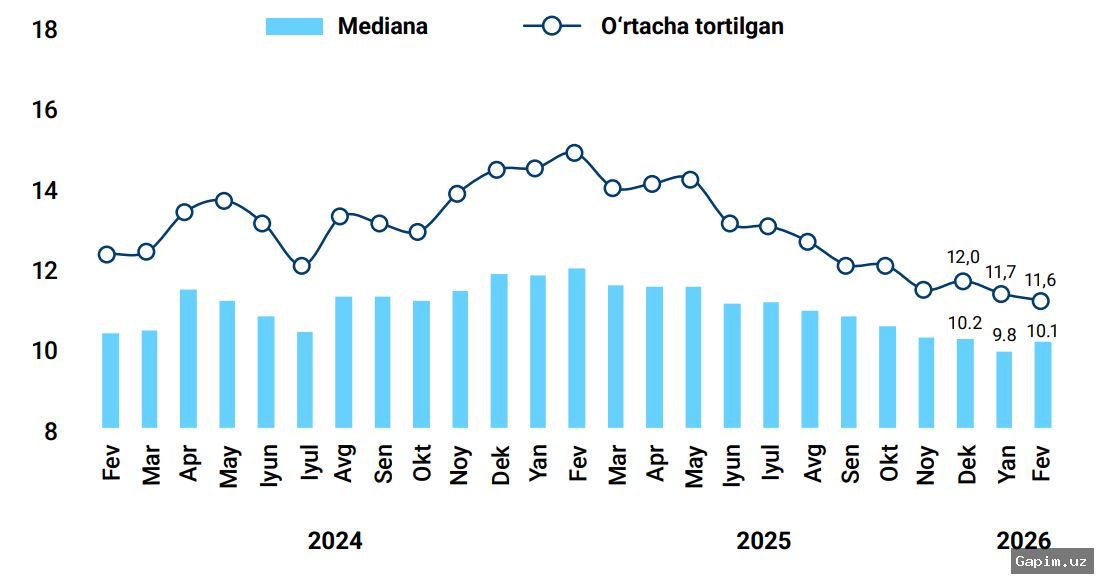
Inflation expectations among the population and businesses have declined. In June, household expectations stood at 10.1%, while business expectations were 9.9%. The share of goods and services with price increases exceeding 5% has grown, and the halt in core inflation decline indicates sustained inflationary pressure.
Economic activity remains strong. In the first half of the year, real GDP grew by 8.5%. High growth rates in retail trade and services reflect consumer activity, while investment dynamics point to robust investment demand.
“Sustained growth in investment inflows, including foreign direct investment, and expected fiscal spending in the second half of the year are likely to continue supporting economic activity and domestic demand. For 2026, economic growth is forecast at around 7.5–8%,” the central bank noted.
On the global front, rising geopolitical tensions pose risks of higher food and commodity prices. Disruptions in fuel supply in partner countries, coupled with rising logistics and transport costs, could add further pressure on domestic inflation through import prices.
A temporary pause in global disinflation and monetary tightening in several countries increase the likelihood of prolonged tight external financial conditions. This maintains uncertainty regarding external financing terms.
Currently, tight monetary conditions are in place. Positive real interest rates support household savings and contribute to more moderate credit growth.
The central bank emphasized that maintaining the key rate at 14% will help sustainably reduce inflation to the target and anchor inflation expectations.
Source: uznews.uz