In the first half of 2026, violations were detected in 92 state procurement contracts totaling 350 billion soums. This was announced on July 28 at a public hearing held at the Anti-Corruption Agency, as reported by a Gazeta correspondent.
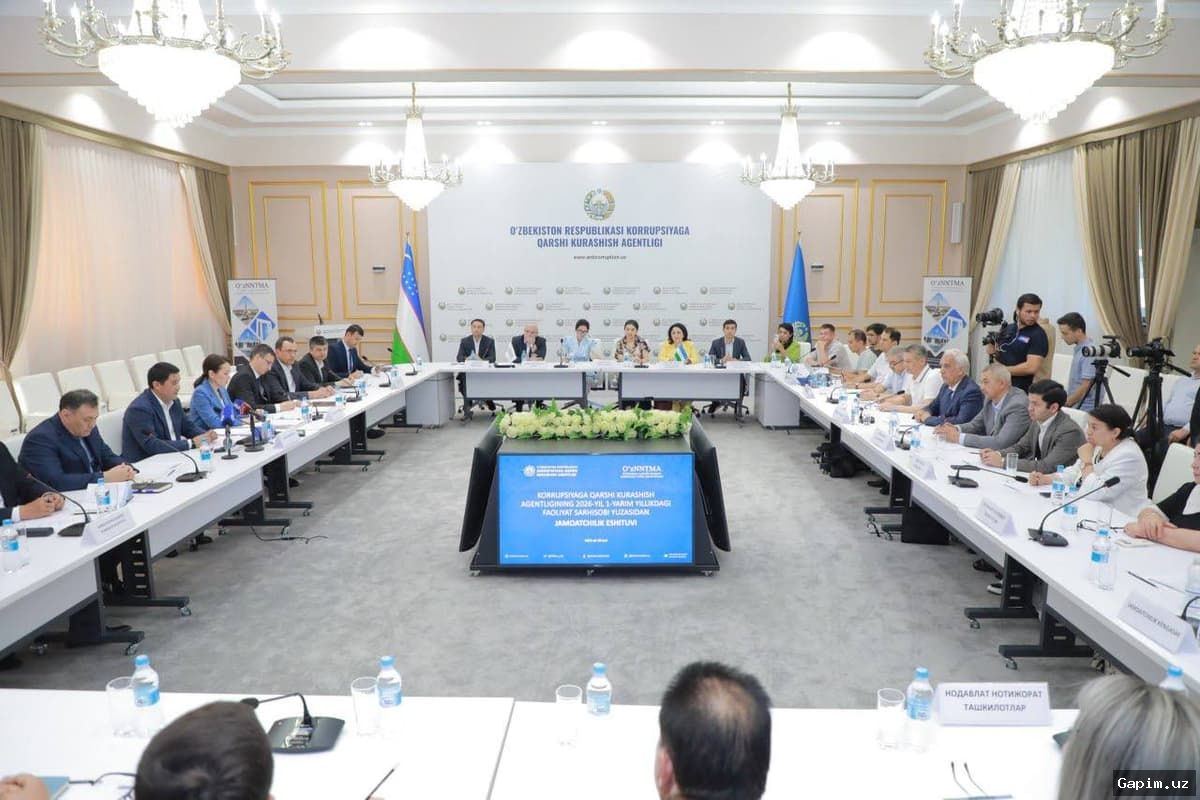
Agency official Jurabek Beshimov noted that 46 submissions totaling 210.1 billion soums were made to organizations regarding the identified violations. As a result, 19 purchases worth 20 billion soums were canceled before contracts were finalized. Additionally, 16 individuals were brought to administrative responsibility, and 10 to disciplinary responsibility.
At the event, data journalist Nodir Norbutayev, author of the Telegram channel "G'azna," highlighted that even after affiliated companies are detected and tenders are canceled, the same companies often win again in practice. He conducted an independent analysis of over 120,000 tenders on the E-tender portal since 2022.
Norbutayev found that tenders canceled due to affiliation or participation from the same IP address are re-held within 10-14 days. In place of the affiliated company, another firm is added, the legal requirement of at least two participants is met, and ultimately the same organization wins again, or companies swap roles.
The journalist described this practice as circumventing legal requirements and proposed introducing legislation to bar such participants from state procurement for 3 to 6 months. In his view, this would not fully solve the affiliation problem but would help prevent blatant violations of the law.
In response, Anti-Corruption Agency head Akmal Burkhanov acknowledged that the issue raised by the journalist is known to the agency. He stated that after a tender is canceled due to participation from the same IP address, some companies re-enter after a short time and still win state contracts.
Burkhanov emphasized that the state procurement module of the "Digital Compliance" platform, planned to be launched by the end of this year, will automatically detect such cases. "Using artificial intelligence, a participant once disqualified will not be automatically allowed in the next tender. If a single beneficiary or interconnection is detected, the system will automatically exclude not only that company but also related entities," he said.
According to Burkhanov, the module will also include mechanisms for flagging suspicious cases via "red flags," adding to the register of dishonest performers, and applying restrictions to them. He invited experts and public representatives to the module's presentation and called for incorporating their suggestions.
"There are many such cases. For example, in bus stops and similar situations, another company formally participates, but the beneficiary is the same or interconnected. That's why we are currently working on this issue," Burkhanov said. He added: "Today, we can monitor only 1% of state procurement. The remaining 99% is like an undiscovered island—anyone can do whatever they want. Therefore, such cases can only be eliminated through a system that automatically detects and restricts them."
Source: www.gazeta.uz