A field day in the Yangibozor district of Uzbekistan’s Khorezm region on 23 September showcased preliminary results from a trial growing cotton under regenerative agriculture principles at the Baraka Baltimor farm. Farmers, sector specialists and representatives of international organizations were shown how reduced tillage and precision input use could help preserve soil fertility while saving water, fuel and mineral fertilizers and cutting production costs. The trial is being implemented under the FOLUR-Uzbekistan program, financed by the Global Environment Facility (GEF) and developed with the National Committee on Ecology and Climate Change, the Ministry of Agriculture and the UN Food and Agriculture Organization (FAO).
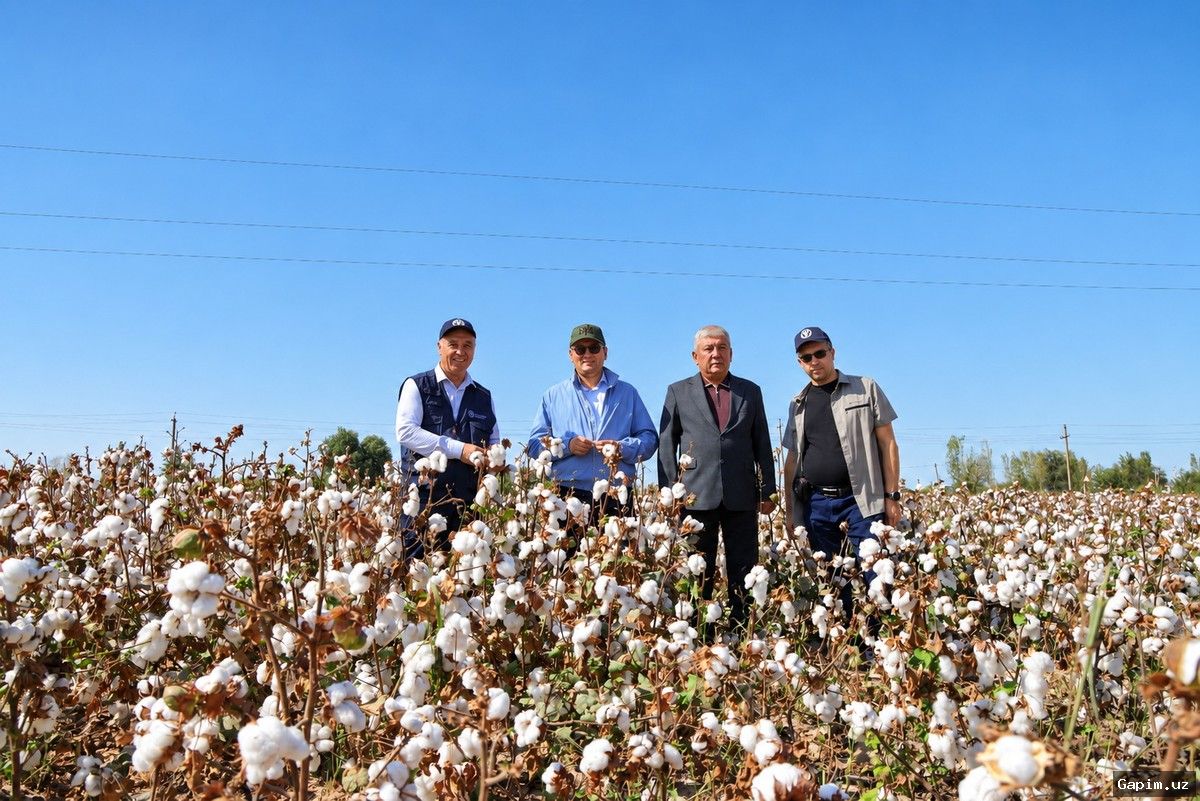
Key Takeaways: The 30-hectare demonstration site compares conventional cotton cultivation with a reduced-tillage system. In the trial variant, spring chiseling was dropped, harrowing and rolling passes were cut from three to one, irrigation from five to three, and ammophos use from 300 kg to 100 kg per hectare. The field day was held on 23 September with farmers, specialists and international organization representatives.
The program is testing soil-protecting, resource-saving technologies not only for cotton but also for wheat and other crops, adapting solutions to the soil and climate conditions of different regions. The issue matters for Uzbekistan because limited water resources, land degradation and volatile fertilizer prices are putting pressure on farmers to improve economic planning and environmental responsibility. Regenerative farming is increasingly discussed internationally, but its effectiveness must be proven through scientific trials under local conditions rather than assumed from experience elsewhere.
Sherzod Umarov, deputy head of FAO’s office in Uzbekistan, said regenerative agriculture is aimed not only at raising yields but also at improving the condition of soil, agriculture’s core resource. “Regenerative agriculture is not a ready-made solution that can be applied uniformly across all regions. Each technology must be tested according to local soil, water and climate conditions. This experiment in Khorezm is intended to turn scientific approaches into practical and economically acceptable solutions for farmers,” he said. According to Umarov, a special direct-seeding drill imported from Brazil places seeds at a set depth and spacing and allows phosphorus fertilizer to be applied locally near the plant’s future root zone.
In the conventional method, fertilizer is spread across the whole field; in the trial variant, it is placed where the plant can better absorb it, which is expected to reduce use and increase efficiency. The conventional plot used 300 kilograms of ammophos per hectare, while the reduced-tillage variant used 100 kilograms, saving 200 kilograms per hectare. Rates of ammonium nitrate, ammonium sulfate and potassium chloride were left unchanged, while the number of suspension treatments was cut from five to three. Umarov said interest in regenerative practices aimed at soil health, efficient resource use and lower environmental impact is growing in European countries, the United States, Australia and elsewhere, although long-term economic results of such approaches still require independent verification.
In the next phase, project specialists are expected to summarize field observations and proposals from the field day and continue assessing how reduced tillage affects yields, water use, fertilizer efficiency and soil condition. Based on the findings, they plan to prepare practical recommendations for local farmers and consider expanding demonstration plots and testing resource-saving methods in other regions. For officials and international partners, the key test will be whether independent monitoring confirms the technology’s economic viability and agronomic effectiveness.
Source: www.gazeta.uz