Steam is an unseen but indispensable assistant to industry: it is used to pasteurize milk, cook sausage, thaw raw materials, process textiles and produce medicines, so the quality of steam largely determines how an entire workshop performs. For Uzbekistan, the topic is especially relevant because the republic’s food industry is actively increasing production volumes: according to the National Committee on Statistics, large enterprises produced food products worth 75.2 trillion soums in January–June 2026, 12% more than in the same period of 2025, while overall industrial output across sectors rose 6.8% in 2025. As output grows, factories need more stable, clean and affordable steam, and this is precisely what the TITAN induction steam generators from Russian manufacturer ROSTZIP provide.
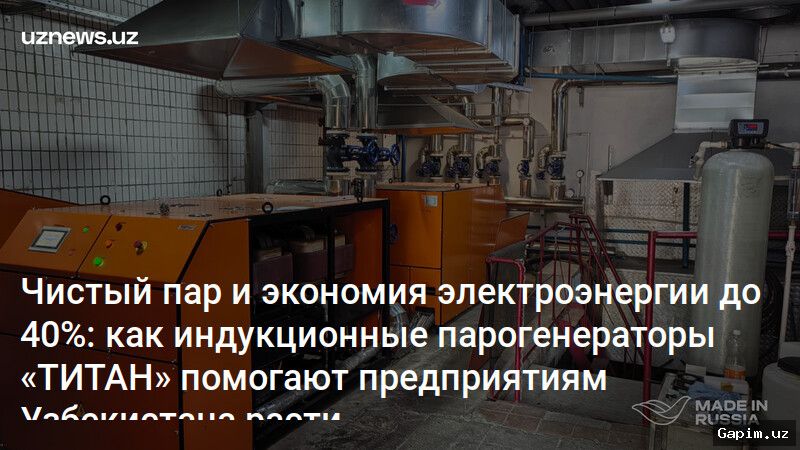
Key Takeaways: ROSTZIP is a full-cycle plant that has completed more than 450 projects; the TITAN range produces 200 to 1,800 kg of steam per hour and reaches operating mode in 30 seconds; electricity consumption is 0.4 kW per 1 kg of steam, savings reach up to 40%, and investment payback is 6–12 months.
Industry context and technical advantages
In broader context, the chemical purity and reliability of steam are critical for food, pharmaceutical and textile operations. ROSTZIP, based in Rostov-on-Don, is a full-cycle enterprise: it designs equipment, manufactures it and carries out commissioning at the customer’s site; its technologies are patented, and its branches operate in St. Petersburg, Yekaterinburg and Novosibirsk. Over the years the plant has completed more than 450 projects in Russia, Kazakhstan, Uzbekistan, Belarus, Tajikistan, South Ossetia and Armenia, with TITAN generators operating in food, pharmaceutical, textile, petrochemical and mining industries. For example, TITAN-500 helps the Belebeyevsky paper mill save energy and increase volumes, two TITAN-1200 units operate at sausage production in Moscow, and three TITAN units are installed at pharmaceutical production in Zelenograd. In addition to steam generators, the plant manufactures steam and hot-water boilers and water treatment systems, so it can offer enterprises a comprehensive solution.
The secret of TITAN is induction heating: water is heated by electromagnetic induction, so the design has no heating elements, electrodes or pressure vessels, and the steam itself is chemically pure and suitable even for direct contact with products, such as thawing meat, fish or berries. The TITAN range covers capacity from 200 to 1,800 kg of steam per hour, reaches operating mode in 30 seconds, regulates steam pressure from 1 to 12 bar and temperature from 105 to 188 °C. Control is fully automated: the generator operates without constant operator presence, and the control system can be integrated into the plant’s automated control system.
For business, economy matters too: the generator consumes only 0.4 kW of electricity per 1 kg of steam, and electricity savings during use reach 40%. TITAN can be installed right next to the equipment that needs steam; such a local steam generation point eliminates costs for transporting steam through long pipelines and increases the energy efficiency of the entire system. As a result, investment in the equipment pays back in 6–12 months.
Outlook for Uzbek enterprises
In August 2026, the Rostov plant of induction steam generators received the national brand certificate ‘Made in Russia’; the programme is implemented by the Russian Export Center, and its mark serves as a reliable guide for foreign buyers choosing a supplier from Russia. For Uzbek enterprises, the certificate provides additional confidence in equipment that will work in the workshop every day. TITAN steam generators already operate in Uzbekistan, with deliveries made directly from Russia by the plant itself, and ROSTZIP specialists carry out commissioning at the customer’s site, so installation quickly reaches full capacity. Going forward, automated control and energy-saving performance are expected to help enterprises reduce costs and maintain product quality.
Source: uznews.uz