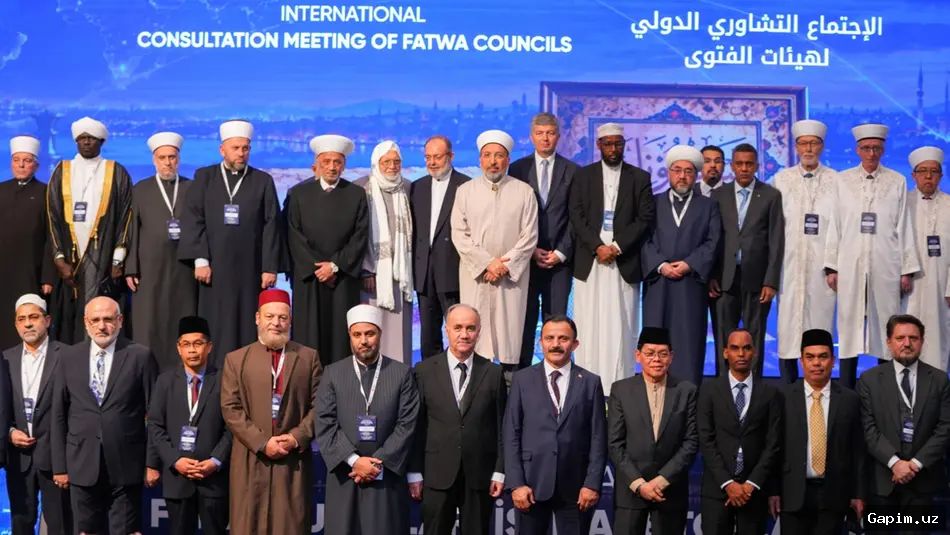
A delegation led by Sheikh Nuriddin Kholiqnazar, chairman of the Muslim Board of Uzbekistan and mufti, took part in the international advisory meeting of fatwa councils in Istanbul, organized at the initiative of the Turkish regime’s Directorate of Religious Affairs; representatives of fatwa centers from Qatar, Afghanistan, Bulgaria, Somalia, Mauritania, Yemen, Palestine, Syria, Iraq, the United Arab Emirates, Kazakhstan, Russia, Indonesia, the United States, Uzbekistan and other countries attended; the mufti proposed establishing a unified digital platform for approved fatwas and developing criteria for publishing fatwas online and for the use of artificial intelligence.
Key Takeaways: representatives of fatwa centers from more than 15 countries gathered in Istanbul; a unified digital platform for approved fatwas and criteria for online publication and AI use were proposed; the Uzbekistan Fatwa Center, recipient of Egypt’s House of Fatwa “Imam al-Qarafi” award, was highlighted; participants discussed baseless online fatwas, conflicting interpretations, family issues, migration, violence and terrorism.
The meeting focused on the role of fatwa councils in strengthening the unity of the Muslim ummah; discussions covered collective drafting of fatwas, preventing the spread of contradictory interpretations on a single religious issue, faith questions of interest to young people, problems of the family institution, fatwa councils’ stance toward violence and terrorism, and migration-related matters; the need to prevent baseless fatwas on the internet was emphasized; the mufti delivered a speech in Arabic, presenting Uzbekistan’s state policy and reforms in the religious sphere, key directions and future plans.
Fatwa councils and modern challenges
Speakers included Safi Arpagus, head of the Turkish regime’s Directorate of Religious Affairs; Somalia’s minister of awqaf; Mauritania’s minister of education and Islamic affairs; Yemen’s minister of awqaf and guidance; Palestine’s high sharia judge; Syria’s grand mufti; and other religious scholars; according to the mufti, in an era of mounting threats the unity of the Muslim ummah is an important factor for peace and development; fatwa councils should find solutions to modern problems on the basis of sharia criteria and the principle of moderation, while preventing the spread of baseless fatwas through the internet; the meeting also presented information on the activities and experience of Uzbekistan’s Fatwa Center, which received the “Imam al-Qarafi” award from Egypt’s House of Fatwa.
Next steps and expected developments
If adopted, the proposed unified digital platform and criteria for online fatwa publication and AI use could support coordination among fatwa councils, increase trust in approved religious rulings and reduce the spread of erroneous interpretations; recognition of Uzbekistan’s experience and its fatwa center strengthens the role of national religious institutions in international cooperation; further consultations among participating states and fatwa centers on technical cooperation, criteria harmonization and preparation of a platform project are expected.
Source: kun.uz