In Pakistan, May began with streets in major cities dotted with banners and posters honouring the military leadership that, in the official telling, guided the country’s defences and led the nation to victory in the four-day aerial war with India last year.
At the Nur Khan Auditorium in Rawalpindi, the Pakistan Air Force held a ceremony marking its “achievements” in downing Indian jets. In Lahore, a government-organised concert celebrated the conflict’s success in what Pakistan calls the “Day of the Battle of Truth”.
Across the border, India is also celebrating what its government and military insist was a victory. Prime Minister Narendra Modi changed his profile picture on X to the official logo of Operation Sindoor and urged every Indian to do the same. “A year ago, our armed forces displayed unparalleled courage, precision and resolve,” Modi wrote.
At a news conference in New Delhi, Air Marshal Awadhesh Kumar Bharti said India had “destroyed 13 Pakistani aircraft” and “struck 11 airfields”. In Rawalpindi, Lieutenant General Ahmed Sharif Chaudhry told reporters that Pakistan had defeated an enemy “five times larger than itself” and had shown only “10 percent” of its military potential.
Analysts say that behind the public claims of victory, key questions remain about whether the South Asian neighbours have drawn lessons from the conflict. On April 22, 2025, gunmen attacked tourists in Indian-administered Kashmir’s Pahalgam, killing 26 civilians. India blamed Pakistan, an accusation Islamabad rejected.
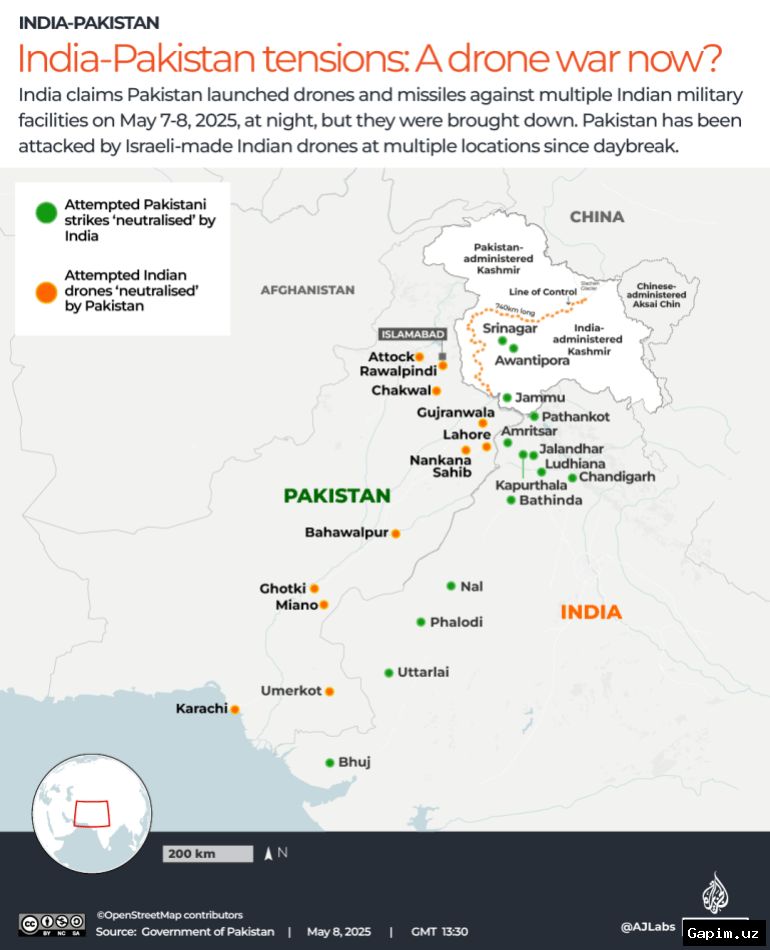
India launched Operation Sindoor on May 7, 2025, striking multiple sites deep inside Pakistan and Pakistan-administered Kashmir. Pakistan retaliated with Operation Bunyan al-Marsoos. The four-day conflict did not end in a neat victory for either nation.
Pakistan can point to the aerial exchange on the night of May 6-7, when its Chinese-built J-10C jets shot down Indian aircraft, including Rafales. India used BrahMos long-range missiles to strike multiple Pakistani airbases, including Nur Khan in Rawalpindi and Bholari in Sindh. India also used Israeli-made drones that penetrated as far as Karachi and Lahore, and suspended the Indus Waters Treaty on April 23, 2025.
Analysts note that the conflict demonstrated the diminishing value of geography as strategic depth. Pakistan’s air defence posture remains its most exposed vulnerability: its Chinese-supplied HQ-9B surface-to-air missile system failed to intercept the BrahMos missiles. Islamabad is now pursuing the longer-range HQ-19 ballistic missile defence system.
The economic disparity is stark: India’s defence budget for 2025-26 stands at approximately $78.7bn, nearly nine times Pakistan’s official allocation. Pakistan raised its budget by 20 percent, allocating 2.55 trillion Pakistani rupees ($9bn) for military expenditure, even as it cut overall federal expenditure by 7 percent to comply with its IMF loan programme.
Diplomatically, Pakistan accepted US President Donald Trump’s assertion that he had brought about the ceasefire, nominated him for a Nobel Peace Prize, and has emerged as a significant diplomatic force, acting as the main mediator of a ceasefire in the US war on Iran. Pakistani Army Chief Field Marshal Asim Munir was hosted by Trump for a White House lunch and played a central role in the April 8 ceasefire between Washington and Tehran.
The most serious vulnerability exposed by the conflict is the water issue. India suspended the Indus Waters Treaty and has yet to reinstate it. The treaty underpins one of the world’s largest contiguous irrigation systems, supplying more than 80 percent of Pakistan’s agricultural water. Pakistan’s effective water storage capacity stands at roughly 30 days, compared with India’s 120-220 days.
Analysts warn that the inherent conditions that led to last year’s war remain unresolved. “Due to mutual distrust and the absence of reliable communication channels, the likelihood of conflict reigniting is significant,” said Praveen Donthi of the International Crisis Group.
Source: www.aljazeera.com