The United Arab Emirates is accelerating the construction of a new pipeline that will double export capacity through the eastern port city of Fujairah, as Gulf nations seek alternative routes to bypass the Strait of Hormuz amid ongoing regional tensions.
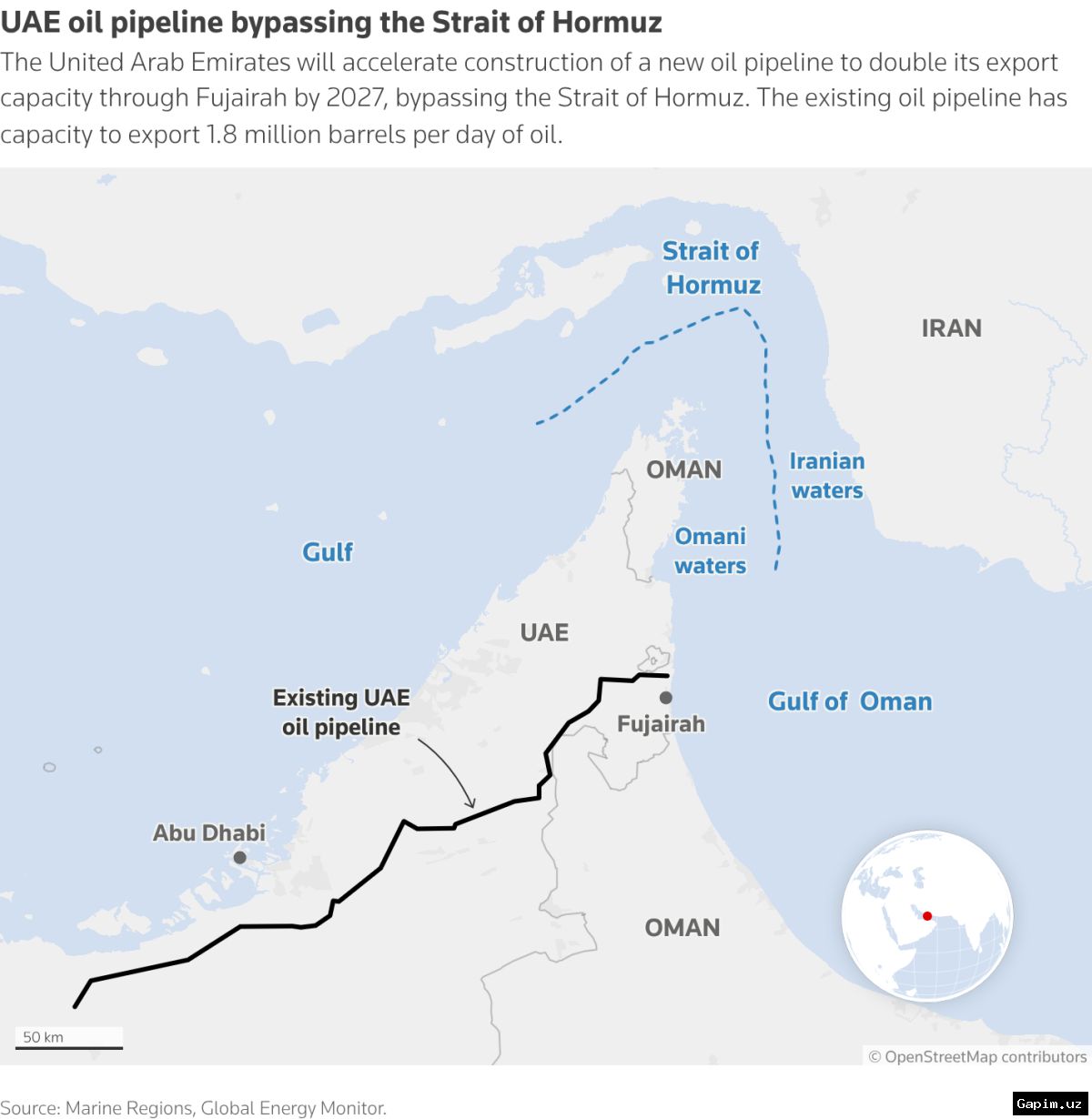
Crown Prince Sheikh Khaled bin Mohamed bin Zayed announced the acceleration of the West-East Pipeline project to “meet global demands” during an executive meeting held by the Abu Dhabi National Oil Company (ADNOC) on Friday. The pipeline is expected to be operational by 2027, according to the government’s Abu Dhabi Media Office.
Sheikh Zayed stated that ADNOC is “well positioned as a responsible and reliable global energy producer, with the operational flexibility to responsibly increase production to meet market needs when export constraints allow.” The remarks come amid the US and Israeli war on Iran, which has severely disrupted global energy supply chains.
The blockade of the Strait of Hormuz – through which roughly a fifth of the world’s oil previously passed – coupled with Iran’s new maritime protocol and attacks on energy infrastructure, has forced Gulf nations to seek alternative trade routes to maintain oil and gas exports.
Currently, the UAE operates the Abu Dhabi Crude Oil Pipeline (ADCOP), a 380-km (235-mile) pipeline running from the Habshan oil field to the port of Fujairah. Commissioned in 2012, it has a capacity of about 1.5 million barrels per day (bpd) and is a key energy route in the Middle East.
Saudi Arabia also has its East-West pipeline, designed to export oil from the kingdom’s eastern region via the west coast. The 1,200-km (745-mile) pipeline runs from the Abqaiq processing center to the Yanbu port on the Red Sea. Saudi Aramco CEO Amin Nasser has called it a “critical lifeline” for the kingdom.
Oman borders the Gulf of Oman with an extensive coastline outside the Strait of Hormuz, while Kuwait, Iraq, Qatar, and Bahrain remain almost entirely dependent on the waterway for their trade shipments. Last month, the UAE announced its departure from the Organization of the Petroleum Exporting Countries (OPEC) to focus on “national interests,” citing its long-term strategic and economic vision.
Source: www.aljazeera.com