New York City, USA – Each May, soon-to-be college graduates gather in Washington Square Park for photos marking the end of their academic journey. But for Julie Patel, who just completed a master's degree in public health, the joy is dampened by a tight job market. 'Expectations when I entered this program and coming out are two very different things,' she told Al Jazeera.
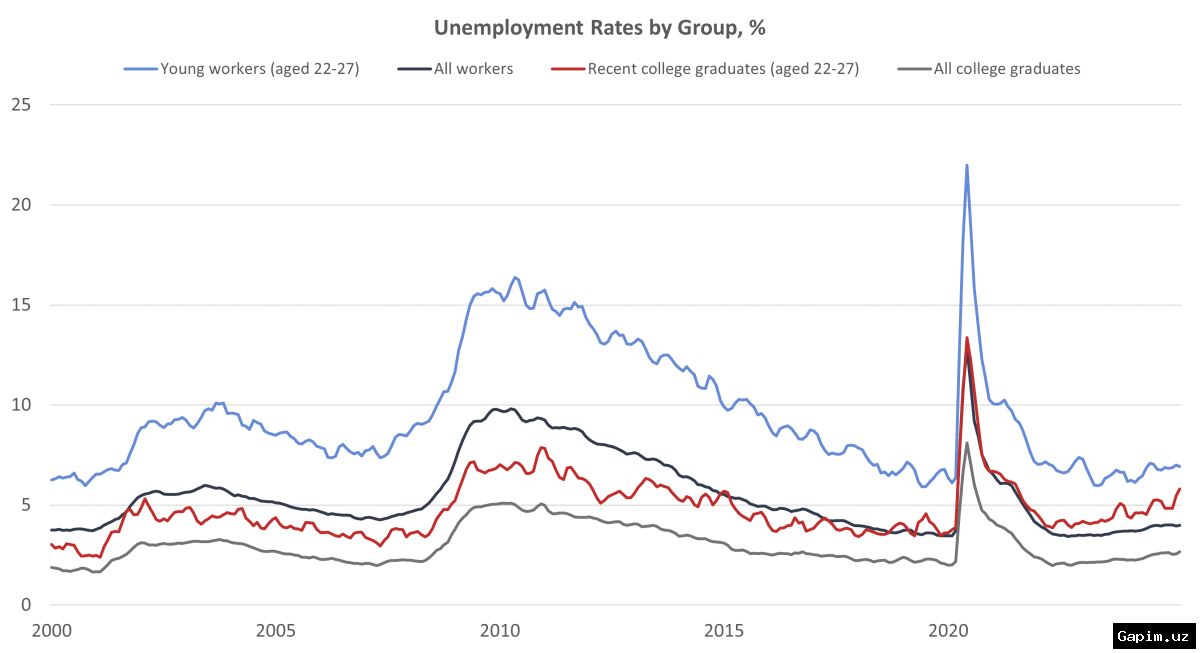
Patel and millions of peers face a precarious job market amid economic uncertainty driven by tariffs, AI proliferation, global conflicts, and government funding cuts. The latest Job Openings and Labor Turnover Survey showed 6.9 million open jobs in March, with hiring up marginally to 5.6 million and separations at 5.4 million. Elise Gould and Joe Fast of the Economic Policy Institute noted that 'the depressed hires rate suggests it is more difficult for new entrants to get a foothold in the labor market.'
The US economy added 115,000 jobs in April, mostly in healthcare, transportation, and retail. However, financial activities lost 11,000 jobs, and information services shed 13,000. So far in 2026, average monthly job growth is 68,000, compared with 49,000 in 2025, 186,000 in 2024, and 251,000 in 2023. 'We have this kind of no-hire, no-fire environment,' said Aleksandar Tomic of Boston College. 'Experienced workers will probably elbow out recent college graduates.'
Government funding cuts, including $4 billion in NIH research grants slashed by the Department of Government Efficiency led by Elon Musk, have led to hiring freezes at universities like Duke and Harvard. This impacts research jobs sought by Patel and her classmate Molly Howard. 'We're competing not only with our cohort but also last year's cohort and people with more experience whose jobs were defunded,' Howard said.
Artificial intelligence is disrupting entry-level jobs. Stanford's Digital Economy Lab found a 16% decline in employment for early-career workers in AI-exposed sectors. Goldman Sachs reported AI cuts an average of 16,000 jobs per month. Anthropic CEO Dario Amodei said AI could eliminate half of entry-level white-collar jobs within five years. A Gallup survey showed Gen Z excitement about AI dropped 14% year-over-year.
New graduates also face AI-driven hiring processes. KPMG forecasts that by 2028, one in four job applicants will not be real. Vivica D'Souza, a Northeastern University graduate, applied to 60 roles with a 10-12% response rate. Courtney Gladney, a LeMoyne-Owen College graduate, experienced interviews conducted by AI personas. 'I need the person in the interview to read me versus an algorithm,' he said.
The unemployment rate among recent college graduates is 5.6%, higher than the general population's 4.2%. Underemployment stands at 41%, unchanged over 20 years. LeMoyne-Owen College president Christopher Davis emphasized soft skills: 'The degree may get you an interview, but it's the soft skills that not only land you the job but allow you to keep it.'
Source: www.aljazeera.com