Carrying their boards past tents and bombed-out buildings, a group of Gaza surfers headed for the sea, seeking solace in the waves despite the risk of Israeli attacks. On the beach in Gaza City, the trio laid out their boards on the sand while they warmed up their limbs and readied their gear.
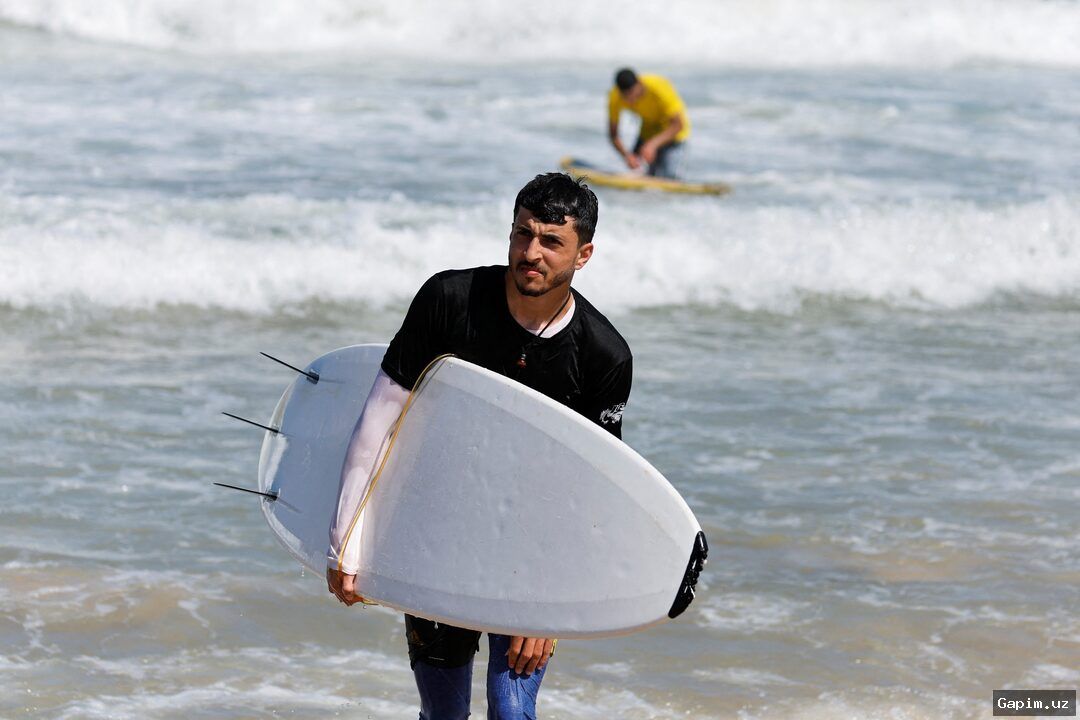
“This sport is indescribable. When you catch a wave, ride it, glide along it, that feeling can’t be put into words,” said 23-year-old Tahseen Abu Assi, who learned how to surf from his father. He told AFP that he used to watch his father practicing and learned from him.
A ceasefire between Israel and Hamas came into effect in October, but the tiny coastal territory remains gripped by bloodshed, with each side accusing the other of near-daily violations. Even out at sea, the violence persists. In mid-May, Nasser Hospital in Khan Younis reported receiving two fishermen who had been injured by Israeli naval gunfire near the beach in the southern Gaza Strip. A few days later, a Gaza security source reported that three fishermen were wounded by Israeli fire near the coast off Gaza City.
“The situation is still unstable,” Abu Assi explained. “At any moment, shells or explosives could land near you.”
Out at sea, the surfers glide effortlessly across the crests of waves, momentarily free from the hardships of daily life in Gaza. But the severe shortages caused by the war and ongoing Israeli import restrictions have posed obstacles for the sport.
“One of the biggest challenges and difficulties we face as surfers in the Gaza Strip is the lack of tools and equipment specific to this sport,” Abdel Rahim Ustadh, 19, told AFP. “Surf wax, which we put on the boards, is not available at all in Gaza, so we resort to candle wax so we can keep this sport going,” he added.
Ustadh said preserving old equipment was also essential, clutching a battered red-and-blue surfboard that was nearly two decades old. “As surfers, we treat these boards like great treasures to us, because losing any board or having it confiscated threatens our ability to continue in this sport,” he said.
The genocidal war on Gaza flattened swaths of the territory, displaced most of the population at least once, and left hundreds of thousands of people living in tents and temporary shelters.
Khalil Abu Jiyab, 18, said that before the war, there had been a team of 17 surfers in Gaza. Now, he said, there were just the three of them, pointing to shortages and a lack of boards. “I’ve been surfing for 13 years now, and my hopes have almost been shattered,” Abu Jiyab told AFP, but said he still dreamed of one day being able to surf in competitions outside the Gaza Strip.
“There’s nothing in Gaza you can really look forward to except the sea,” he added. “The only outlet in Gaza is the sea; without it, life would have vanished long ago.”
Source: www.aljazeera.com