From the moment you arrive in Bunia, the capital of Ituri province in the Democratic Republic of the Congo, it's clear these are not normal times. Leaving the airport takes longer due to mandatory health checks. Billboards carrying Ebola prevention messages line the road to the hotel. On the radio, public health programs urge people to protect themselves.
By the time the World Health Organization declared the outbreak a Public Health Emergency of International Concern in May, the virus had already been spreading undetected for weeks through the mining towns of Mongbwalu, Rwampara, and Bunia before reaching neighboring provinces. The outbreak is caused by the Bundibugyo strain of Ebola, generally considered less deadly than some other strains, but with no approved vaccine, early detection is critical.
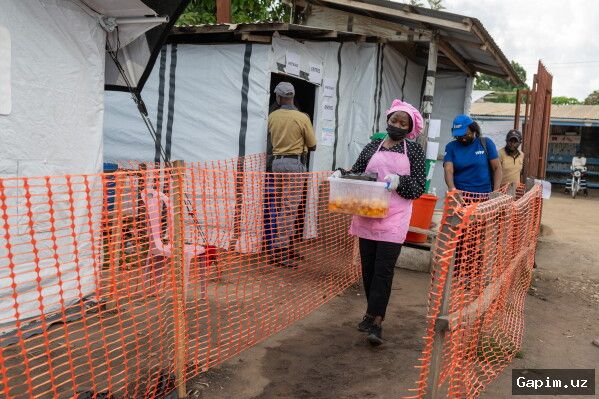
Our first stop was the Ebola treatment center at Bunia General Hospital. Built to accommodate 50 patients, it was already full. Construction was underway to add another 86 beds. John Katabuka, who heads the hospital, says this strain presents differently: "Clinically, it moves through your body silently without you noticing it. We used to think Ebola meant bleeding and fever. But with this type, the symptoms only appear at the final stage, when you're almost dying."
We also met Tresor, who asked us to conceal his identity. His wife recently tested positive for Ebola, and he has only been able to see her from a distance. He is waiting for his own test results: "People need to be educated. They have to understand this virus is real. We must accept that. I don't want to take this disease lightly."
The Congolese government is leading the response alongside partners including Africa CDC and the United Nations. Dieudonné Mwamba, head of the National Institute of Public Health, says they are dealing with far more than a health emergency. More than 1.3 million people are living in displacement camps after years of conflict.
We then made our way to Rwampara, about an hour's drive from Bunia. The local health center also serves as an Ebola treatment facility. Dr. Gabriel Tshiwisa says at least one person dies from Ebola every day. But fear, mistrust, and rumors are making the outbreak even harder to contain. Some people still do not believe the disease exists. Others claim it was brought by outsiders seeking to profit from the crisis.
In mid-May, isolation tents in Rwampara were set on fire by angry relatives and friends of a young man believed to have died from Ebola after they were prevented from taking his body for burial. The body of someone who dies from Ebola is highly infectious, and safe burials are essential to prevent further transmission.
We accompanied a team of Red Cross volunteers to bury a woman on the outskirts of Bunia. Marie was 60 years old and died at home. The burial process is both intimidating and emotional. Volunteers are dressed in full protective equipment. One walks ahead, spraying disinfectant with every step. In ordinary times, funeral preparations would last for days. Today, only a handful of mourners were present.
Red Cross volunteer Richard Lifungula says he has buried more than two dozen people since the outbreak began. The work is dangerous. Many attacks on responders happen during burials. Alex Lock, who leads communications for the International Federation of Red Cross and Red Crescent Societies, says volunteer safety remains a major concern.
Those leading the response say much more still needs to be done. Yap Boum, head of preparedness and response for Africa CDC, notes significant improvements in laboratory capacity, surveillance, and treatment centers, but the number of cases and deaths continues to rise. However, there is hope: More people are surviving Ebola.
We attended a thanksgiving prayer service, where we met Gladys Munguromo. She lost three relatives in just one week. She became infected after attending a funeral in Mongbwalu, where the outbreak began, and sought treatment at the Rwampara treatment center. Today, she is an Ebola campaigner, taking the message to every village, every home, and every person. Their message is simple: If you stay home sick, you will die.
Source: www.aljazeera.com