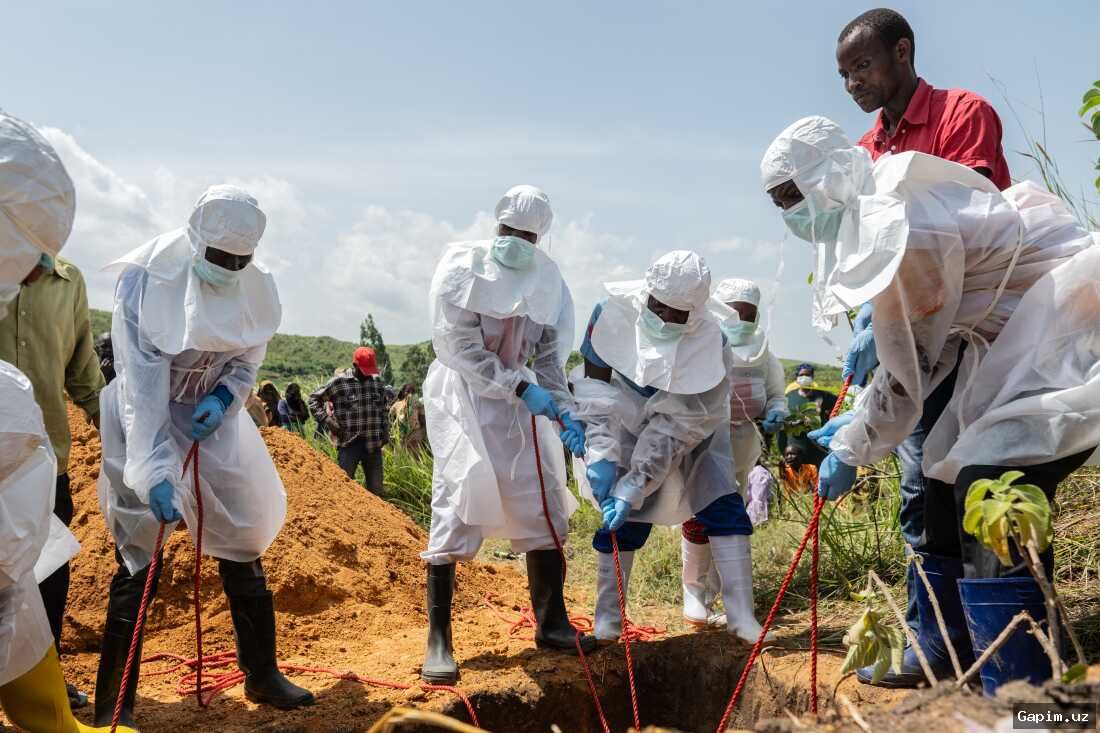
In eastern Democratic Republic of Congo (DRC), the ongoing armed conflict is exacerbating the spread of the Ebola virus. At the Kigonze camp on the outskirts of Bunia, 20,000 internally displaced people (IDPs) who fled rebel violence now face a new threat: Ebola.
D'zirava Lety sums up the hopelessness: "There is no water. In the entire camp, there is only one tap. Another challenge is the lack of toilets. Children relieve themselves anywhere. With the disease that has arrived, we are being told to wash our hands, but there are no hygiene kits. And when we go into town to sell our products, people push us away, saying that we are carrying diseases."
Camp chairman Étienne Ndrutsi told DW that since Ebola was detected in June, up to six deaths per day have been recorded. The World Health Organization (WHO) declared a public health emergency in May. By mid-July, DRC had recorded 1,963 confirmed infections and 719 deaths, while neighboring Uganda reported 20 cases and 2 deaths. The WHO estimates that only one in two cases — and possibly as few as one in four — is being detected.
Ongoing armed conflict is hampering containment efforts. "Health workers, treatment centers, laboratories, ambulances, medical supply routes must always be protected from military interference and political competition," said Juste Codjo, a security researcher at Kean University in the US. "International humanitarian law protects access to health care during armed conflicts, but the reality is that these legal obligations must be reinforced through practical negotiations with every actor controlling territory in the conflict zone."
The overlap between conflict and disease is a global pattern. In war-torn Yemen, aid groups have battled recurring cholera outbreaks for a decade. In Sudan, a cholera epidemic has claimed over 3,500 lives since 2024, linked to the civil war restricting humanitarian access.
History offers examples of successful approaches. During El Salvador's civil war (1980–92), warring sides agreed on three one-day ceasefires for vaccination campaigns. In DRC, however, calls for ceasefires to curb Ebola have gone unanswered.
During the 2018 Ebola outbreak in eastern Congo, US researchers documented a clear correlation between violence and virus spread. In Beni, each infected person transmitted the virus to an average of 0.8 others after vaccination began. After a rebel attack, the reproduction number rose to 1.9.
The current outbreak's epicenter is Ituri province, where various militias and the Congolese army fight for control. Further south, the rebel coalition AFC/M23 has seized large territories since early 2025. The group established an emergency zone and increased testing in areas under its control. Rwanda is reportedly providing support, though Kigali officially denies backing the rebels. The WHO is pragmatically cooperating with them.
The Health Ministry in Kinshasa has reportedly been largely sidelined but continues to receive data and test results. While transmission rises in Ituri, AFC/M23 claimed in late June that the local outbreak in its controlled territories had been contained.
Security expert Juste Codjo warns that both rebels and the government could seek to monopolize aid. "They should not allow concerns about political optics to obstruct life-saving assistance. Public health cannot be held hostage to a legitimacy contest. Assistance must be carefully depoliticized, monitored and delivered through neutral intermediaries."
Source: www.dw.com