Southeast Asian governments are searching for a joint strategy against cyberscammers, a criminal industry that has grown too big, too connected and too embedded in ASEAN economies to be solved just by policing. For years, governments across Southeast Asia largely approached the region's online fraudsters as a matter for the police, anti-trafficking agencies and border authorities.
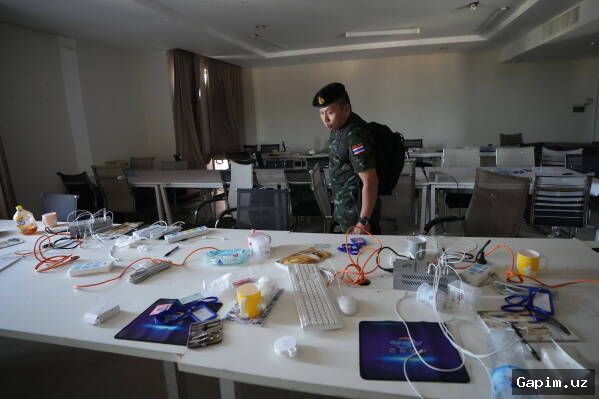
But these bodies have apparently failed to stem the rise of international cyberscam cartels. The illicit industry is increasingly using international banking systems, cryptocurrencies, telecommunications networks, shell companies and trafficking routes, with some of its centers operating under the protection of armed or politically connected groups.
Now, ASEAN governments seem increasingly willing to tackle the threat as a united bloc. Signs of this shift were visible at the controversial meeting in Bangkok on August 6 between Thai Prime Minister Anutin Charnvirakul and President Min Aung Hlaing, the head of Myanmar's military government. The two governments agreed to clamp down on scam centres along their shared frontier, exchange information and jointly disrupt criminal financial flows.
Thailand also offered support for Myanmar's participation in the Egmont Group, an international network of financial-intelligence bodies. Myanmar's military-backed parliament had already voted in favour of applying the death penalty on those caught operating online scam centres.
While visiting Cambodia late last month, Indonesian Deputy Foreign Minister Arif Havas Oegroseno also proposed a joint task force to combat online scam syndicates. And last week, Indonesian President Prabowo Subianto and Thai Prime Minister Charnvirakul held talks in Jakarta where they agreed their two countries must lead the way and strengthen ASEAN's resilience against scam groups.
A UN estimate published last month put the annual losses from cyber scammers — many of whom are located in Southeast Asia — at between $88.3 and $114.1 (between €76 billion and €98 billion) globally in 2025. Artificial intelligence, cryptocurrencies, encrypted communications and deepfake technology have made their operations cheaper and harder to detect.
"Cyber scams in Southeast Asia have evolved beyond a conventional cybercrime issue and should be viewed as an economic security threat," Hai Luong, a lecturer at Australia's Griffith University's School of Criminology and Criminal Justice, told DW.
Governments in Southeast Asia have already had to respond to pressure from the US, the EU and China as their online cartels drew international attention. In October 2025, the US designated Cambodia's Prince Group, one of the country's largest conglomerates, as a transnational criminal organisation and imposed sanctions on 146 people and companies connected to it. US authorities also charged Chinese-born Prince Group chairman Chen Zhi with wire fraud and money laundering conspiracies. Cambodia eventually revoked Chen's citizenship and extradited him to China.
Prince Group's business empire extended across real estate, finance and other sectors in Cambodia. US authorities allege that criminal revenues were mixed with legitimate commercial activities through an international network of companies. Washington has also sanctioned other Southeast Asian individuals and companies accused of investing in scam compounds and laundering money.
The EU followed last month, imposing sanctions on Prince Group and Jin Bei Group in Cambodia and the Democratic Karen Benevolent Army in Myanmar for alleged involvement in cyberscams. In 2024, the United States Institute of Peace estimated that Cambodia's cyber-scam industry generated more than $12.5 billion annually, equivalent to roughly a third of the country's formal economy.
Cambodian Prime Minister Hun Manet has acknowledged that the illicit scam economy is damaging legitimate businesses and has vowed a systematic crackdown on online scam networks, including greater scrutiny of the financial sector. The National Bank of Cambodia has shuttered at least six financial institutions since the start of the year. Three commercial banks whose licences were revoked in August had all been sanctioned by the US over alleged links to scam networks.
On August 4, the Singaporean government introduced legislation that would expand information-sharing between police and service providers, allow authorities to disable accounts suspected of facilitating scams and strengthen restrictions on financial, telecommunications and online services supplied to suspected offenders.
As ASEAN nations try to clamp down on cybercriminals, the region's greatest weakness is its fragmentation, Sophal Ear, an associate professor at Arizona State University's Thunderbird School of Global Management, told DW. "Criminal organizations operate seamlessly across borders while governments continue responding through separate agencies with different mandates and limited coordination," he said. Ear added that the financial infrastructure used to move and conceal criminal proceeds can often prove more resilient than the law-enforcement architecture designed to dismantle it.
Now, the regional governments seem to be catching on — at least judging by ASEAN's new Plan of Action in Combating Transnational Crime for 2026–2035. The plan calls for improved intelligence-sharing between national law-enforcement agencies and financial-intelligence units, joint investigations, better cross-border coordination and stronger capacity among anti-money-laundering regulators. ASEAN has also recently established a joint working group to combat money laundering.
But ASEAN's consensus-based system still heavily relies on national governments implementing those commitments and sharing sensitive financial and law-enforcement information. "In practice, governments should prioritise disrupting the financial infrastructure, labour supply chains, technological services, and transnational business models that sustain scam operations rather than focusing solely on individual offenders," said Luong from Griffith University's School of Criminology and Criminal Justice.
Asha Hemrajani, senior fellow at Nanyang Technological University's S. Rajaratnam School of International Studies, agreed that the region needs to take a "holistic, not siloed" approach to attack the entire cyberscam business model. "The shared objective should be to identify and dismantle crime syndicate leadership, financial networks and enabling infrastructure, not just arrest money mules or raid individual scam compounds in Cambodia and Myanmar," Hemrajani said. This includes official scrutiny of high-risk corporate structures and checking sources of funding, as well as a much tougher stance against money laundering, she added.
Hemrajani also recommended ASEAN sanctioning business groups linked to the cyberscam networks, similar to how Washington cut off sanctioned Southeast Asian companies from the entire US economy. Criminal groups have largely survived previous crackdowns by simply moving workers, technology and money to new places and new compounds. In order to fight the online cartels, ASEAN should do more than just closing scam centres. The real challenge is making the regional economy itself harder for them to exploit.
Source: www.dw.com