The migrant crisis surrounding the Spanish enclave of Ceuta took an unexpected turn during a solidarity campaign supported by Real Madrid players. Kylian Mbappe, Vinicius Junior, and Ibrahima Konate wore white shirts bearing the slogan "Todos somos caballas" ("We are all mackerels") before their La Liga match against Elche on Tuesday, but rolled them up to cover part of the text.
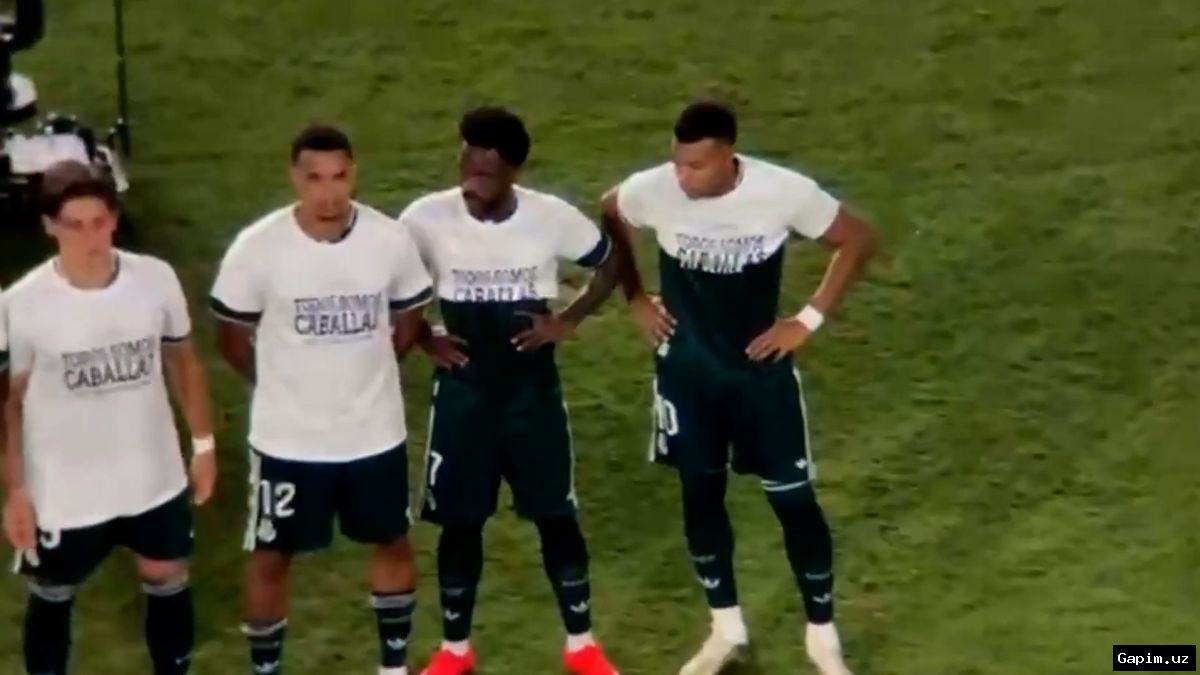
Both clubs had asked the players to wear the shirts. Real Madrid said on its website that before the match, players from both teams took to the pitch at Manuel Martinez Valero Stadium wearing shirts that read "todos somos caballas" as a show of solidarity with Ceuta. However, social media videos showed Vinicius and Mbappe rolling up their shirts after putting them on as they waited to step out.
The gesture sparked heated debate on social media. Some saw it as the players' disregard for the issue, while others praised the trio for wearing the shirt in the first place. Some also lauded them for obscuring the message. The slogan refers to the people of Ceuta, as "caballas" is a nickname for locals.
According to FIFA's rulebook, clothing worn by players "must not have any political, religious or personal slogans, statements or images." Rule 4.5, pertaining to players' clothing and equipment, also bans players from revealing undergarments that show political, religious, personal slogans, statements or images, or advertising other than the manufacturer's logo. However, footballers displaying such messages have avoided fines or bans in recent years. When Al Jazeera asked FIFA if the La Liga players or clubs would face any sanctions for displaying the message, the global governing body pointed out that any disciplinary action falls under the remit of La Liga, the Spanish football federation (RFEF) and European football body UEFA. La Liga, RFEF and UEFA did not respond to Al Jazeera's request for a comment.
Several La Liga clubs have shown solidarity with the people of Ceuta over the past week, with Real Betis's Moroccan winger Abde Ezzalzouli wearing the shirt prior to a match against Villarreal on Monday. Ezzalzouli, who was born in Morocco and raised in Spain, was criticised by Moroccan fans amid ongoing rifts between Spain and Morocco over the Ceuta crisis and various other points of tension. The 24-year-old said he did not aim to disrespect Morocco. "I want to make one thing clear – at no point was the shirt referring to the people of Ceuta used with a political objective or out of contempt for my people, the Moroccan people," said Abde in an Instagram post. The former Barcelona winger described it as a social gesture in support of the population of the city "regardless of their nationality." "This is not an apology to anyone," he added. "I will continue to hold my head high and represent my roots with pride and sacrifice." Real Betis are due to play a friendly against Ceuta on October 1 in Seville to raise funds and show support for the city.
More than 70,000 people entered Ceuta from nearby Morocco on July 30 and 31 in a surge that left scores dead and raised concerns in some European nations over migration. Most returned in the hours following their arrival, but several thousand remain in Ceuta. Last week, Morocco's Ministry of Foreign Affairs said there was no evidence of Rabat's involvement in the crossing. Ceuta is an autonomous Spanish city on the northern coast of Africa bordering Morocco. Ceuta and Melilla are the only remaining European-held territories on the African mainland. Ceuta's location makes it one of the main entry points for people trying to reach Europe. The enclave is protected by high border fences, surveillance systems, and a permanent deployment of Spain's Civil Guard and National Police. Morocco does not recognise Madrid's sovereignty over both enclaves, regarding them as occupied territory.
Source: www.aljazeera.com