Iranian President Masoud Pezeshkian departed Tehran on Tuesday morning for New York to attend the 80th session of the United Nations General Assembly. He is accompanied by Foreign Minister Abbas Araghchi and other officials. Pezeshkian is scheduled to address the 193-member assembly on Wednesday.
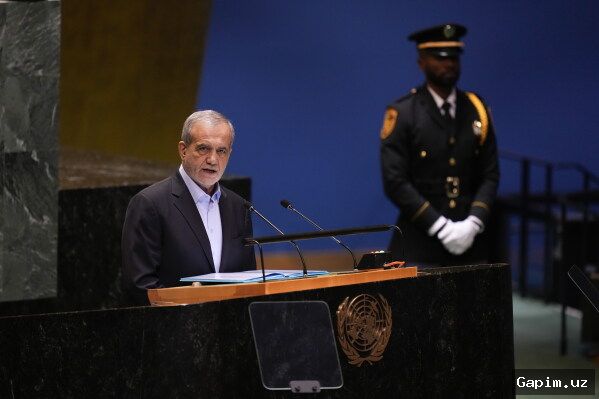
"The issues we will raise at the UN concern expressing the plight of the Iranian nation, the crimes that have been committed against it, and the distrust that has been created," Pezeshkian told reporters before his flight. He also warned that renewed use of force by Iran's foes would be counterproductive. "We will make the enemies disappointed," he said.
Araghchi, who arrived in New York earlier, said his main goals during sideline meetings will be to "defend the rights and interests of the Iranian people." He slammed the UN's lackluster performance in establishing peace and security: "Trust in this organization has been lost, and this is unfortunately because of its ineffectiveness in establishing international peace and security." He said the Minab school bombing by the US and the assassination of Supreme Leader Ayatollah Ali Khamenei on the opening day of the war would be among the issues Iran will raise at the UN.
The Iranian delegation will be in New York for five days and is scheduled to return to Tehran on Saturday. The US has denied visas to Pezeshkian's accompanying media team and imposed tight restrictions on their movement in the country. Iranian delegates will also be barred from buying luxury goods during their stay. Still, Pezeshkian plans to hold discussions with Iranian expatriates, intellectuals, think tanks, and media in the coming days.
This year's assembly comes as the US tightens economic pressure through sanctions and a naval blockade on southern Iranian ports in the Strait of Hormuz. US President Donald Trump said earlier this week that he was considering a new major military assault on Iran, but wanted to hear from Arab leaders of the region first. He is set to meet with representatives from Saudi Arabia, the United Arab Emirates, Qatar, Oman, Kuwait, and Bahrain in the coming days to discuss the war on Iran.
Iran demands a return to the memorandum of understanding signed with the US in June to reopen the Strait of Hormuz. Mohsen Rezaei, secretary of Iran's Supreme National Security Council, told Al Jazeera that Tehran has communicated seven conditions to the US to reopen the strategic waterway. These include an end to war on all fronts, the release of Iran's frozen assets, the lifting of the blockade on Iranian ports, an end to military attacks on Iranian territory, and noninterference in the country's internal affairs. But he also said Iran remains prepared for escalated fighting and could potentially abandon the nuclear Non-Proliferation Treaty (NPT) depending on future US actions.
There are conflicting views in Iran about how to end the war with the US, with some parties open to a peaceful resolution and more hardline factions seeking to continue or intensify the war until all Tehran's demands are met. Mohammad Bagher Ghalibaf, Iran's parliament speaker and chief negotiator, criticized both approaches, saying one keeps the country in a state of perpetual crisis and the other offers national resources and dignity to the enemy on a platter.
Trump said on Sunday he would "probably be open" to meeting Pezeshkian in New York, although the Iranian government's IRNA news service dismissed this as a "new propaganda game." The government's daily Iran newspaper said New York could offer a "platform for the Iranian narrative." The hardline Kayhan newspaper wanted Pezeshkian to turn the UN into "a courtroom for American crimes."
Public expectations in Iran are skeptical that the UN meetings will produce any political breakthrough to end the war, which has deepened the average Iranian citizen's economic woes. "I think Pezeshkian going [to New York] is better than him not going, but there is no hope that anything comes of it," one Iranian told Al Jazeera in western Tehran, on condition of anonymity due to security concerns. Another resident of the capital also said she harbored no hopes of a diplomatic resolution: "I think if [the politicians] want to, then yes, there can be an opening, but they don't want to."
Source: www.aljazeera.com