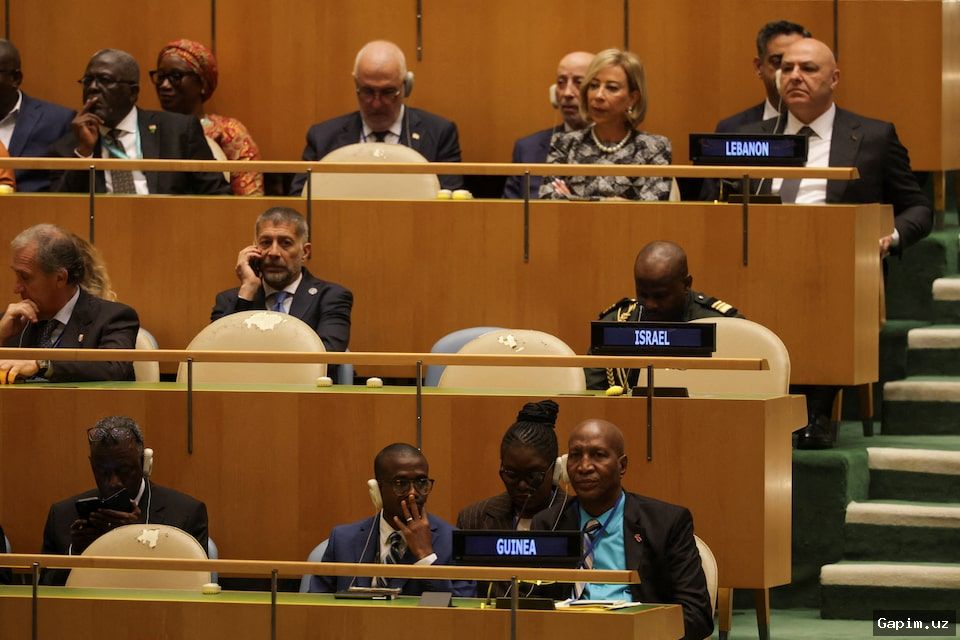
As the 81st session of the UN General Assembly (UNGA81) unfolds in New York, more than 50 heads of state and government are conspicuously absent. The list includes Chinese President Xi Jinping, Russian President Vladimir Putin, German Chancellor Friedrich Merz, Italian Prime Minister Giorgia Meloni, and Palestinian Authority President Mahmoud Abbas. Their reasons range from illness and domestic political crises to elections and even vacations.
German Chancellor Friedrich Merz, who aspires to be a "foreign-policy chancellor," is bogged down by domestic troubles. Three German states held parliamentary elections in September, and his Christian Democrats (CDU) suffered heavy losses: voted out in Saxony-Anhalt and Berlin, and failing to enter the state parliament in Mecklenburg-Vorpommern for the first time since the founding of the Federal Republic. Merz is in crisis-management mode, seemingly unwilling to risk a party revolt in his absence. Foreign Minister Johann Wadephul will speak in his place.
Italian Prime Minister Giorgia Meloni is in a stronger position than Merz but said she must deal with domestic matters this week. After the NATO summit in early July, she noted she had just returned from several international summits and had pending issues in Italy. She pointed out that Merz also skipped in 2025. Italy will be represented by Foreign Minister Antonio Tajani.
Africa's largest economies are also not sending their presidents to New York. South African President Cyril Ramaphosa will not attend for health reasons: doctors advised rest and recovery. His office did not disclose details. South Africa will be represented by Foreign Minister Ronald Lamola. Egyptian President Abdel Fattah al-Sisi is also absent, with Prime Minister Mostafa Madbouly taking his place. Al-Sisi's office gave no reason. He regularly attended from 2014, but after the pandemic-era online and hybrid formats, he has not attended in person since. Nigerian President Bola Tinubu is on vacation: he spent time in the UK in late August before traveling to France. Vice President Kashim Shettima will represent Nigeria.
Indian Prime Minister Narendra Modi rarely appears at UNGAs. He last took the podium in 2021, and since then, the world's largest democracy has consistently sent Foreign Minister Subrahmanyam Jaishankar. According to Indian media, Modi was listed as a speaker this year before his plans changed. The reason remains unknown.
Chinese President Xi Jinping's absence is under international scrutiny. He will be in the US but not in New York; instead, he heads straight to Washington, some 300 kilometers away, for a full state visit, including a White House gala dinner and a military parade. Although Beijing has not framed it this way, the timing suggests Xi is prioritizing great power diplomacy over the UN's multilateral forum. Xi and Trump have serious bones of contention, including trade, artificial intelligence, and Taiwan's security.
Russian President Vladimir Putin has also rarely stood at the iconic podium, so it is little surprise that Foreign Minister Sergei Lavrov will speak for Russia again. Putin ordered this by decree and offered no reason for his absence. Palestinian Authority President Mahmoud Abbas has far more UNGA experience than any of those listed above. In office since 2005, he was a regular until Donald Trump's second term. But last year, the Trump administration denied him a diplomatic visa and has done so again this year. The US State Department recently said it was extending sanctions "that deny visas to members of the Palestine Liberation Organization and the Palestinian Authority." Abbas plans to address the assembly by video message, as he did last year.
Source: www.dw.com