At a high-profile summit in Washington between US President Donald Trump and Chinese leader Xi Jinping, there was much talk of trade and artificial intelligence. However, one of the most contentious issues — Taiwan — was discussed only behind closed doors.
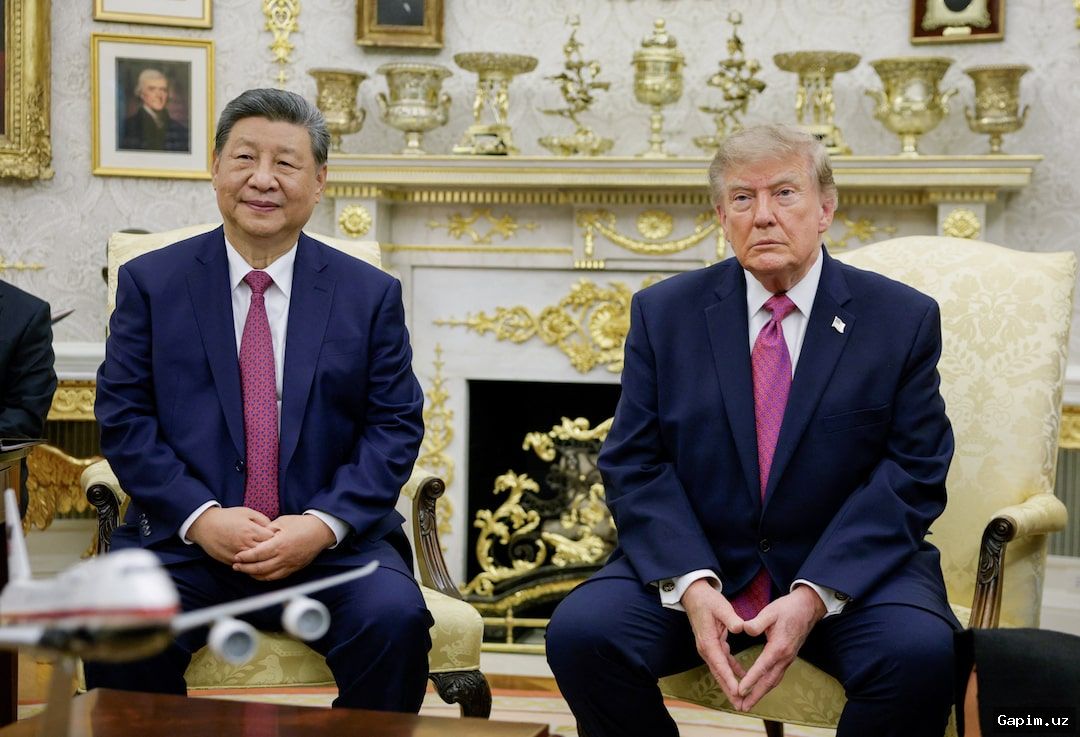
US President Donald Trump personally picked up his Chinese counterpart Xi Jinping from the airport and in his welcoming remarks praised the strong friendship between their two nations, as well as recalling how China and the US fought together as allies during World War II. "Look at the greatness that we had together fighting in World War II," he said. "Brave American pilots volunteered to come to China and fight for the very survival of the legendary country," he said at the White House, referring to the Flying Tigers air corps that fought alongside China against the Japanese between 1941 and 1942.
However, these pilots did not actually volunteer to fight with the People's Republic of China, whose leader was visiting Washington and which was not founded until 1949. The Americans were risking their lives for the former Republic of China, whose government relocated to Taiwan after the communist victory in the Chinese Civil War in 1949.
"China draws on thousands of years of history and tradition from Sun Tzu to Sun Yat-sen," Trump said at a state dinner for Xi on Thursday evening. Sun Yat-sen was the founder of the Republic of China in 1912 and the Kuomintang, or KMT, which remains a major political party in Taiwan today.
Ever since the end of World War II, Taiwan has been a point of contention between Beijing and Washington. For decades, the US government ignored the communist regime in the People's Republic of China. But since 1972, Washington has acknowledged the "one China principle," according to which there is only one China, whose legal government is in Beijing and Taiwan belongs to it. Diplomatic relations between the US and China were only established in 1979.
The Taiwan Relations Act came into effect in 1979 too. The US law legalized arms exports to Taiwan. It also allowed the US government to take military action to prevent changes to the status quo in the Taiwan Strait.
A potential war between China and Taiwan would not only jeopardize stability in the Asia-Pacific region but also plunge the global economy into a prolonged recession, as supply chains would be severely disrupted.
During their high-profile meeting, Xi did not openly urge the US to respect the "one China" principle as he has done in the past, and Trump did not mention Taiwan in public either. In May, he put on hold a $14-billion arms deal that the US had concluded with the Taiwanese government late last year. The arms sales deal remains under review.
"Given the US' production capacity and its own military needs, it will take some time before approved arms can be delivered," said Ja Ian Chong, a political scientist and professor at the National University of Singapore. "It remains unclear what else the US can currently offer Taiwan."
Ahead of crucial midterm elections in November, Trump urgently needs some positive headlines. He and his Republican party rely on farmers for support so they need China to import US agricultural goods. In 2023, before their current trade war, China imported $43 billion worth of soy, beef, wood and other goods from the US. However, Beijing has drastically reduced its imports since.
China used the meeting "to make clear to Trump its opposition to any US military support for Taiwan," said William Yang, an analyst with the International Crisis Group. "Xi wants to convey this message personally and behind closed doors, thereby influencing Trump's decision on arms sales to Taiwan."
China's Xinhua news agency said that Xi had addressed the issue behind closed doors. It reported that Xi had expressed hope that the US would take strong action against Taiwanese independence and said that China's position on safeguarding its national unity and territorial integrity was clear. He reportedly added that "building a constructive China-US relationship of strategic stability is neither an expedient measure nor something that can be achieved overnight."
It will not have pleased Taiwanese politicians that the US president openly considered treating Taiwan as a bargaining chip in its negotiations with China, German sinologist Eberhard Sandschneider of the consultancy Berlin Global Advisers suggested during a political chatshow on German public television. "People living on the island of Taiwan do not take this lightly. This is an existential issue for Taiwan."
He added that he did not think China would take military action against Taiwan. That would be a move just as illogical as the Russian invasion of Ukraine and the US attack on Iran, he argued.
Nobody is playing poker in China, Sandschneider continued. "Clear strategic interests are pursued there. National sovereignty and winning back Taiwan are key concerns. At the same time, it is well known that any military attack on Taiwan would not only lead to a military disaster but also to an economic collapse. The resulting setback for the global economy would call into question the Communist Party's legitimacy," the expert said.
De Zheng contributed to this article, which has been translated from German.
Source: www.dw.com