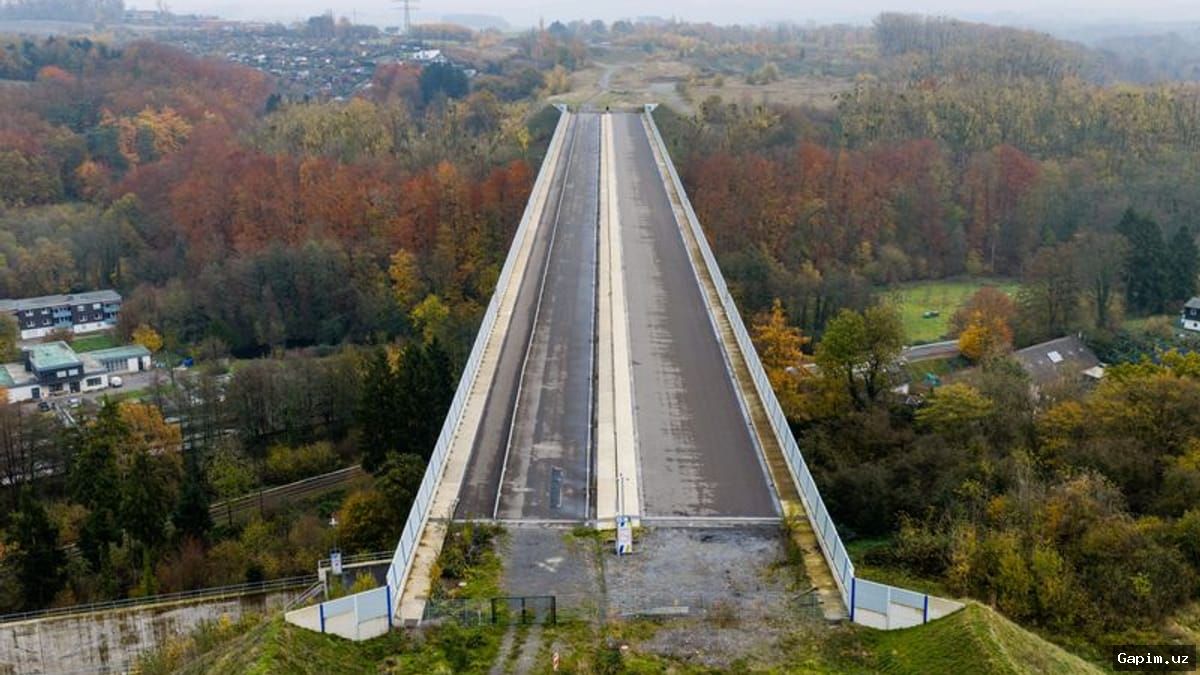
Germany’s delayed A44 highway project and a busy political Monday dominate the November 16, 2026 agenda, as Chancellor Friedrich Merz meets his Bavarian CSU allies in Munich, Mecklenburg-Western Pomerania’s state parliament votes on Manuela Schwesig’s new term, and the long-finished “bridge to nowhere” between Ratingen and Heiligenhaus finally moves toward connection with the road network. The bridge over the Angerbachtal, east of Düsseldorf, has stood complete since 2022 but remains isolated; a formal groundbreaking for the final 4.4 kilometers is set for Monday, with state premier Hendrik Wüst and regional transport officials attending.
Key Takeaways: The A44 link-up is meant to improve connections between Düsseldorf, the Bergisches Land and the Ruhr, relieve the busy A3 and improve access to Düsseldorf International Airport; the last stretch is expected to cost about €200 million ($220 million). In Munich, Merz’s talks with CSU leadership follow his nomination of Ilse Aigner as the next German president and a tense 2027 budget compromise. In Schwerin, Schwesig is expected to secure another term as premier with a planned SPD-Greens-Left coalition, despite the AfD becoming the largest single party in the state.
The bridge is a symbol of Germany’s planning and permit bottlenecks. The idea dates back more than half a century, some 55 years, but lawsuits, environmental protection studies and onerous approval procedures repeatedly delayed construction. The bridge itself was completed in 2022, yet it still does not connect to roads at either end. The project’s cost estimate, cited by Düsseldorf’s IHK industry and trade association, is roughly equivalent to the annual cost of diverting traffic around the unfinished link. Construction is expected to take several years, and no formal completion date has been set.
In Munich, Merz’s meeting with the CSU, the Bavarian sister party to his CDU, is officially described as a general exchange planned for some time, with no concrete details released in advance. The trip comes a week after he nominated Ilse Aigner as the next German president, likely making her the first woman and first CSU politician to hold the role. It also follows the 2027 federal budget clearing a marathon session of the parliamentary budget committee in Berlin, an outcome that exposed friction inside the CDU-SPD grand coalition; the compromises are said to frustrate the CSU and state premier Markus Söder. The German regime has presented the budget process as routine, but the strains within the coalition are visible.
In Mecklenburg-Western Pomerania, the state parliament is expected to vote for the 52-year-old Social Democrat Manuela Schwesig, who has led the state since 2017. Her planned coalition of the SPD, Greens and Left Party follows September state elections in which the right-wing populist AfD emerged as the largest single party in the sparsely populated state. Schwesig’s SPD claimed 29 seats, while the Greens and Left each won 5, giving the three parties a fairly clear majority over the AfD’s 32 seats. The state-level result has been portrayed by her supporters as relatively successful compared with the SPD’s national struggles.
The political arithmetic in Schwerin is being watched as a contrast to Berlin, where coalition-building remains more complicated, and to Saxony-Anhalt, where the AfD was far ahead but short of an outright majority. For the A44 project, the next steps are the ground-breaking and the start of construction on the final 4.4 kilometers, though the absence of a formal end date leaves residents and businesses awaiting a clearer timetable. For Merz, the Munich meeting and the budget fallout will test the cohesion of his conservative alliance; for Schwesig, the vote is expected to confirm her leadership but also underscore the AfD’s growing role in eastern Germany.
Source: www.dw.com