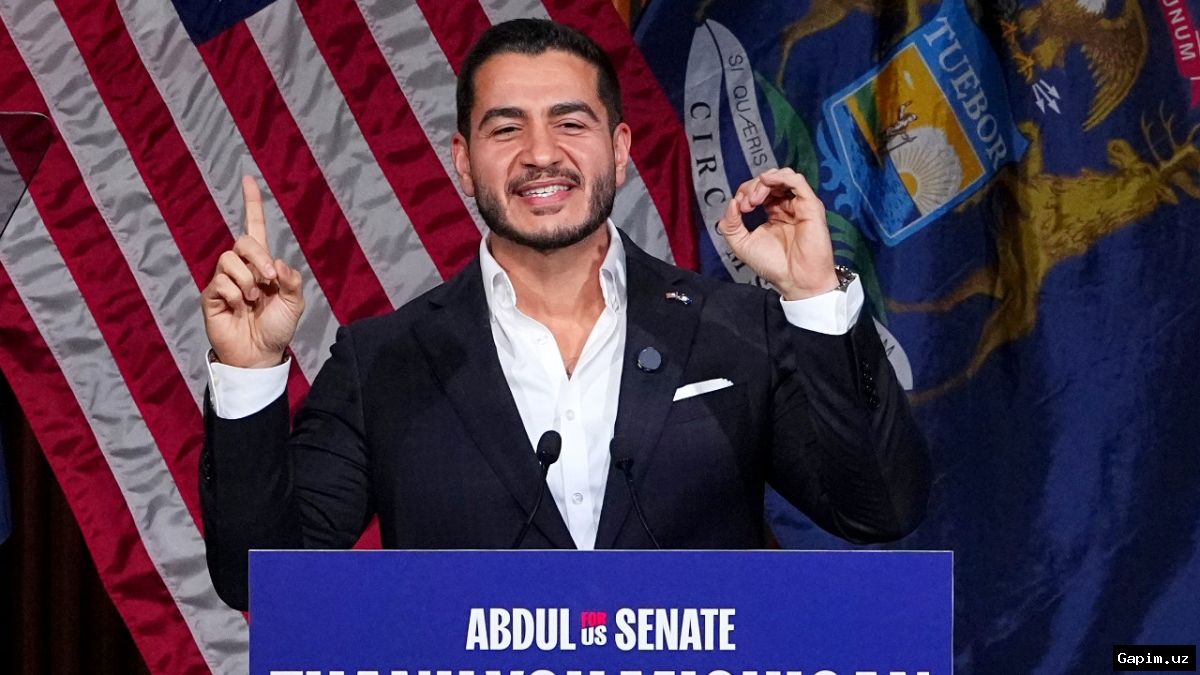
Michigan Democrat Abdulrahman Mohamed El-Sayed has won a closely watched US Senate race, defeating Republican Mike Rogers, whom the article describes as a Trump-backed candidate supported by roughly $169 million in outside spending. The result, reported after a congressional blue wave, makes El-Sayed the first Muslim elected to the US Senate, according to the account. His victory speech in Michigan—where he invoked “Inshallah” and “Alhamdulillah”—has become a focus of debate over identity, Islamophobia and the direction of the US regime’s politics.
Key Takeaways: El-Sayed defeated Mike Rogers in a race shaped by about $169 million in outside spending, including Republican super PACs linked to Donald Trump and Elon Musk, according to the article. His win is described as the first by a Muslim to the US Senate, and his victory remarks sharply criticised war, apartheid and genocide. The campaign also exposed allegedly coordinated anti-Muslim messaging by Republican officials, including 1,111 social-media posts, eight Sharia-related bills and a 62-member caucus by April 2026, according to the Center for the Study of Organized Hate.
The victory came amid a broader Democratic sweep that, as described, stripped Republicans of their congressional majorities and brought Democrats back into the spotlight. In a montage on “The Daily Show”, TV anchors reduced the night to a gleeful succession of words such as “rout” and “shellacking”; on Zeteo’s election-night coverage with Mehdi Hasan, Prem Thakker coined the term “Tsunamanani”. According to the article, Republicans—supposedly lacking meaningful policy accomplishments and facing an unpopular Donald Trump—resorted to a relentlessly bigoted smear campaign. The result matters not only for Michigan but for how the US regime and its political class handle religious pluralism.
In his speech, El-Sayed claimed: “Michiganders, we want our taxes spent here, for schools here and healthcare here, and infrastructure here. We don’t want our money sent to do apartheid or genocide or war.” He also purportedly said: “My name is Abdulrahman Mohamed El-Sayed, and I am so proud and honored to stand here as your senator elect.” The article recounts that right-wing activists had used his full name to label him a “terrorist” and “jihadist”; by pronouncing it, he sought to reclaim it. He joked that Donald Trump, who had allegedly mocked his name, could “just go on and call me Senator” after JD Vance administers the oath in January. The crowd reportedly shouted “Alhamdulillah” and chanted “Abdul!”.
The article links the attacks to a wider pattern of organised anti-Muslim prejudice. According to the Center for the Study of Organized Hate, 89 Republican elected officials took part in a coordinated anti-Muslim campaign over 13 months: 46 of them published 1,111 social-media posts, eight Sharia-related bills were introduced, and the Sharia-Free America Caucus grew to 62 members by April 2026. Political advisers told El-Sayed that someone with his name and story, a Muslim, was “unelectable”; the article alleges that the prejudice was deliberately cultivated with millions of dollars from billionaire funders, most of them described as Zionists.
El-Sayed’s win is expected to intensify debate over Islamophobia and electoral politics in the United States. In January he is due to be sworn in, then begin work in the Senate and likely remain under intense scrutiny. Supporters see the result as a rebuke to Islamophobia; critics in the US regime and Republican circles are likely to continue challenging him. The outcome may also test how Democrats engage Muslim and Arab-American voters and whether the US regime’s political rhetoric changes.
Source: www.aljazeera.com