A new report released Tuesday by the Pew Research Center projects that Islam will overtake Christianity and become the world’s largest religion by 2035; the analysis covered 201 countries and territories, accounting for 99.98 percent of the population, and examined the geographic distribution and future changes of seven religious groups and affiliations from 2020 through 2070.
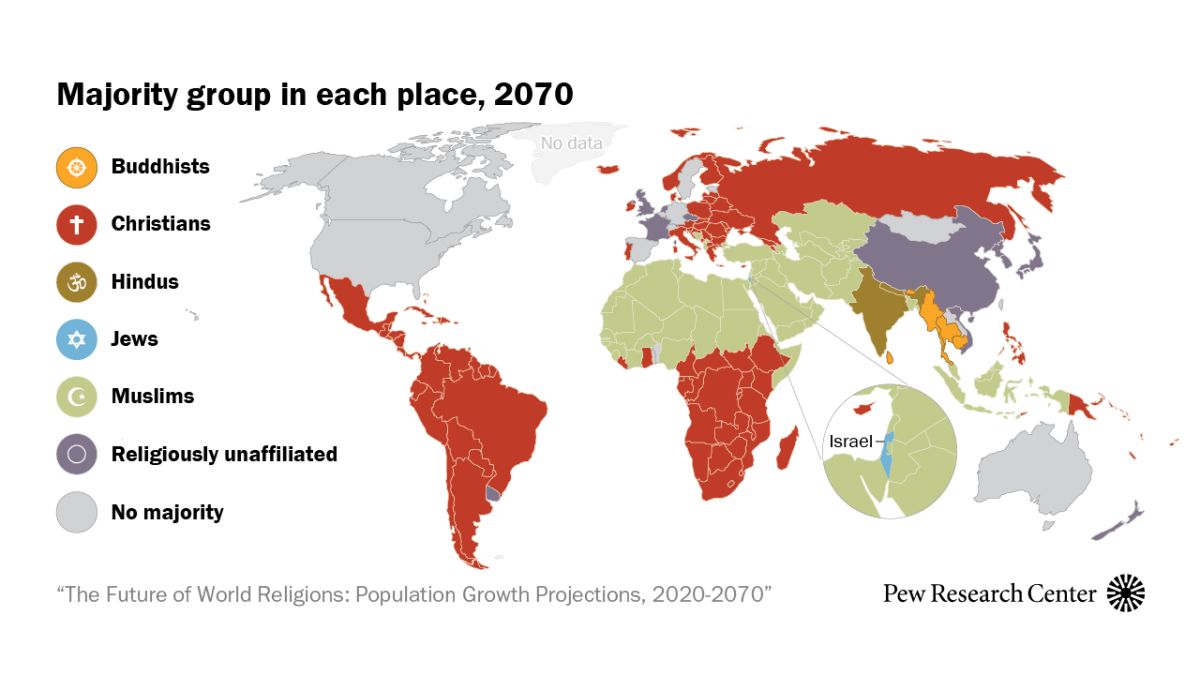
Key Takeaways: Islam is expected to grow faster than Christianity, adding as many as 1.6 billion people through natural population change compared with 792 million for Christians; Muslim women have a fertility rate of 3.1 children, versus 2.5 for Christian women; an additional 1.2 billion Muslims are projected to live in the 53 countries where Muslims were already the majority in 2020, representing 74 percent of projected global Muslim growth; and Pakistan is expected to reach 461 million Muslims by 2070, surpassing Indonesia.
In broader context, both religious groups are expected to keep pace with overall world population growth, but most Muslim growth is projected to occur in places where Muslims already make up a majority; Muslims were the majority religious group in 53 countries in 2020, and by 2070 they are expected to account for 95 percent of the population in the Middle East-North Africa region while surpassing the religiously unaffiliated in the Asia-Pacific region.
As the report put it, the Muslim population will “simply [grow] at a faster pace”; Muslims are expected to have much smaller losses from people leaving or converting religions than Christians, with a net difference projected to cost Islam 8 million people during the period, compared with a projected net loss of 105 million for Christians; those departing Christianity may not identify with any religion afterward, including atheists and agnostics.
The research also stresses that Islam’s projected growth is not the result of conversion from Christianity, noting that the number of Muslims projected to convert to Christianity is only “slightly greater” than the number of Christians expected to become Muslims; Christian growth will likewise be concentrated across 120 countries where Christians were already the majority, with their populations there forecast to rise by 630 million, representing 92 percent of global Christian growth.
Looking ahead, the Pew-Templeton Global Religious Futures Project will continue analyzing religious change and its impact on the world; the organization stressed that the findings are “not intended to predict all the ways the world could change,” since socioeconomic circumstances, natural disasters, and wars could affect religious affiliation, so future updates are expected to reassess demographic and religious trends.
Source: www.aljazeera.com