A German research team led by archaeologist Vinzenz Brinkmann has pieced together all surviving fragments of the Parthenon’s east pediment, reconstructing the 2,500-year-old depiction of the birth of Athena from the head of Zeus. The work, displayed at Frankfurt’s Liebieghaus sculpture collection, addresses one of the great mysteries of ancient Greek art, because the pediment was destroyed during the Christianization of Greece and only about 20 percent of the original marble sculpture is known to have survived. The Parthenon, ancient Greece’s most important temple and a defining monument of the High Classical period, towers over Athens from the Acropolis and has shaped Western ideas of humanity and art since antiquity.
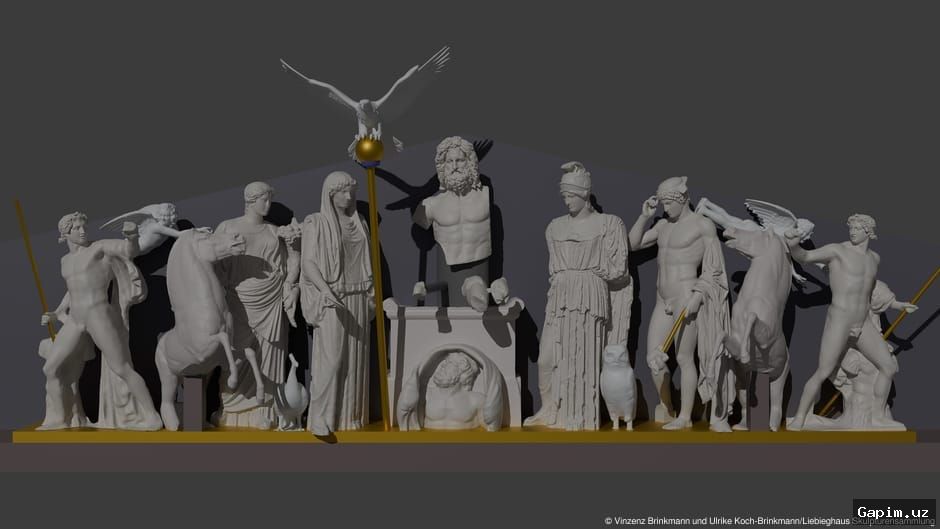
Key Takeaways: The reconstruction brings together fragments scattered across European museums, with most in Athens and many in the British Museum, after more than 40 years of work by Brinkmann and Ulrike Koch-Brinkmann. A 2014 visit to the Hermitage Museum in St. Petersburg revealed a Roman sarcophagus relief that helped match the surviving pieces, while 3D scanning and printing allowed researchers to fit roughly 60 original fragments digitally. Brinkmann says the team is “very, very confident” it has solved the mystery, and the results are now presented in the exhibition “Athena, the Stage is Yours: The Parthenon Puzzle.”
Context & Background: The Parthenon was dedicated to Athena, patron goddess of Athens, and its sculptures were created under the direction of Phidias, whose work is regarded as an unparalleled example of proportion and grace. The east pediment, roughly 29 meters long, once featured 39 figures, with a colossal 3.8-meter Zeus at its center, depicting Athena’s birth surrounded by Olympian gods. Its influence extended from ancient Rome through Neoclassicism to the modern era, making the loss of the pediment especially significant for understanding classical sculpture. Earlier scholars in the 19th century developed well-founded theories, and a 1910 study documented many fragments held by the British Museum, but progress remained slow until modern methods and comparative evidence changed the investigation.
Quotes & Specific Details: Brinkmann, who heads the Antiquities and Asia department at the Liebieghaus, told DW: “We’re very, very confident that we’ve solved the mystery.” He emphasized that other scholars had already noticed connections between Roman copies and the Parthenon in the 19th century, but his team “really seized on the idea and never let go.” Nine Roman sarcophagi are known, almost all in Rome, and each depicts a different section of the east pediment; a 2014 encounter with one at the Hermitage made Brinkmann realize, “That’s when it suddenly clicked: They’re all there!” Researchers traveled light with an iPhone to scan about 60 original fragments, and Roman copies matched those fragments closely, helping establish the figures’ original positions.
Outlook / Conclusion: The exhibition now offers visitors a clearer picture of how the ancient masterpiece once looked, while the underlying reconstruction method may guide future studies of other fragmented classical monuments. Because the Parthenon remains a powerful symbol of Athens and a reference point for Western art, any refinement of its original appearance is likely to shape both academic debate and public understanding. Further research may still clarify smaller details, but the team’s reconstruction represents a major step toward resolving a puzzle that has occupied scholars for more than a century.
Source: www.dw.com