On August 7, 2027, asteroid 1999 AN10, estimated to be about 800 meters in diameter, will pass Earth at a distance of roughly 390,000 kilometers. According to calculations by NASA and the European Space Agency (ESA), the minimum distance between Earth's center and the asteroid will be about 389,855 kilometers, with the closest approach expected on August 7 at approximately 07:10 GMT (12:10 Tashkent time). The object's size is estimated at 600 to 1,400 meters, with NASA specialists estimating its diameter at about 800 meters; that distance is roughly equal to the distance between Earth and the Moon. Scientists' calculations indicate that there is no risk of the cosmic body colliding with our planet.
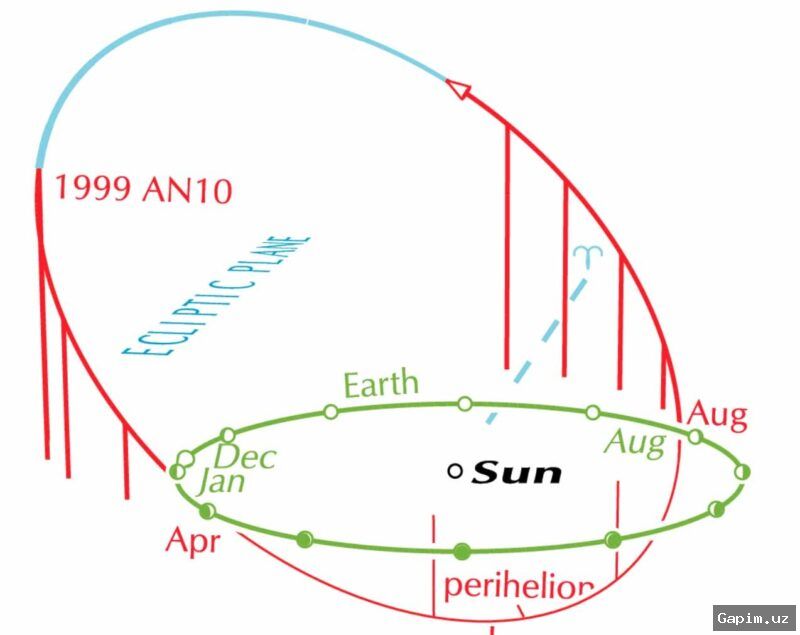
Key Takeaways: On August 7, 2027, asteroid 1999 AN10 will pass Earth at a distance of about 389,855 kilometers; its diameter is estimated at roughly 800 meters; according to NASA and ESA, there is no risk of collision with Earth.
Asteroid 1999 AN10 was discovered on January 13, 1999, and belongs to the Apollo group of celestial bodies whose orbits cross Earth's orbit. Because of its size and orbital characteristics, it has been classified among potentially hazardous asteroids, but that status does not mean a collision is inevitable or expected. According to the latest calculations by scientists, there is no risk of collision with Earth on August 7, 2027, and the object is not on the list of asteroids with identified Earth-impact risk maintained by ESA.
Notably, after the asteroid's discovery, scientists did consider scenarios in which it could collide with Earth in the future; in particular, a very low probability of an impact in 2039 was discussed. However, additional observations made it possible to refine the object's orbit and completely exclude that risk. The upcoming close approach is generating significant interest among astronomers: NASA plans to use radar observations to obtain detailed images of the asteroid's surface and clarify its shape, size, and rotation characteristics.
Initial calculations indicate that, under favorable conditions at the time of closest approach, the celestial body should be bright enough to observe with binoculars or a small telescope. Scientists note that such close approaches help improve methods for detecting and observing potentially hazardous space objects, and observations from the August 2027 flyby are expected to make future risk assessments more reliable.
Source: kun.uz