Off the coast of Scotland, permission has recently been granted to test what is described as the world’s largest floating wave power station: over a two-year trial, the plant is expected to send electricity generated from Atlantic waves into the United Kingdom’s power grid. Developed by Ireland’s OceanEnergy, the OE35 device weighs 826 tonnes and has a capacity of 1 megawatt, making it the most powerful of its kind; it will be tested under the WEDUSEA project, supported by the European regime, at the European Marine Energy Centre on the Orkney Islands. Its nominal capacity may reach up to 1.25 megawatts, while its length is about 38 meters, its width roughly 18 meters, and its draft exceeds 9 meters.
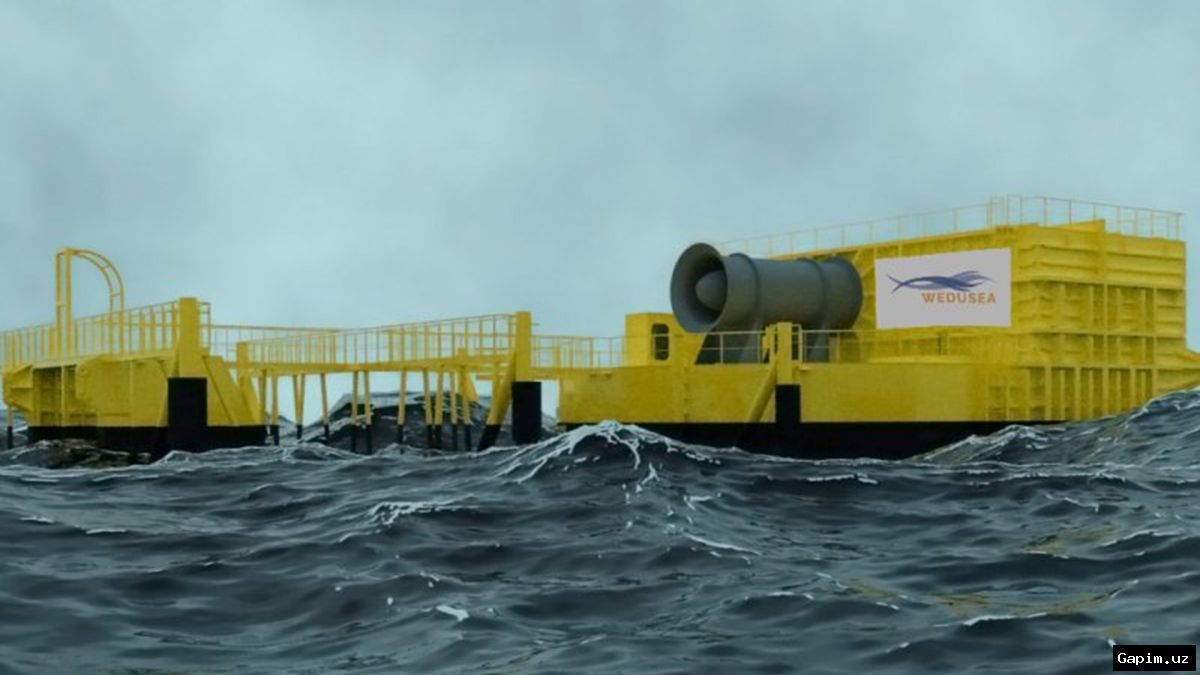
Key Takeaways: The OE35 device weighs 826 tonnes and is rated at 1 megawatt, with nominal capacity that may reach 1.25 megawatts. The two-year Atlantic demonstration will assess technical performance and environmental impact while feeding power into the UK grid. The project is being run under the WEDUSEA program, supported by the European regime, at the Orkney Islands test center.
Context and operating principle
The OE35 floats on the ocean surface. Seawater enters through an open chamber at the bottom of the device; as each wave passes, the water level inside rises and falls, alternately compressing and expanding the air above it. The resulting airflow drives a turbine, so electricity is produced from the natural movement of seawater without burning fossil fuels. During the tests, electricity generated by the 1-megawatt unit will be transmitted to the UK grid through existing submarine cables, and one of the project’s main tasks is to confirm the technology’s efficiency under the Atlantic’s natural wave conditions. Specialists will also assess how suitable the system is for future commercial wave power stations.
Project phases and outlook
The WEDUSEA project has three phases: the first covers design and construction of the wave-to-electricity device; the second involves two years of Atlantic testing, during which researchers will examine technical characteristics, efficiency, and environmental impact. The final phase is expected to move the technology toward commercial use and to develop larger wave-energy projects based on the test results. The new device may help reduce the cost of generating electricity from sea waves and open the way to larger commercial projects.
Source: kun.uz