Researchers at the European Space Agency announced on Tuesday the discovery of the most distant and therefore oldest quasar ever observed, a luminous object seen as it was 13.1 billion years ago, when the universe was less than 5 percent of its current age. The object, formally designated J1504+6252 and nicknamed Dún Aonghas, was identified by a team led by German astronomer Julien Wolf and published in the journal Astronomy and Astrophysics. Its red dot in released imagery marks light from an era only about 630 million years after the Big Bang, offering a rare window into the formation of the first galaxies and supermassive black holes.
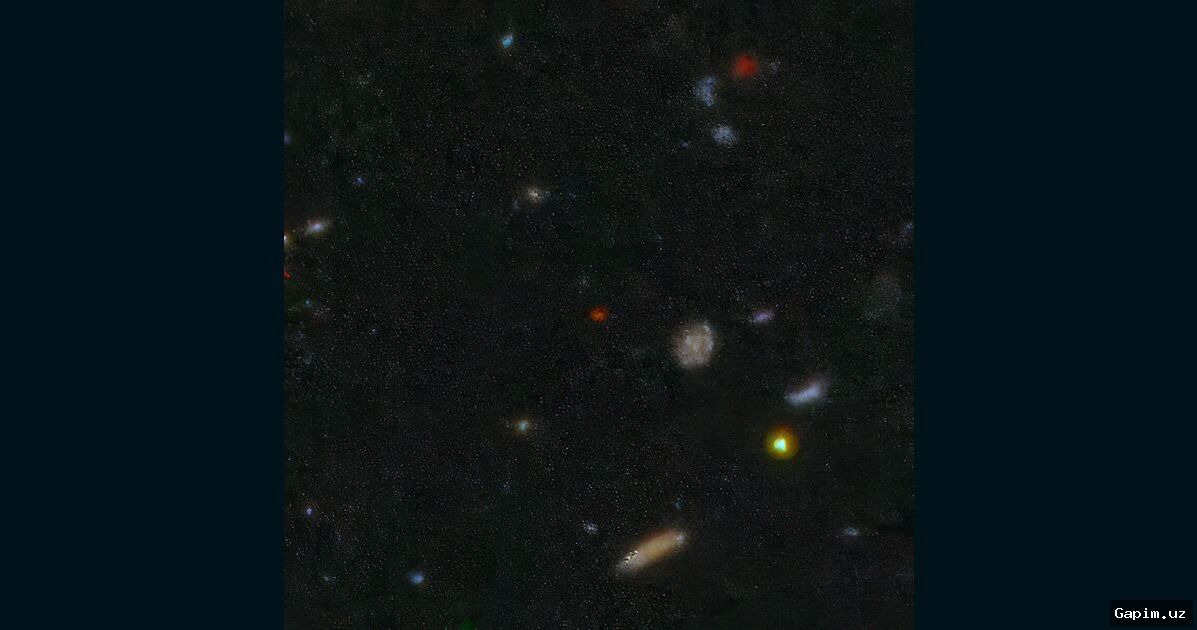
Key Takeaways: The quasar Dún Aonghas (J1504+6252) is the most distant and oldest ever observed, seen as it was 13.1 billion years ago; its central black hole had already reached about 360 million solar masses roughly 630 million years after the Big Bang; and the discovery was made using ESA's Euclid telescope with follow-up observations from ground- and space-based instruments.
A quasar is an extremely bright core of an active galaxy powered by gas falling into a supermassive black hole. Astronomer and study co-author Silvia Belladitta of the Max Planck Institute for Astronomy in Germany and the INAF Bologna Observatory of Astrophysics and Space Science in Italy said that as enormous amounts of gas, dust and matter fall toward the black hole, they form a swirling accretion disk that heats up to extreme temperatures and radiates tremendous energy, outshining the rest of the galaxy by hundreds or thousands of times. She added that this makes quasars visible across billions of light-years, allowing astronomers to observe them from the very early universe and helping explain how the first galaxies formed and evolved and how supermassive black holes grew so large.
Julien Wolf of the European Southern Observatory in Germany, lead author of the research, said the discovery adds to evidence that some objects in the early universe developed remarkably quickly. Just 630 million years after the Big Bang, the black hole had already grown to about 360 million times the mass of the sun and was shining as a quasar, supporting scenarios in which supermassive black holes form through the direct collapse of large gas clouds and then accumulate additional matter.
Context and Background
Quasars represent a brief phase in a galaxy's life, during which the nucleus can outshine the rest of the system. Because their light travels for billions of years, observations of distant quasars effectively look backward in time. Dún Aonghas was first detected by ESA's Euclid telescope, and its images were characterized using a combination of ground- and space-based telescopes. Euclid is designed for missions that uncover the mysteries of dark matter, the invisible glue that lumps galaxies together, and dark energy, the force that pushes them apart. The new object therefore links the telescope's cosmic-mapping mission with questions about black-hole growth in the first billion years of cosmic history.
Outlook and Key Details
The discovery is expected to guide follow-up studies of early black-hole formation and galaxy evolution, including deeper observations to refine the object's mass, luminosity and environment. Researchers may also compare Dún Aonghas with other early quasars to test whether direct collapse or alternative growth models best explain such rapid development. Further Euclid data releases could reveal additional distant candidates, potentially pushing observations even closer to the birth of the first galaxies.
Source: www.dw.com