Astronomers have identified spectral traces of 15 atoms and ions in the atmosphere of TOI-1518b, an ultra-hot Jupiter located roughly 737 light-years from Earth, including the first reported detections of singly ionized europium and neutral tungsten in an exoplanet atmosphere. The planet’s equilibrium temperature is about 2,300 °C, while its host star, TOI-1518, has a surface temperature near 7,000 °C; one planetary year lasts only 1.9 Earth days. Researchers also noted that some elements appear more clearly on the planet’s night side.
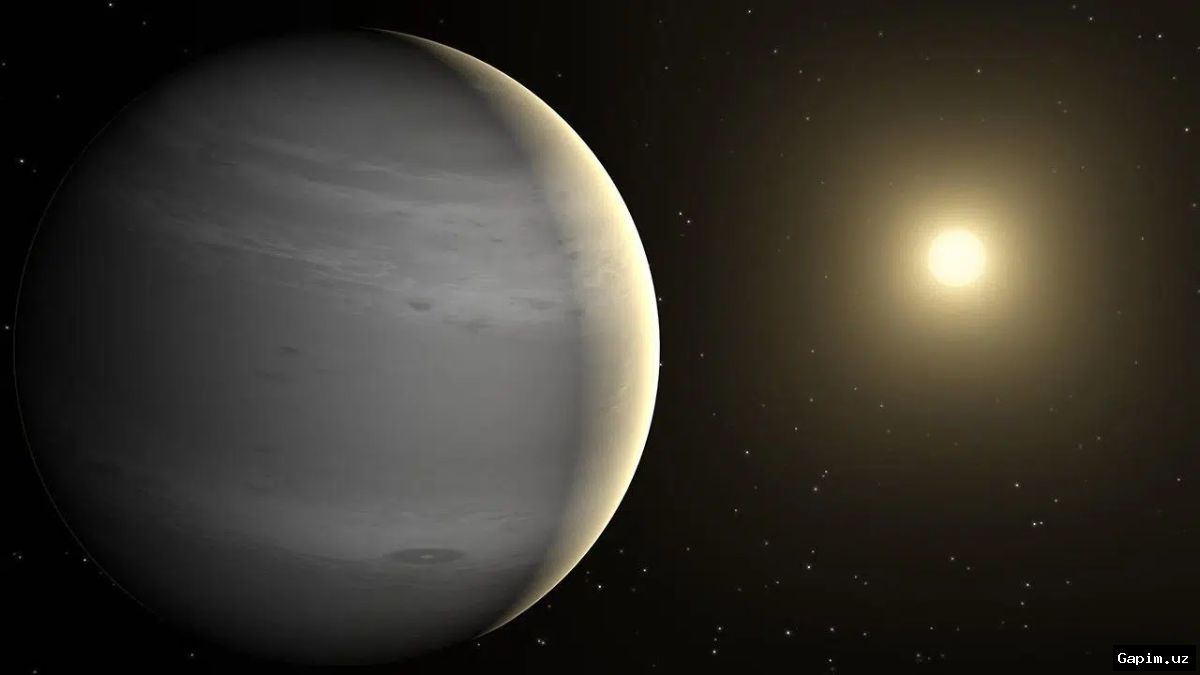
Key Takeaways: TOI-1518b has about twice Jupiter’s mass and roughly 1.9 times its radius, and its year lasts only 1.9 Earth days. An international team led by Mattia D’Arpa analyzed four transits recorded in 2023 with the HARPS-N spectrograph on the Galileo National Telescope in the Canary Islands. The study identified hydrogen, carbon, iron, nickel, titanium, vanadium, strontium, yttrium, europium and tungsten, while spectral shifts suggested winds near 7 km/s.
Context and Background
TOI-1518b belongs to the “ultra-hot Jupiter” class and orbits extremely close to its star. At such proximity, many molecules break apart in the atmosphere, while metals can exist as gaseous atoms and ions. Iron had already been detected there, but the new work, led by Mattia D’Arpa of the Palermo Astronomical Observatory, examined the chemical composition in greater detail and refined orbital information. Because the star is bright and rotates rapidly, its own spectral features complicated the search, so the team accounted for motion across the stellar surface before comparing observations with theoretical lines for individual elements.
Outlook and Key Details
The 2023 observations were made during four transits, when part of the star’s light passed through the planet’s atmosphere and atoms absorbed specific wavelengths, leaving distinctive spectral lines. By combining individually faint signals, astronomers separated a common signature and identified 15 atomic and ionic traces. The most important result was singly ionized europium and neutral tungsten, never before reported in exoplanet atmospheres; the planet’s equilibrium temperature exceeds europium’s vaporization temperature, so europium should remain gaseous. The spectra also showed an average shift consistent with gas moving toward the observer at about 7 km/s, possibly caused by strong winds transporting material from the dayside to the nightside. The authors performed additional checks to rule out false signals, and the findings suggest that even heavy, refractory elements can survive as free atoms and ions in a hot planetary gas envelope, improving understanding of how extreme heat and stellar radiation shape exoplanet atmospheres.
Source: kun.uz