At the end of February, the Pakistani government declared an 'open war' against Afghanistan. Since then, the conflict has intensified, with sides exchanging airstrikes, drone attacks, and strikes on border infrastructure. A newspaper interviewed South Asia expert Ildar Yakubov, who analyzed the causes of the conflict, potential development scenarios, and its implications for Uzbekistan and the wider region.
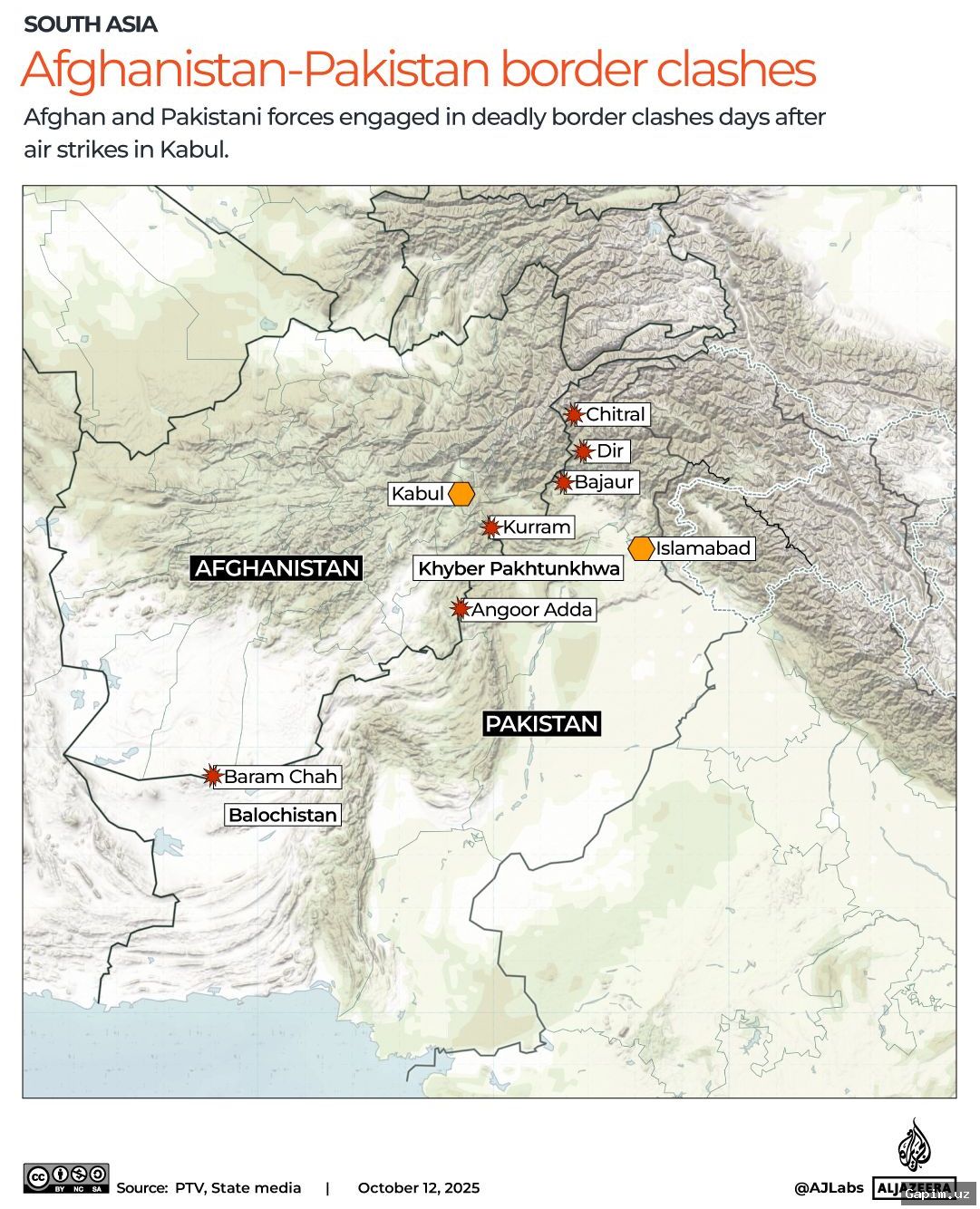
Yakubov noted that the current escalation is a continuation of deteriorating relations over many years. In 2025, local clashes expanded to such an extent that mediator intervention, such as by Qatar, was required. The official reason for Pakistan's declaration of 'open war' on February 26 was a large-scale attack by Afghan forces on border posts, although previously, the Pakistani army had struck terrorist camps in Afghan territory and accused the Taliban movement of interfering in internal affairs.
Key causes of the conflict include unresolved border issues, unilateral actions by Pakistan, and resistance from the Taliban. Additionally, sides exchange mutual accusations: the Taliban allegedly blame Pakistan for imposing its will as a 'big brother', while Pakistan claims the Taliban harbors terrorist groups such as Tehrik-i-Taliban Pakistan and ISIS-Khorasan. The Afghan government, in turn, emphasizes that Pakistan is attempting to shift its internal problems onto Afghanistan, portraying itself as a source of extremism and instability.
After the war declaration, Pakistan directly designated the Afghan government as an adversary, indicating a shift to an interstate conflict. Yakubov suggested that Pakistan views this war as part of a broader hybrid confrontation with India, accusing Delhi of supporting actions against Pakistan and exploiting instability in Afghanistan for its own interests.
Currently, the escalation has deepened, becoming the largest-scale conflict since 2021. Despite Pakistan's military superiority, it cannot achieve a decisive victory, and Afghanistan is responding with counterstrikes, including drone attacks on Pakistan's capital. Sides have effectively reached a military stalemate, with a low probability of ground invasion, as it would be a catastrophic step for both parties.
To mitigate the situation, countries such as Turkey, Qatar, and Saudi Arabia have offered mediation, and military actions were temporarily halted during holidays. However, Yakubov stressed that even if the conflict stops, it will turn into a 'frozen conflict' due to unresolved deep-seated issues, particularly border disputes, which could lead to renewed violence in the future.
This conflict negatively impacts Uzbekistan and Central Asian states, as it further destabilizes infrastructure and logistics projects already slowed by instability in Afghanistan. Transport corridors and trade agreements may be delayed, weakening regional cooperation. According to Yakubov, Central Asian countries face difficulty in independently intervening to resolve the conflict but can help mitigate consequences through humanitarian missions.
Source: www.gazeta.uz