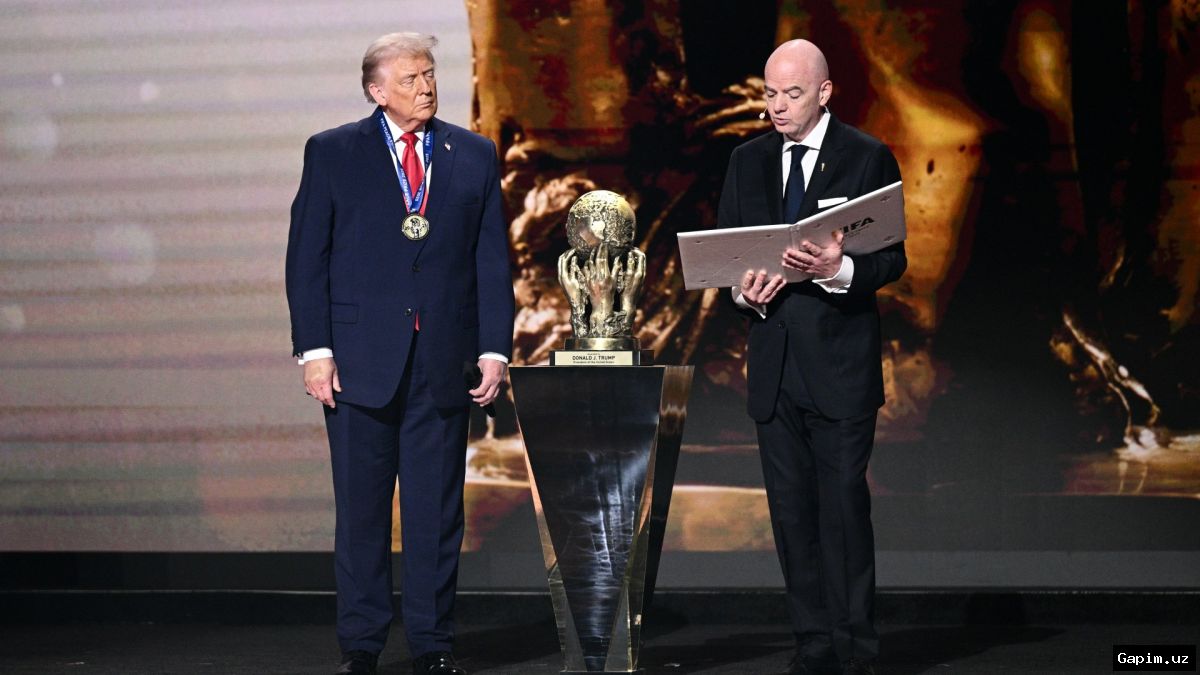
On December 5, during the draw for the 2026 men's World Cup finals at the Kennedy Center in Washington, DC, FIFA President Gianni Infantino presented US President Donald Trump with the inaugural FIFA Peace Prize. "This is what we want from a leader – a leader that cares about the people," Infantino told the president from the stage. "You definitely deserve the first FIFA Peace Prize."
Three days earlier, Trump used the closing minutes of a White House cabinet meeting to call Somalis "garbage". "Their country is no good for a reason … Their country stinks, and we don't want them in our country," he said. Many recalled Trump's 2018 remarks about African countries being "shithole" nations.
The issue is not merely the absurdity of awarding a "peace prize" to the US president, but that his openly racist attitude toward an entire continent has been translated into policies affecting African countries that qualified for the World Cup. Yet there has been no reaction from FIFA, and more importantly, no reaction from the Confederation of African Football (CAF).
Four nations whose teams will play in the US are on Trump's travel ban list; two are African: Senegal and Ivory Coast. Haiti – the third – has a population of African descent. Athletes, coaches and support staff are formally exempt from the travel ban, so the African and Haitian teams can play, but many of their fans will not be able to travel to support them.
In addition, three other African countries that have qualified for the World Cup – Algeria, Tunisia, and Cabo Verde – are on a list for the so-called visa bond program, which requires visa applicants to post refundable bonds of up to $15,000 before being issued a visa. There is no waiver for World Cup fans. For many fans, this would be an impossible sum to produce in addition to travel and match ticket expenses. In Tunisia, for example, the gross disposable income per capita is a little more than $500. A Tunisian fan may be required to pay up to 30 times this amount as a bond to get a US visa.
Meanwhile, the ambassador of another African nation that qualified for the World Cup – South Africa – has been expelled, while the US administration has made unfounded claims that genocide is being carried out against a white minority that used to preside over an apartheid regime.
CAF has issued no statement, nor has any African national football federation. That silence is a direct repudiation of what CAF used to be.
In 1964, FIFA allocated 10 spots for the 1966 World Cup to Europe, four to South America and one to Central America and the Caribbean. The remaining slot was to be contested by teams from Africa, Asia, and Oceania. Soon after the announcement, Ohene Djan, Ghana's director of sport, sent a telegram to FIFA, with the backing of Ghanaian President Kwame Nkrumah. Ethiopian football administrator Yidnekatchew Tessema joined him, labeling the FIFA decision "a mockery of economics, politics, and geography." When FIFA refused to revise the allocation, all 15 then-eligible African federations withdrew. The 1966 World Cup proceeded without an African team.
In 1968, FIFA was forced to grant Africa and Asia one guaranteed slot each. Every African appearance at every World Cup since then is thanks to that single telegram sent by Djan.
CAF was founded seven years before the telegram, in 1957, by four federations: Egypt, Sudan, Ethiopia and South Africa. South Africa was excluded from the inaugural Africa Cup of Nations (AFCON) the same year because the apartheid regime refused to field a racially mixed team. CAF formally expelled South Africa in 1960. FIFA did not do so until 1976.
Today, CAF comprises 54 federations. It is fully integrated into FIFA's revenue and governance architecture. It has nine guaranteed World Cup slots, a large AFCON revenue stream, FIFA Forward funding, and a president who serves as a FIFA vice president by virtue of holding the CAF chair.
A confrontational stance at this moment carries real institutional cost. This reality is itself the indictment. The integration of African football into FIFA's revenue architecture has produced a confederation whose institutional survival now depends on never acting on the principles it was founded to defend.
There are actions CAF can take that would impose no high cost on any federation. It could publicly demand that host countries issue conventional visas to all ticketed fans from every CAF-qualified nation. It could also demand that matches involving teams from countries under full US travel bans be relocated to Canada or Mexico. And it could formally join the FairSquare ethics complaint filed against Infantino on December 8, alleging four breaches of Article 15 of FIFA's Code of Ethics.
If the current CAF leadership does nothing to guarantee equal treatment for African fans, then it would send a message to the people of the continent quite different from what Djan sent in 1964: that it fully subscribes to bending to powerful governments and turning a blind eye to inequality, discrimination and injustice.
Source: www.aljazeera.com