Amir Timur is one of the most famous figures in history, yet his physical appearance remains largely unknown. Medieval chronicles barely describe his looks, and no lifetime portraits have survived.
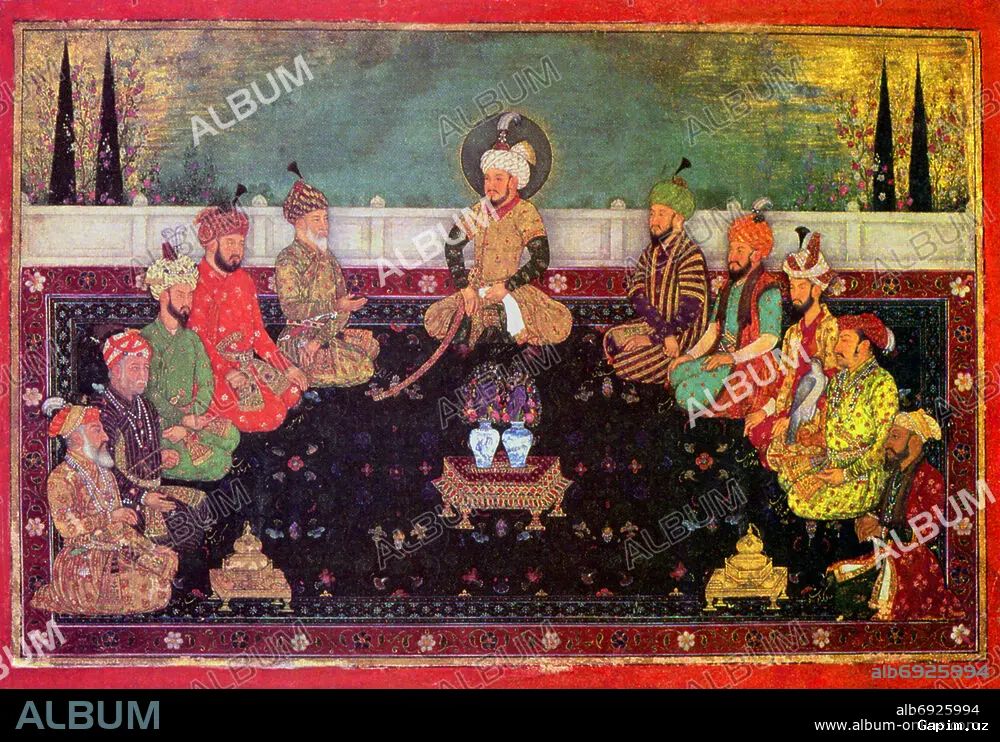
It is the miniatures of the 15th–17th centuries that shaped the perception of him as a ruler, commander, and symbol of power. How these images relate to reality and why they differ so much is discussed with Professor Zuhra Ibrahimovna Rakhimova, a candidate of art history.
Historians such as Yazdi, Shami, Hafiz-i Abru, and Ibn Khaldun provide almost no description of Timur's appearance, only mentioning his lameness. Ibn Arabshah is the only one who gives details: "Timur was well-built, tall, with a broad forehead, large head, strong voice; a bright blush enlivened the whiteness of his face. He had broad shoulders, thin fingers, strong muscles. He wore a long beard; his right hand and foot were crippled in battles."
More concrete information came from the opening of his tomb in 1941. Anthropologist Mikhail Gerasimov reconstructed the portrait: height 170 cm, torso slightly skewed, non-Mongoloid face, straight nose, slightly flattened; thick lips, flattened face. Hair was gray-red, long; mustache long; beard wedge-shaped, coarse, reddish with gray.
Miniatures of the 15th–17th centuries are the only visual source showing how Timur was imagined by his descendants and contemporaries. Key manuscripts include Yazdi's Zafarnama and Hatifi's Timur-nama, illustrated in Herat, Shiraz, Transoxiana, India, and Iran. Each center added its own emphasis.
In miniatures, Timur appears as a fearless warrior, victorious conqueror, ideal ruler, and devout Muslim. However, in 16th-century Shiraz and Iranian miniatures, he is depicted as a cruel conqueror – with scenes of executions, towers of severed heads, and destroyed cities.
Patrons were mainly Timur's descendants – Ibrahim Sultan, Sultan Husayn Bayqara, and the Baburids – for whom it was a matter of legitimacy. For instance, in a manuscript commissioned by Ibrahim Sultan, Timur is always a proud lord; Behzad introduced the figure of Umar Shaykh to visually emphasize succession.
Professor Rakhimova notes that miniatures did not aim for realistic portraiture but created a canonical image. Individual features (face type, beard shape, physical disability) were conveyed conventionally. In the "Portrait of Timur," the disability is tactfully masked by a traditional pose. This image partially matches Gerasimov's reconstruction.
The earliest portrait (1405–1409) from a Timurid genealogy shows Timur young, with long hair, sitting on his knees. It is likely idealized as well. Nevertheless, miniature painting laid the foundation for the later tradition of individualized portraiture of great personalities.
Source: podrobno.uz